

- Production Machines
- Other Manufacturing Equipment
- Inert nitrogen generator
- BERG Kompressoren GmbH

- Company
- Products
- Catalogs
- News & Trends
- Exhibitions
Inert nitrogen generator NITROBERG®high-purityfor the food industryindustrial

Add to favorites
Compare this product
Characteristics
- Gas characteristics
- inert, high-purity
- Domain
- for the food industry, industrial, laboratory
- Applications
- for laser cutting
- Technology
- PSA, membrane
- Configuration
- compact, on site
- Other characteristics
- with on-board booster, with desiccant dryer, on skid, containerized
- Gas purity
Min.: 97 %
Max.: 99.999 %
Description
Overview
Produce nitrogen on-site from compressed air to reduce dependency on cylinders or bulk deliveries. BERG systems (NITROBERG®) are engineered for demanding industrial applications and can be supplied as standalone units, skid packages or containerised plants. This page summarises generator categories, performance ranges and selection criteria to define a suitable solution.
What is an on-site nitrogen generator?
An on-site nitrogen generator separates nitrogen from ambient air and supplies it directly to the process. Feed air is compressed, cooled, dried and filtered before separation. In PSA systems a carbon molecular sieve retains oxygen and trace gases while nitrogen passes to the product receiver. In membrane systems selected gases permeate hollow fibres at different rates. A complete installation requires stable pressure, appropriate compressed-air quality, buffer storage, monitoring and realistic peak-demand calculation.
Practical engineering rule
Do not begin with the highest possible purity. Start from the oxygen limit your process tolerates. Every unnecessary increment of purity can increase compressed-air consumption, system size and capital cost.
Benefits of on-site generation
Technology selection: PSA vs membrane
Neither technology is universally better; the correct choice depends on purity, flow, operating profile, footprint and lifecycle cost.
Portfolio overview — NITROBERG® technical data at a glance
Nitrogen purity: 97%–99.999%
Residual oxygen: 3%–10 ppm
Portfolio capacity: 1.2–1,709.1 Nm³/h
Compressed-air factor: Approx. 2.3–6.4
Configurations: Standalone, skid, container or membrane
Project options: Compression, treatment, storage, boosting and monitoring
Typical industrial applications
Selection data required for a reliable proposal
Technical data / specifications
Produce nitrogen on-site from compressed air to reduce dependency on cylinders or bulk deliveries. BERG systems (NITROBERG®) are engineered for demanding industrial applications and can be supplied as standalone units, skid packages or containerised plants. This page summarises generator categories, performance ranges and selection criteria to define a suitable solution.
What is an on-site nitrogen generator?
An on-site nitrogen generator separates nitrogen from ambient air and supplies it directly to the process. Feed air is compressed, cooled, dried and filtered before separation. In PSA systems a carbon molecular sieve retains oxygen and trace gases while nitrogen passes to the product receiver. In membrane systems selected gases permeate hollow fibres at different rates. A complete installation requires stable pressure, appropriate compressed-air quality, buffer storage, monitoring and realistic peak-demand calculation.
Practical engineering rule
Do not begin with the highest possible purity. Start from the oxygen limit your process tolerates. Every unnecessary increment of purity can increase compressed-air consumption, system size and capital cost.
Benefits of on-site generation
- More control over supply: produce nitrogen when needed without planning cylinder exchanges or bulk deliveries.
- Purity matched to the process: avoid the energy penalty of higher purity than required.
- Predictable operating costs: replace recurring gas and delivery charges with measurable compressed-air, energy and service costs.
- One accountable system: BERG can coordinate compressor, treatment, generator, storage, controls and downstream equipment.
Technology selection: PSA vs membrane
Neither technology is universally better; the correct choice depends on purity, flow, operating profile, footprint and lifecycle cost.
- PSA nitrogen generator: high and precisely controlled purity; suitable for laser, electronics, food, laboratory and high-purity processes.
- Membrane nitrogen generator: compact, robust moderate-purity supply; suited to inerting, blanketing, marine and space-limited installations and to intermittent operation with fast start-up.
Portfolio overview — NITROBERG® technical data at a glance
Nitrogen purity: 97%–99.999%
Residual oxygen: 3%–10 ppm
Portfolio capacity: 1.2–1,709.1 Nm³/h
Compressed-air factor: Approx. 2.3–6.4
Configurations: Standalone, skid, container or membrane
Project options: Compression, treatment, storage, boosting and monitoring
Typical industrial applications
- Food packaging: modified-atmosphere packaging and storage to protect freshness and quality.
- Beverage production: tank blanketing, bottling and process protection.
- Laser cutting & metal: high-purity assist gas for oxidation-free edges; requires proper pressure and peak storage.
- Chemical & pharmaceutical: inerting, blanketing, purging and process protection per safety requirements.
- Electronics manufacturing: controlled atmospheres for reflow, wave and selective soldering and component storage.
- Oil, gas & marine: purging, blanketing, pressure testing and maintenance support in remote or harsh environments.
- Laboratory & research: on-site supply for analytical instruments and continuous lab demand.
- Mining & metallurgy: inerting, purging and atmosphere control for mineral processing and heat treatment.
Selection data required for a reliable proposal
- Application: where and how nitrogen is used.
- Purity or O₂ limit: specify nitrogen purity or maximum acceptable residual oxygen.
- Average and peak flow: normal demand, short peaks, operating hours and future expansion.
- Delivery pressure: outlet pressure at point of use and distribution losses.
- Existing air system: compressor capacity, pressure, dryer type and air quality.
- Site and project rules: location, ambient conditions, format and applicable codes.
Technical data / specifications
- Nitrogen purity range: 97% – 99.999%.
- Residual oxygen: 3% – 10 ppm (depending on purity target).
- Portfolio capacity: 1.2 – 1,709.1 Nm³/h.
- Compressed-air factor (approx.): 2.3 – 6.4 (varies by model and purity).
- Typical configurations: standalone unit, skid-mounted package, container solution, membrane modules.
- Included project options: compression, filtration, drying, buffer storage, boosting, monitoring and controls.
- Recommended design practice: size for process oxygen limit rather than maximum purity to optimise air consumption and cost.
Catalogs
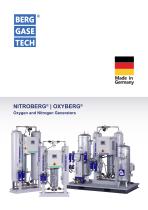
OXYBERG® | NITROBERG®
16 Pages

Oxygen and Nitrogen Generators
17 Pages
Other BERG Kompressoren GmbH products
GASETECH


Related Searches
- Nitrogen gas generator
- PSA nitrogen gas generator
- Compact nitrogen gas generator
- Laboratory nitrogen gas generator
- Process nitrogen gas generator
- Pure nitrogen gas generator
- Industrial nitrogen gas generator
- Oxygen gas generator
- Membrane nitrogen gas generator
- UHP nitrogen generator
- LC/MS nitrogen gas generator
- PSA oxygen concentrator
- Nitrogen gas generator on site
- Nitrogen generator for the food industry
- Laser cutting nitrogen gas generator
- Dry nitrogen gas generator
- CMS nitrogen generator
- Automatic nitrogen gas generator
- Laboratory oxygen generator
- Process oxygen generator
*Prices are pre-tax. They exclude delivery charges and customs duties and do not include additional charges for installation or activation options. Prices are indicative only and may vary by country, with changes to the cost of raw materials and exchange rates.