



- Detection - Measurement
- Electrical Measurements
- Single-channel source measure unit
- Keithley Instruments
Single-channel source measure unit 2400GPIBhigh-precision4-quadrant

Add to favorites
Compare this product
Characteristics
- Number of channels
- single-channel
- Communication interface
- GPIB
- Other characteristic
- high-precision, 4-quadrant
- Voltage
20 V, 200 V, 1,100 V
- Current
1 A
- Power
20 W
Description
Overview
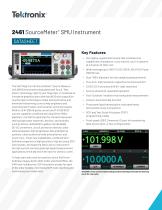
Keithley’s 2400 Standard Series Source Measure Unit (SMU) combines a four-quadrant precision voltage and current source/load with instrument-grade measurement. Each unit functions as a stable DC power source and a 6½-digit multimeter, delivering low noise, high repeatability and precise readback.
Highlights
Built-in sweep capabilities
Integrate with switching systems
Education and lab use
Models (table)
Columns: Model / Touchscreen / Channels / Max Current / Max Voltage / Resolution (Current / Voltage) / Power / List Price
2401. — No — 1 — 1 A — 20 V — 1 pA / 100 nV — 20 W — US $6,380
2400 — No — 1 — 1 A — 200 V — 1 pA / 100 nV — 20 W — US $10,000
2410. — No — 1 — 1 A — 1100 V — 1 pA / 100 nV — 20 W — US $18,200
Software & resources
KickStart instrument control software enables I‑V characterization without programming and export of results. Firmware updates, CAD models, detailed specifications and application notes are available for system integration.
Technical specifications
Keithley’s 2400 Standard Series Source Measure Unit (SMU) combines a four-quadrant precision voltage and current source/load with instrument-grade measurement. Each unit functions as a stable DC power source and a 6½-digit multimeter, delivering low noise, high repeatability and precise readback.
Highlights
- Precision SMU for I‑V characterization of semiconductors, sensors and materials
- Can source voltage or current and measure both simultaneously
- Compact single-channel design for benchtop and rack integration
Built-in sweep capabilities
- Linear staircase sweeps
- Logarithmic staircase sweeps
- Custom sweep profiles for automated characterization
Integrate with switching systems
- Pair with Keithley switch systems for fast, multipoint testing
- Typical applications: semiconductor devices, circuit protection components, optoelectronic tests, accelerated stress testing
Education and lab use
- Combines multiple instrument functions for teaching Ohm's Law and I‑V measurement
- Suitable for undergraduate/graduate labs and R&D benches
Models (table)
Columns: Model / Touchscreen / Channels / Max Current / Max Voltage / Resolution (Current / Voltage) / Power / List Price
2401. — No — 1 — 1 A — 20 V — 1 pA / 100 nV — 20 W — US $6,380
2400 — No — 1 — 1 A — 200 V — 1 pA / 100 nV — 20 W — US $10,000
2410. — No — 1 — 1 A — 1100 V — 1 pA / 100 nV — 20 W — US $18,200
Software & resources
KickStart instrument control software enables I‑V characterization without programming and export of results. Firmware updates, CAD models, detailed specifications and application notes are available for system integration.
Technical specifications
- Max power envelope (series): 60 W DC
- Voltage range (series): 100 nV to 1100 V
- Current range (series): 1 pA to 5 A (model/option dependent)
- Measurement resolution: 1 pA / 100 nV
- Basic accuracy: 0.012% (6.5 digits)
- Max speed: up to 2000 readings/s to buffer
- Interface: GPIB, USB, Ethernet (depending on configuration)
- Typical applications: I‑V characterization, production testing, teaching and R&D
Catalogs


Other Keithley Instruments products
Sources and Supplies


Related Searches
- Measuring device
- Portable testing system
- Digital testing system
- Generator
- Digital measuring device
- Multimeter
- Portable measuring device
- Digital multimeter
- Benchtop testing system
- Industrial multimeter
- Benchtop measuring device
- Automatic measuring device
- Continuity testing system
- 1000 V multimeter
- Frequency multimeter
- Measuring device with display
- Universal tester
- 10 A multimeter
- TRMS multimeter
- Current measuring device
*Prices are pre-tax. They exclude delivery charges and customs duties and do not include additional charges for installation or activation options. Prices are indicative only and may vary by country, with changes to the cost of raw materials and exchange rates.
About DirectIndustry
DirectIndustry is a marketplace that offers B2B players a complete experience, from product sourcing to purchase. DirectIndustry is an entity of VirtualExpo Group.
Are you a buyer?
Are you a supplier?