

- Power Transmission - Mechanical components
- Actuator and Positioning System
- Rotary solenoid
- Weilong Intelligent Technology (Dongguan) Co., Ltd.


- Company
- Products
- Catalogs
- News & Trends
- Exhibitions
Rotary solenoid WL0616miniaturecompact24-volt


Add to favorites
Compare this product
Characteristics
- Type
- rotary
- Other characteristics
- compact, miniature, electromagnetic, 24-volt, DC
- Voltage
24 V
Max.: 24 V
Min.: 12 V
Description
Overview
The bistable rotary solenoid is an electromagnetic actuator that rotates between two stable positions. It requires power only to change state; after switching the rotor remains latched without continuous current, enabling low power consumption and reduced heating — suitable for battery-powered and energy-sensitive systems.
How it works
A coil receives a pulse or a polarity-switched pulse to move the internal rotor/armature to a preset angle (common options: 20°, 25°, 30°, 45°, 60°, 90°). A permanent magnet or mechanical latch holds the rotor after the pulse. Typical switching times range from 10–50 ms, with high-performance variants below 10 ms.
Main characteristics and benefits
Common applications
Advantages
Limitations / Disadvantages
Datasheet summary and usage notes
For WL0616 selection key parameters include rotation angle, torque output, coil voltage and pulse-drive capability. Consider response time, duty cycle and mounting constraints when integrating into counters, vending devices, locks or medical instruments.
Technical specifications
The bistable rotary solenoid is an electromagnetic actuator that rotates between two stable positions. It requires power only to change state; after switching the rotor remains latched without continuous current, enabling low power consumption and reduced heating — suitable for battery-powered and energy-sensitive systems.
How it works
A coil receives a pulse or a polarity-switched pulse to move the internal rotor/armature to a preset angle (common options: 20°, 25°, 30°, 45°, 60°, 90°). A permanent magnet or mechanical latch holds the rotor after the pulse. Typical switching times range from 10–50 ms, with high-performance variants below 10 ms.
Main characteristics and benefits
- Low power consumption: short pulse required to switch; no continuous holding current.
- Reduced thermal buildup compared with continuous-current rotary actuators.
- High reliability and long operational life (typical mechanical/electrical life ≥1,000,000 cycles).
- Fast response suitable for high-speed switching applications.
- Compact size and simple electromagnetic structure with few moving parts.
- Quiet operation and stable latched holding force.
Common applications
- Banknote counters and currency sorting machines (diverter gates, flaps).
- Vending machines and dispensers (release/locking mechanisms).
- Smart locks and security latching systems.
- Industrial automation: switching mechanisms, positioning devices, robot end-effectors.
- Medical devices: sample selectors, valve actuators, optical switching elements.
- Ticketing machines, gaming machines, camera modules and precision switching equipment.
Advantages
- Energy savings due to pulsed operation and magnetic/mechanical latching.
- Position memory: maintains state without power.
- Low thermal dissipation thanks to brief coil energization.
- High switching speed and small footprint.
- Suitable for battery-operated and embedded systems.
Limitations / Disadvantages
- Limited rotation range compared with continuous rotary motors (fixed angles only).
- Lower continuous torque than motors or geared actuators; not for high-torque continuous rotation.
- Typically only two preset positions; not suitable for multi-position continuous control without additional mechanisms.
- Requires a pulse drive/control circuit capable of delivering correct pulse shape and/or polarity changes.
- Mechanical wear on springs or stops may occur over very long life; performance depends on voltage stability and environment.
Datasheet summary and usage notes
For WL0616 selection key parameters include rotation angle, torque output, coil voltage and pulse-drive capability. Consider response time, duty cycle and mounting constraints when integrating into counters, vending devices, locks or medical instruments.
Technical specifications
- Model: WL0616
- Product dimensions (typical): 39 × 32 × 16 mm
- Rotation angle (example): 20° (options: 20°, 25°, 30°, 45°, 60°, 90°)
- Starting torque: ≥2 N·cm
- Nominal coil voltage (example): DC 24 V
- Pulse power (example): 28.8 W
- Current (at 24 V example): 1.2 A
- Coil resistance (example): 20 Ω
- Operating life (mechanical/electrical): ≥1,000,000 cycles (typical)
- Typical working cycle (example): 0.03 s ON, 0.12 s OFF
- Typical switching time: 10–50 ms (high-performance variants may be
- Typical torque ranges for selection: small gates 0.05–0.2 Nm, medium 0.2–0.5 Nm, heavier diverters up to ~0.5–1.0 Nm
- Drive method: pulse drive with polarity switching or specified pulse waveform; requires appropriate driver electronics
- Key selection parameters: rotation angle, output torque, response time, coil voltage, duty cycle, mounting size and environmental conditions
VIDEO
Catalogs
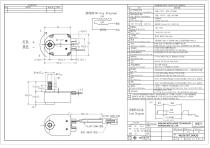
WL0616 Holding Solenoid
8 Pages
Other Weilong Intelligent Technology (Dongguan) Co., Ltd. products
Rotary Solenoid


Related Searches
- Actuator
- Linear actuator
- Electric actuator
- Compact actuator
- Industrial actuator
- DC actuator
- Electromagnet
- Rotary actuator
- 24 V actuator
- 12 V actuator
- Linear electromagnet
- DC electromagnet
- Actuator for medical applications
- ISO actuator
- Voltage solenoid
- Compact electromagnet
- Holding electromagnet
- 24-volt electromagnet
- Single-acting actuator
- Electromagnetic electromagnet
*Prices are pre-tax. They exclude delivery charges and customs duties and do not include additional charges for installation or activation options. Prices are indicative only and may vary by country, with changes to the cost of raw materials and exchange rates.
About DirectIndustry
DirectIndustry is a marketplace that offers B2B players a complete experience, from product sourcing to purchase. DirectIndustry is an entity of VirtualExpo Group.
Are you a buyer?
Are you a supplier?