

- Power Transmission - Mechanical components
- Actuator and Positioning System
- Rotary solenoid
- Weilong Intelligent Technology (Dongguan) Co., Ltd.


- Company
- Products
- Catalogs
- News & Trends
- Exhibitions
Rotary solenoid WL 0623lockingsortingmaintenance-free


Add to favorites
Compare this product
Characteristics
- Type
- locking, rotary, sorting
- Other characteristics
- compact, electromagnetic, maintenance-free, 24-volt, DC, with spring return
- Voltage
Max.: 24 V
Min.: 12 V
- Force
Max.: 0 N
Min.: 0 N
Description
Overview
The rotary solenoid operates through electromagnetic force: an electric current through the coil produces a magnetic field that rotates the armature and the shaft of the rotary actuator. Magnetic operation reduces friction in moving parts, extending component life and lowering replacement frequency in automated systems.
Operation
You can control rotation rate by adjusting the current amplitude and frequency. Increasing current strengthens the magnetic field and raises rotation speed (useful for fast tasks like sorting); decreasing current reduces speed for precise motion control (for example, robotic arm positioning). Some advanced rotary actuators offer angle feedback devices to monitor and correct angle positioning in closed-loop control systems.
Key Features
Applications
Operation & Maintenance
Caractéristiques / Spécifications techniques
The rotary solenoid operates through electromagnetic force: an electric current through the coil produces a magnetic field that rotates the armature and the shaft of the rotary actuator. Magnetic operation reduces friction in moving parts, extending component life and lowering replacement frequency in automated systems.
Operation
You can control rotation rate by adjusting the current amplitude and frequency. Increasing current strengthens the magnetic field and raises rotation speed (useful for fast tasks like sorting); decreasing current reduces speed for precise motion control (for example, robotic arm positioning). Some advanced rotary actuators offer angle feedback devices to monitor and correct angle positioning in closed-loop control systems.
Key Features
- Precise angular motion in fixed steps (typical angles: 25°, 45°, 90°).
- Fast dynamic response (milliseconds) for start/stop or direction changes.
- High repeatability and reliable positioning without complex linkages.
- Compact, integration-friendly electromagnetic structure (coil, core, armature, return spring if required, rotating shaft).
- Bi-directional or spring-return modes available to suit design needs.
- Low maintenance due to simple design; consistent torque output; configurable for voltage, stroke angle, and duty cycle.
Applications
- High-speed product sorting and gating in packaging and sorting machinery.
- Valve actuation (quarter-turn valves / ball valves).
- Vending machines, product release mechanisms and package diverters.
- Medical equipment for sample control and lock releases.
- Office automation (printer controls, document diverters) and security (electronic locks).
- Robotics and mechatronic systems requiring fast, repeatable angular motion.
Operation & Maintenance
- Regular inspection of coil continuity and armature/shaft connections (use a multimeter to check coil condition).
- Keep actuator surfaces clean to prevent dust/debris ingress; increase cleaning in harsh environments.
- Common problems: reduced force (caused by coil degradation or low voltage), inflexible rotation (foreign objects between armature and core or corrosion on shaft).
- Typical remedies: replace degraded coils, verify and restore correct supply voltage, remove obstructions, clean and lubricate stuck/rusty shafts.
- Speed modification: rotary solenoids are designed for snap action — speed is mostly determined by electromagnetic design; PWM can slow action but may reduce torque and increase heating risk.
Caractéristiques / Spécifications techniques
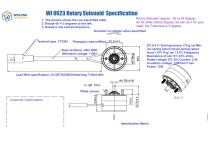
- Brand: Weilong Technology
- Model Number: WL 0623
- Rated Voltage: DC 12V, 18V or 24V
- Rated Power: 20–50 W (datasheet lists typical ranges 15–70 W)
- Work Model: Rotation
- Holding Torque / Force: typical holding torque 0.1 – 0.4 Nm (datasheet: 0.15 – 0.4 Nm ≈ 20–55 oz-in)
- Rotating Angle: available from 25°, 45°
- Working Duty / Duty Cycle: intermittent (10% or 25% noted); datasheet indicates 1–100% possible variants
- Service Life / Expected Life: 500,000 times (table) ; datasheet notes 1–5 million cycles typical
- Certification: CE, ROHS, ISO9001
- Material / Housing: Carbon steel housing
- Lead Wire Length: 200 mm
- Install Style: screw
- Dimension Tolerance: +/- 0.1 mm
- Water-proof: None (standard)
- Insulation Class: B
- Hi-Pot Test: AC 600V 50/60Hz 2s
- Non-excitation Holding Force: 0
- Operating Temperature Range: -10°C to 100°C (datasheet typical operating temp cited -10°C to +50°C)
- Sample Order: Yes
- Warranty: 1 Year
- MOQ: 1000 PCS
- Supply Ability: 5000 pcs per week
- Delivery Time: 30 Days
- Port of Loading: Shenzhen
VIDEO
Catalogs
Other Weilong Intelligent Technology (Dongguan) Co., Ltd. products
Rotary Solenoid


Related Searches
- Actuator
- Linear actuator
- Electric actuator
- Compact actuator
- Industrial actuator
- DC actuator
- Electromagnet
- Rotary actuator
- 24 V actuator
- 12 V actuator
- Linear electromagnet
- DC electromagnet
- Actuator for medical applications
- ISO actuator
- Voltage solenoid
- Compact electromagnet
- Holding electromagnet
- 24-volt electromagnet
- Single-acting actuator
- Electromagnetic electromagnet
*Prices are pre-tax. They exclude delivery charges and customs duties and do not include additional charges for installation or activation options. Prices are indicative only and may vary by country, with changes to the cost of raw materials and exchange rates.
About DirectIndustry
DirectIndustry is a marketplace that offers B2B players a complete experience, from product sourcing to purchase. DirectIndustry is an entity of VirtualExpo Group.
Are you a buyer?
Are you a supplier?