

- Production Machines
- Other Manufacturing Equipment
- Ultra high-purity nitrogen generator
- BERG Kompressoren GmbH

- Company
- Products
- Catalogs
- News & Trends
- Exhibitions
UHP nitrogen generator NITROBERG®ultra high-purityhigh-puritylaboratory

Add to favorites
Compare this product
Characteristics
- Gas characteristics
- UHP, ultra high-purity, high-purity
- Domain
- laboratory
- Applications
- for gas chromatography, for thermal analysis, for LC/MS, for spectrometers
- Technology
- molecular carbon sieve, PSA
- Configuration
- benchtop
- Other characteristics
- on skid, high-flow
- Flow rate
Min.: 1.2 m³/h
(42.378 ft³/h)Max.: 1,709.1 m³/h
(60,356.297 ft³/h)- Gas purity
Min.: 97 %
Max.: 99.999 %
Description
Overview
NITROBERG® nitrogen generators produce nitrogen on site from compressed air for laboratory applications at grades from 97 % up to 99.999 % (grade 5.0). They are suitable for feeding LC-MS, GC, TGA, blowdown evaporators, gloveboxes, multigas incubators and blanketed sample storage. Typical outputs across the NITROBERG® range run from 1.2 to 1,709.1 Nm³/h.
Key performance figures
What a laboratory nitrogen generator delivers
Nitrogen supply for multiple instrument types, with continuous output by PSA (pressure swing adsorption) technology using carbon molecular sieve. PSA separates nitrogen from compressed air: one sieve bed produces while the other regenerates, allowing continuous supply. PSA reaches up to 99.999 % in practice and is the technology for GC carrier gas, GC-MS, ICP-MS collision/reaction gas and TGA inert atmospheres. Membrane systems are compact and suitable where up to about 99.5 % is sufficient.
Which laboratory instruments need which nitrogen purity (table)
Instrument | Typical grade | What the nitrogen does | Drives
LC-MS | 99 % to 99.5 % | Nebuliser, drying and curtain gas | Volume
GC with FID (flame ionisation) | 99.999 % | Carrier and make-up gas | Purity
GC with ECD (electron capture) | 99.999 % and above | Carrier gas for an oxygen-sensitive detector | Purity
GC-MS | 99.999 % | Carrier gas | Purity
ICP-MS | 99.999 % | Collision and reaction gas, auxiliary gas | Purity
TGA | 99.999 % | Inert atmosphere in the balance chamber | Purity
Blowdown evaporators, sample prep | 95 % to 99 % | Solvent removal | Volume
Glovebox | 99.99 % and above | Protective atmosphere | Purity
Multigas incubator | 99.5 % | Displacing oxygen to a set concentration | Neither, low draw
Blanketed sample storage | 99.5 % | Headspace protection for standards and reagents | Neither, low draw
Air factor (compressed air required per m3 N2) by purity (table)
Purity | Air factor
97 % | 2.3
98 % | 2.3
99 % | 2.6
99.5 % | 2.9
99.9 % | 3.4
99.99 % | 4.6
99.995 % | 5.2
99.999 % | 6.4
NITROBERG® sizes for laboratory duty (typical figures at grade 5.0 and 99.9 %) (table)
Model | N2 at 99.999 % | Approx. | N2 at 99.9 % | Compressed air at 99.999 %
NITROBERG® 500 | 1.2 Nm³/h | 20 L/min | 4.1 Nm³/h | 7.7 Nm³/h
NITROBERG® 600 | 2.2 Nm³/h | 37 L/min | 7.4 Nm³/h | 13.8 Nm³/h
NITROBERG® 700 | 3.4 Nm³/h | 57 L/min | 11.5 Nm³/h | 21.5 Nm³/h
NITROBERG® 800 | 4.8 Nm³/h | 80 L/min | 16.4 Nm³/h | 30.7 Nm³/h
NITROBERG® 900 | 7.4 Nm³/h | 123 L/min | 25.3 Nm³/h | 47.3 Nm³/h
NITROBERG® 1000 | 10.1 Nm³/h | 168 L/min | 34.4 Nm³/h | 64.5 Nm³/h
Sizing guidance (practical steps)
Operational trade-offs and recommendations
Centralised single-source supply reduces multiple service visits and spare parts but means all users pay the compressed-air cost of the highest purity required and introduces a single point of failure; buffer vessels and reserve cylinders are common mitigations. A split supply (high-purity central line for analytical instruments and separate lower-purity line for high-volume consumers) is often economical.
Benefits / Advantages
Technical specifications
NITROBERG® nitrogen generators produce nitrogen on site from compressed air for laboratory applications at grades from 97 % up to 99.999 % (grade 5.0). They are suitable for feeding LC-MS, GC, TGA, blowdown evaporators, gloveboxes, multigas incubators and blanketed sample storage. Typical outputs across the NITROBERG® range run from 1.2 to 1,709.1 Nm³/h.
Key performance figures
- Maximum purity: up to 99.999 % (grade 5.0), residual O2 from 10 ppm at grade 5.0
- Smallest NITROBERG® at grade 5.0: 20 L/min
- Nitrogen output across range: 1.2 to 1,709.1 Nm³/h
- PED conformity: PED 2014/68/EU (conformity assessed, notified body NB 2912)
What a laboratory nitrogen generator delivers
Nitrogen supply for multiple instrument types, with continuous output by PSA (pressure swing adsorption) technology using carbon molecular sieve. PSA separates nitrogen from compressed air: one sieve bed produces while the other regenerates, allowing continuous supply. PSA reaches up to 99.999 % in practice and is the technology for GC carrier gas, GC-MS, ICP-MS collision/reaction gas and TGA inert atmospheres. Membrane systems are compact and suitable where up to about 99.5 % is sufficient.
Which laboratory instruments need which nitrogen purity (table)
Instrument | Typical grade | What the nitrogen does | Drives
LC-MS | 99 % to 99.5 % | Nebuliser, drying and curtain gas | Volume
GC with FID (flame ionisation) | 99.999 % | Carrier and make-up gas | Purity
GC with ECD (electron capture) | 99.999 % and above | Carrier gas for an oxygen-sensitive detector | Purity
GC-MS | 99.999 % | Carrier gas | Purity
ICP-MS | 99.999 % | Collision and reaction gas, auxiliary gas | Purity
TGA | 99.999 % | Inert atmosphere in the balance chamber | Purity
Blowdown evaporators, sample prep | 95 % to 99 % | Solvent removal | Volume
Glovebox | 99.99 % and above | Protective atmosphere | Purity
Multigas incubator | 99.5 % | Displacing oxygen to a set concentration | Neither, low draw
Blanketed sample storage | 99.5 % | Headspace protection for standards and reagents | Neither, low draw
Air factor (compressed air required per m3 N2) by purity (table)
Purity | Air factor
97 % | 2.3
98 % | 2.3
99 % | 2.6
99.5 % | 2.9
99.9 % | 3.4
99.99 % | 4.6
99.995 % | 5.2
99.999 % | 6.4
NITROBERG® sizes for laboratory duty (typical figures at grade 5.0 and 99.9 %) (table)
Model | N2 at 99.999 % | Approx. | N2 at 99.9 % | Compressed air at 99.999 %
NITROBERG® 500 | 1.2 Nm³/h | 20 L/min | 4.1 Nm³/h | 7.7 Nm³/h
NITROBERG® 600 | 2.2 Nm³/h | 37 L/min | 7.4 Nm³/h | 13.8 Nm³/h
NITROBERG® 700 | 3.4 Nm³/h | 57 L/min | 11.5 Nm³/h | 21.5 Nm³/h
NITROBERG® 800 | 4.8 Nm³/h | 80 L/min | 16.4 Nm³/h | 30.7 Nm³/h
NITROBERG® 900 | 7.4 Nm³/h | 123 L/min | 25.3 Nm³/h | 47.3 Nm³/h
NITROBERG® 1000 | 10.1 Nm³/h | 168 L/min | 34.4 Nm³/h | 64.5 Nm³/h
Sizing guidance (practical steps)
- 1. List instruments and their consumption in litres per minute, taken from each instrument manual.
- 2. Set the purity to the highest requirement among the instruments that will share the supply.
- 3. Add simultaneity (which instruments run at the same time) and headroom for future analysers.
- 4. Check compressed air implications by multiplying nitrogen demand by the air factor for the chosen purity; if no building compressed air network exists, an integrated skid-mounted package provides compressor, treatment, storage and control.
Operational trade-offs and recommendations
Centralised single-source supply reduces multiple service visits and spare parts but means all users pay the compressed-air cost of the highest purity required and introduces a single point of failure; buffer vessels and reserve cylinders are common mitigations. A split supply (high-purity central line for analytical instruments and separate lower-purity line for high-volume consumers) is often economical.
Benefits / Advantages
- High N2 purity up to 99.999 % (grade 5.0) suitable for GC, GC-MS, ICP-MS and TGA
- Predictable running costs tied to electricity and compressed air consumption (air factor)
- Standardised, off-the-shelf wear parts (filters and consumables)
- Range covers bench to laboratory building (1.2 to 1,709.1 Nm³/h)
- Engineering and manufacturing: Made in Germany; PED conformity assessed (PED 2014/68/EU, NB 2912)
Technical specifications
- Product family: NITROBERG® nitrogen generators
- Purity range: 97 % to 99.999 % (grade 5.0, residual O2 from 10 ppm at 99.999 %)
- NITROBERG® range output: 1.2 to 1,709.1 Nm³/h
- Smallest unit (grade 5.0): 20 L/min
- Air factor (compressed air per m³ N2): 2.3 (97–98 %) up to 6.4 (99.999 %)
- Representative models and outputs at grade 5.0 and 99.9 %: NITROBERG® 500–1000 (see table above)
- Technology: PSA with carbon molecular sieve
- Pressure equipment conformity: PED 2014/68/EU (notified body NB 2912)
- Manufacturer / brand: BERG GaseTech
- Warranty: standard three years, up to five with service contract (documentary confirmation required)
Catalogs
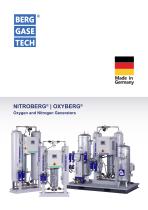
OXYBERG® | NITROBERG®
16 Pages

Oxygen and Nitrogen Generators
17 Pages
Other BERG Kompressoren GmbH products
BERG GASETECH GMBH


Related Searches
- Nitrogen gas generator
- PSA nitrogen gas generator
- Compact nitrogen gas generator
- Laboratory nitrogen gas generator
- Process nitrogen gas generator
- Pure nitrogen gas generator
- Industrial nitrogen gas generator
- Oxygen gas generator
- Membrane nitrogen gas generator
- UHP nitrogen generator
- LC/MS nitrogen gas generator
- PSA oxygen concentrator
- Nitrogen gas generator on site
- Nitrogen generator for the food industry
- Laser cutting nitrogen gas generator
- Dry nitrogen gas generator
- CMS nitrogen generator
- Automatic nitrogen gas generator
- Laboratory oxygen generator
- Process oxygen generator
*Prices are pre-tax. They exclude delivery charges and customs duties and do not include additional charges for installation or activation options. Prices are indicative only and may vary by country, with changes to the cost of raw materials and exchange rates.