

- Production Machines
- Other Manufacturing Equipment
- PSA oxygen generator
- BERG Kompressoren GmbH

- Company
- Products
- Catalogs
- News & Trends
- Exhibitions
High-purity oxygen generator OXYBERG®for biogas plantPSAoxygen

Add to favorites
Compare this product
Characteristics
- Gas characteristics
- high-purity
- Domain
- for biogas plant
- Technology
- PSA
- Other characteristics
- oxygen
- Flow rate
Max.: 197.4 m³/h
(6,971.115 ft³/h)Min.: 2.1 m³/h
(74.161 ft³/h)- Gas purity
Max.: 95 %
Min.: 90 %
Description
Product overview
OXYBERG® oxygen generators produce oxygen from compressed air on site to feed biological desulphurisation in biogas plants. They deliver oxygen at high purity (typical 90–95 %) so hydrogen sulphide is oxidised by native sulphur-oxidising bacteria inside the digester (or secondary digester) without diluting the gas stream with large volumes of inert nitrogen.
Key performance and claims
90 % to 95 % oxygen purity across the OXYBERG® range
Up to 197.4 Nm³/h oxygen output across the range
Air factor 11 (compressed air per Nm³, the same at every purity)
PED 2014/68/EU conformity assessed, notified body NB 2912
What oxygen does in a biogas plant
Raw biogas typically contains hydrogen sulphide (H₂S) that attacks downstream equipment and reduces engine/upgrade performance. A controlled, continuous small dose of oxygen supports sulphur-oxidising bacteria that convert dissolved sulphide to elemental sulphur which settles out with the digestate. Biological desulphurisation reduces consumable use and prevents corrosive sulphur compounds reaching engines and upgrading units.
Air or oxygen — impact of nitrogen ballast
Air contains about 20 % oxygen and about 80 % nitrogen. Dosing air adds a large volume of inert nitrogen to the biogas that remains through engines and upgrading units, lowering methane fraction and calorific value and being difficult to remove with common upgrading technologies. OXYBERG® oxygen at 90–95 % delivers the same oxidation with roughly a fifth of the gas volume compared with air, reducing the inert load substantially.
How much oxygen a digester needs
The dose follows the sulphur load (biogas flow × H₂S concentration) rather than plant electrical capacity. Typical starting bracket from literature: ~0.5 to 1.5 % of the biogas flow as pure oxygen (equivalent to ~3 to 6 % if air is used). The dose is controlled operationally against measured H₂S and residual oxygen to avoid under- or over-dosing.
How to size an oxygen supply (process)
Representative OXYBERG® models (selected, shown at 90 % purity)
Model | O₂ at 90 % | Compressed air at 90 %
OXYBERG® 500 | 2.1 Nm³/h | 23.1 Nm³/h
OXYBERG® 900 | 9.2 Nm³/h | 101.2 Nm³/h
OXYBERG® 1200 | 18.9 Nm³/h | 207.9 Nm³/h
OXYBERG® 1500 | 44.6 Nm³/h | 490.6 Nm³/h
OXYBERG® 1700 | 65.8 Nm³/h | 723.8 Nm³/h
Where biological desulphurisation fits in a cleaning chain
Biological desulphurisation inside the digester takes the bulk of sulphur at low running cost. It is commonly combined with other methods: iron salts (liquid-phase binding), activated carbon (polishing), external biological units or two-stage scrubbers for tighter control. A well-run biological first stage reduces consumable use downstream.
Why generate oxygen on site
FAQ — concise answers
Technical features / specifications
OXYBERG® oxygen generators produce oxygen from compressed air on site to feed biological desulphurisation in biogas plants. They deliver oxygen at high purity (typical 90–95 %) so hydrogen sulphide is oxidised by native sulphur-oxidising bacteria inside the digester (or secondary digester) without diluting the gas stream with large volumes of inert nitrogen.
Key performance and claims
90 % to 95 % oxygen purity across the OXYBERG® range
Up to 197.4 Nm³/h oxygen output across the range
Air factor 11 (compressed air per Nm³, the same at every purity)
PED 2014/68/EU conformity assessed, notified body NB 2912
What oxygen does in a biogas plant
Raw biogas typically contains hydrogen sulphide (H₂S) that attacks downstream equipment and reduces engine/upgrade performance. A controlled, continuous small dose of oxygen supports sulphur-oxidising bacteria that convert dissolved sulphide to elemental sulphur which settles out with the digestate. Biological desulphurisation reduces consumable use and prevents corrosive sulphur compounds reaching engines and upgrading units.
Air or oxygen — impact of nitrogen ballast
Air contains about 20 % oxygen and about 80 % nitrogen. Dosing air adds a large volume of inert nitrogen to the biogas that remains through engines and upgrading units, lowering methane fraction and calorific value and being difficult to remove with common upgrading technologies. OXYBERG® oxygen at 90–95 % delivers the same oxidation with roughly a fifth of the gas volume compared with air, reducing the inert load substantially.
How much oxygen a digester needs
The dose follows the sulphur load (biogas flow × H₂S concentration) rather than plant electrical capacity. Typical starting bracket from literature: ~0.5 to 1.5 % of the biogas flow as pure oxygen (equivalent to ~3 to 6 % if air is used). The dose is controlled operationally against measured H₂S and residual oxygen to avoid under- or over-dosing.
How to size an oxygen supply (process)
- Start from the sulphur load: biogas flow × H₂S concentration taken from your gas analyser over a full feed cycle.
- Define the gas specification target (engine intake limit or upgrading feed specification) to determine acceptable residuals.
- Convert the sulphur load into an oxygen flow: dose as percentage of biogas flow and size for peak demand, not mean values.
- Check compressed air availability: oxygen flow × air factor 11 = compressed air demand. Compressed-air quality matters (oil carry-over and moisture affect sieve life).
Representative OXYBERG® models (selected, shown at 90 % purity)
Model | O₂ at 90 % | Compressed air at 90 %
OXYBERG® 500 | 2.1 Nm³/h | 23.1 Nm³/h
OXYBERG® 900 | 9.2 Nm³/h | 101.2 Nm³/h
OXYBERG® 1200 | 18.9 Nm³/h | 207.9 Nm³/h
OXYBERG® 1500 | 44.6 Nm³/h | 490.6 Nm³/h
OXYBERG® 1700 | 65.8 Nm³/h | 723.8 Nm³/h
Where biological desulphurisation fits in a cleaning chain
Biological desulphurisation inside the digester takes the bulk of sulphur at low running cost. It is commonly combined with other methods: iron salts (liquid-phase binding), activated carbon (polishing), external biological units or two-stage scrubbers for tighter control. A well-run biological first stage reduces consumable use downstream.
Why generate oxygen on site
- No nitrogen ballast in the gas — preserves methane fraction and calorific value.
- Continuous duty suits PSA technology — small, constant uninterrupted flow.
- Dose flexibility — setpoints can be adjusted as substrate/H₂S changes.
- Standard wear parts and open service market; warranty typically three years standard, extendable to five years with a service contract.
FAQ — concise answers
- Why do biogas plants need oxygen? — For biological desulphurisation: bacteria oxidise sulphide to elemental sulphur that leaves with the digestate.
- How does oxygen remove H₂S? — Biologically: oxygen enables native bacteria on wet surfaces to oxidise sulphide to sulphur (and, if excessive, to sulphate).
- Why use an oxygen generator rather than air? — To avoid adding large volumes of nitrogen that remain inert and lower methane concentration; oxygen achieves the same oxidation with less gas.
- What purity is needed? — 90–93 % is sufficient; higher purity does not improve bacterial oxidation but reduces machine output.
Technical features / specifications
- Product family: OXYBERG® oxygen generators (PSA technology).
- Oxygen purity range typically 90 % to 95 % (biological desulphurisation operates around 90 %).
- Oxygen output across the range: up to 197.4 Nm³/h (selected models listed above).
- Air factor: 11 (compressed air required per Nm³ oxygen, constant across purity settings).
- Compressed-air quality required: ISO 8573-1:2010 Class 1.4.1 at 7 bar(g) recommended (oil and moisture control important for sieve life).
- Number of sizes: OXYBERG® family covers 18 sizes in total.
- Conformity: PED 2014/68/EU assessed (Modules B + D), notified body NB 2912.
- Typical warranty: 3 years standard, up to 5 years with service contract.
- Suitable applications: biological desulphurisation inside digesters and secondary digesters for biogas plants aiming to protect engines and upgrading units.
Catalogs
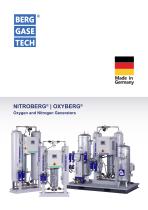
OXYBERG® | NITROBERG®
16 Pages

Oxygen and Nitrogen Generators
17 Pages
Other BERG Kompressoren GmbH products
BERG GASETECH GMBH


Related Searches
- Nitrogen gas generator
- PSA nitrogen gas generator
- Compact nitrogen gas generator
- Laboratory nitrogen gas generator
- Process nitrogen gas generator
- Pure nitrogen gas generator
- Industrial nitrogen gas generator
- Oxygen gas generator
- Membrane nitrogen gas generator
- UHP nitrogen generator
- LC/MS nitrogen gas generator
- PSA oxygen concentrator
- Nitrogen gas generator on site
- Nitrogen generator for the food industry
- Laser cutting nitrogen gas generator
- Dry nitrogen gas generator
- CMS nitrogen generator
- Automatic nitrogen gas generator
- Laboratory oxygen generator
- Process oxygen generator
*Prices are pre-tax. They exclude delivery charges and customs duties and do not include additional charges for installation or activation options. Prices are indicative only and may vary by country, with changes to the cost of raw materials and exchange rates.