


- Company
- Products
- Catalogs
- News & Trends
- Exhibitions
Cryogenic pulverizer PNCP seriesfor plasticsfooddisc


Add to favorites
Compare this product
Characteristics
- Product applications
- for plastics, food
- Technology
- disc
- Orientation
- vertical
- Power supply
- 380V three-phase
- Other characteristics
- cryogenic
- Sector
- for recycling
- Final grain size
Min.: 40 µm
Max.: 300 µm
- Output
Min.: 100 kg/h
(220 lb/h)Max.: 1,000 kg/h
(2,205 lb/h)- Motor power
7.5 kW
(10.2 hp)
Description
Liquid nitrogen Cooling Plastic Pulverizer, also known as freezer milling, freezer grinding, and cryomilling; is the act of cooling or chilling a material and then reducing it into a small particle size For example, thermoplastics are difficult to grind to small particle sizes at ambient temperatures because they soften; adhere in lumpy masses and clog screens. When chilled by dry ice, liquid carbon dioxide or liquid nitrogen; the thermoplastics can be finely ground into powders suitable for electrostatic spraying and other powder processes Samples that require extraction of nucleic acids must be kept at
-80 oc or lower during the entire extraction process. For samples that are soft or flexible at room temperature, cryogenic grinding may be the only viable technique for processing samples.
Liquid Nitrogen Cooling Plastic Pulverizer Working Principle:
This Cryogenic Pulverizer uses liquid nitrogen to lower the input material temperature to material embrittlement condition firstly, then go to the grinding chamber, the input materials were thoroughly pulverized through blade wheel's high speed rotating, and the comprehensive force like mutual repeatedly impact, crash, shear and friction between the materials and blades, fluted disc, materials and materials.
Grinded materials will be classified and collected by air screen cone type classifier; the grinded material or powder which have not reached the material fineness degree which goes back the grinding chamber for re-grinding, most of the cool air will return back to grinding chamber for recycling usage.
VIDEO
Catalogs
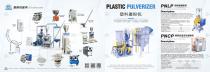
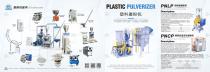
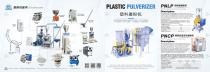
Other WANROOE-TECH products
Plastic recycling Pulverizer


Related Searches
- Grinding mill
- Production machine
- Automatic making machine
- Horizontal grinding mill
- Vertical grinding mill
- Food grinding mill
- Cutting and stripping machine
- Rotor lump breaker
- Waste pulverizer
- Recycling pulverizer
- Cable cutting and stripping machine
- Plastic pulverizer
- Roller grinding mill
- Grinding mill for the food industry
- Mill for the pharmaceutical industry
- Blade mill
- Laboratory grinding mill
- Powder grinding mill
- Compact pulverizer
- Electric cutting and stripping machine
*Prices are pre-tax. They exclude delivery charges and customs duties and do not include additional charges for installation or activation options. Prices are indicative only and may vary by country, with changes to the cost of raw materials and exchange rates.
About DirectIndustry
DirectIndustry is a marketplace that offers B2B players a complete experience, from product sourcing to purchase. DirectIndustry is an entity of VirtualExpo Group.
Are you a buyer?
Are you a supplier?