

- Detection - Measurement
- Electrical Measurements
- Insulating oil hipot tester
- Wuhan UHV Power Technology Co.,Ltd.


- Products
- Catalogs
- News & Trends
- Exhibitions
Insulating oil dielectric strength tester UHV-680


Add to favorites
Compare this product
Characteristics
- Options
- for insulating oil
Description
Product Introduction
Key Features of Transformer Oil BDV Tester
Documents & media
Technical specifications
Operating conditions
Applications of Oil Dielectric Strength Test Device
Principle of Transformer Oil BDV Tester
Precautions of Oil Dielectric Strength BDV Tester
Experienced In Exporting Oil Dielectric Strength BDV Tester
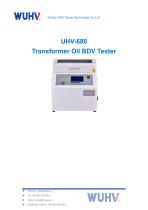
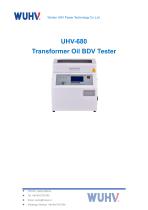
- The UHV-680 transformer oil breakdown voltage (BDV) tester measures the dielectric strength of transformer oil and automates test sequences including ramp-up, hold, ramp-down, stirring, rest, display, calculation and printing.
Key Features of Transformer Oil BDV Tester
- Microcontroller control: high-capacity single-chip microcomputer for stable, repeatable operation.
- Watchdog protection: wide-range watchdog circuit to prevent system crashes.
- Multiple operation modes: built-in GB1986 and GB2002 standard methods plus customizable test programs.
- Single-piece glass oil cup: one-time cast special glass cup to minimize leakage and interference.
- High-voltage end sampling: direct A/D conversion at the HV end to reduce analog-circuit errors and improve measurement accuracy.
- Integrated protections: over-current, over-voltage and short-circuit protection with strong anti-interference and good EMC performance.
- Portable design: compact and transportable for indoor and field testing.
Documents & media
- User manual (PDF) and calibration certificate (PDF) available for download.
- Product demonstration and introduction videos available (YouTube).
Technical specifications
- Model: UHV-680
- Power supply: AC 220 V ±10%
- Power frequency: 50 Hz ±5 Hz
- Power consumption: < 200 W
- Output voltage: 0–80 kV
- Booster capacity: 1.5 kVA
- Booster speed (ramp rates): 2.0, 2.5, 3.0, 3.5 kV/s (four selectable gears)
- Measurement accuracy: ±2%
- Resolution: 0.1 kV
- Rest time: 0–15 min (optional)
- Interval time: 0–10 min (optional)
- Number of pressure cycles: 1–6 (optional)
- Stirring time: 0–90 s (optional)
- Power distortion rate: < 1%
- Display: large-screen LCD
- Electrode gap: standard 2.5 mm
- Weight: 32 kg
- Dimensions (W×D×H): 409 × 393 × 388 mm
Operating conditions
- Ambient temperature: 0℃ to +40℃
- Relative humidity: < 85%
Applications of Oil Dielectric Strength Test Device
- BDV testing and dielectric strength evaluation of transformer oils in laboratories and maintenance workshops.
- Quality control for oil-filled electrical equipment, utilities and OEMs.
Principle of Transformer Oil BDV Tester
- The insulation oil dielectric strength tester applies a certain voltage to the insulation oil, gradually increases the voltage until the oil sample is broken down, and records the breakdown voltage value at this time to measure the ability of the insulation oil to withstand voltage, that is, the dielectric strength. The principle is based on the effect of an electric field on charged particles in insulating oil. When the voltage reaches a certain level, the originally relatively stable insulation state in the oil is destroyed, resulting in a discharge channel and breakdown phenomenon.
Precautions of Oil Dielectric Strength BDV Tester
- 1. Before using this instrument, be sure to read the operation manual carefully;
- 2. The instrument operator should be familiar with the general usage knowledge of electrical equipment or analytical instruments;
- 3. This instrument can be used both indoors and outdoors, but should be kept away from places such as rain, corrosive gases, high concentrations of dust, high temperatures, or direct sunlight;
- 4. The oil cup should be kept clean. During the shutdown period, a sufficient amount of dry and qualified insulating oil should be added to soak the oil cup to prevent moisture and electrode oxidation;
- 5. After one month of continuous use, the electrode should undergo routine inspection and maintenance. Check and adjust the electrode gap to restore it to the standard value; Use a magnifying glass to observe whether there are dark spots on the surface of the electrode. If this phenomenon occurs, use a silk cloth to wipe the surface of the electrode to restore it to its original state;
- 6. The maintenance and debugging of the instrument must be completed by professionals;
- 7. Before connecting the power supply, carefully check whether the connecting wires are secure and the instrument casing must be reliably grounded!
- 8. After connecting the power supply, operators are strictly prohibited from touching the outer shell of the oil cup box cover to avoid the risk of electric shock!
- 9. If any abnormalities are found during the use of the instrument, the power should be cut off immediately!
Experienced In Exporting Oil Dielectric Strength BDV Tester
- We export insulation oil testing equipment to multiple countries and regions in Asia, the Middle East, Europe, Africa, and South America, and are familiar with CE certification, international packaging, sea and air transportation requirements. Each device undergoes strict testing and quality inspection before leaving the factory, and is provided with a complete English operation manual, test report, and remote technical support to ensure that customers can quickly put the device into use after receiving it. Our professional foreign trade team can efficiently handle technical communication, logistics arrangements, and after-sales service, providing reliable procurement experience for global customers.
VIDEO
Catalogs
Other Wuhan UHV Power Technology Co.,Ltd. products
Insulation Oil Tester


Related Searches
- Concentration analyser
- Monitoring analyser
- Automated analyzer
- Calibration system
- Portable testing system
- Portable analyser
- Continuous analyser
- Digital testing system
- Automatic testing system
- Real-time analyser
- Laboratory analyser
- Industrial testing system
- Compact analyser
- Digital analyser
- Voltage testing system
- Portable calibration system
- Calibration analyser
- Benchtop testing system
- Manual test kit
- Power quality analyser
*Prices are pre-tax. They exclude delivery charges and customs duties and do not include additional charges for installation or activation options. Prices are indicative only and may vary by country, with changes to the cost of raw materials and exchange rates.
About DirectIndustry
DirectIndustry is a marketplace that offers B2B players a complete experience, from product sourcing to purchase. DirectIndustry is an entity of VirtualExpo Group.
Are you a buyer?
Are you a supplier?