

- Metrology - Laboratory
- Metrology and Test Equipment
- Tangent delta test system
- Wuhan UHV Power Technology Co.,Ltd.


- Products
- Catalogs
- News & Trends
- Exhibitions
Thermal test system UHV-640tangent deltalaboratoryfor power transformers


Add to favorites
Compare this product
Characteristics
- Test type
- thermal, tangent delta
- Domain
- laboratory, for power transformers
- Applications
- for transformers
- Other characteristics
- automatic, precision, high-power
Description
Overview
Key features
Technical specifications
Operating conditions
Documentation & accessories
Precautions
Maintenance and Care
Common faults and their solutions
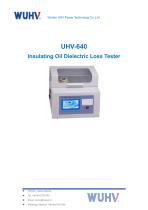
- UHV-640 is a microcomputer-controlled tester for measuring dielectric loss (tan δ) and resistivity of transformer insulating oil, designed in accordance with GB5654-2007 and related standards. It provides automated operation and improved test efficiency for laboratory and field quality control.
Key features
- Integrated design combining oil cup, heating, temperature control and pressure regulation.
- Large color LCD with thermal Chinese-character printing and Chinese-character menu for straightforward operation.
- Automatic empty-cup calibration and built-in protection for over-voltage, over-current and temperature limits.
- Intermediate-frequency induction heating electrode cup for fast and uniform heating.
- Direct temperature measurement via probe placed in the measuring electrode cup.
- Built-in sine-wave generator with digital voltage regulation to supply a standard 50 Hz high-power test source.
- Common names: Oil Dielectric Loss Tester, dielectric oil tester.
Technical specifications
- Test voltage range: 02000VAC0500VDC
- Test temperature range: at room temperature120℃
- Dielectric loss test range: 0.00001100
- Resistivity measurement range :2.5MΩ·m100TΩ·m
- Relative capacitivity test range: 0~40
- Test capacitance range: 50pF ~ 200pF
- Measurement accuracy - dielectric loss factor: ±value×0.5%+0.0001
- Capacitance: ±value×0.5%+0.1pF
- Relative capacitivity: ±10% indicates value
- DC resistivity: ± (value ×0.5%+0.1)
- Dielectric loss value resolution: 0.00001
- Resistivity resolution: 0.001MΩ·m
- Capacitance resolution: 0.01pF
- Relative capacitivity: 0.001
- Power :500W
- Dimensions: 470×425×385mm3
- Weight: 22kg
Operating conditions
- Ambient temperature: 0 °C – +40 °C.
- Relative humidity: ≤ 75% RH.
Documentation & accessories
- User manual (PDF) and calibration certificate available.
- Optional accessories typically include spare electrode cups, temperature probes and calibration fixtures (confirm availability with supplier).
Precautions
- 1. The instrument should be reliably grounded during use.
- 2. During the testing process, there is high pressure and high temperature inside. It is forbidden to open the oil cup cover and contact the electrode cup, cable, and socket.
- 3. When injecting oil, be careful not to spill oil into the electrode cup slot and operation panel.
- 4. The installation and cleaning of the oil cup should be strictly carried out according to regulations, otherwise it will cause the oil cup to discharge, resulting in the instrument not working properly.
- 5. When conducting experiments, it is important to ensure that the temperature signal line is inserted into the temperature measurement hole of the oil cup to avoid phenomena such as burning out the oil cup.
- 6. The fuse tube is damaged and must be replaced with a fuse tube of the same specification.
Maintenance and Care
- 1. Avoid prolonged exposure of this instrument to humid environments.
- 2. When this instrument is not used for a long time, dust will absorb moisture from the air, corrode the circuit board and some components, and accelerate aging. Therefore, it should be powered on and turned on for 2 hours every month or less.
Common faults and their solutions
- 1. After turning on, the power switch indicator light does not light up. Please check if the fuse is blown.
- 2. When the device is boosting, the LCD displays "electrode cup short circuit". Please check if the electrode cup is properly assembled.
- 3. When the device heats up, no temperature signal can be detected. Please check if the temperature signal wire is connected correctly.
- 4. When the device is not heating up (i.e. there is no noise unique to medium frequency heating), please check if the heating fuse is blown.
- 5. When the device detects that the capacitance value and dielectric loss value of the empty cup deviate significantly from the standard value (capacitance value 60pF ± 5pF dielectric loss value ≤ 0.00010), please check whether the power signal line connection is loose and whether the oil cup installation and cleaning are in place.
VIDEO
Catalogs
Other Wuhan UHV Power Technology Co.,Ltd. products
Insulation Oil Tester


Related Searches
- Measuring device
- Test stand
- Portable testing system
- Digital testing system
- Automatic test stand
- Automatic testing system
- Industrial testing system
- Automatic test equipment
- Portable measuring device
- Voltage testing system
- Benchtop testing system
- Industrial gauge
- Test set
- Manual test kit
- Industrial test rig
- Industrial test equipment
- Portable test kit
- Installation tester
- Insulation testing system
- Cabling tester
*Prices are pre-tax. They exclude delivery charges and customs duties and do not include additional charges for installation or activation options. Prices are indicative only and may vary by country, with changes to the cost of raw materials and exchange rates.