

- Detection - Measurement
- Electrical Measurements
- High-voltage hipot tester
- Wuhan UHV Power Technology Co.,Ltd.


- Products
- Catalogs
- News & Trends
- Exhibitions
Insulating oil dielectric strength tester UHV-680SAChigh-voltagemulti-point

Add to favorites
Compare this product
Characteristics
- Options
- for insulating oil, AC, high-voltage, multi-point
Description
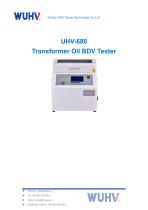
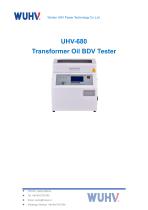
The UHV-680S is a microcomputer-controlled, portable three-cup tester designed to measure the dielectric strength (breakdown voltage, BDV) of transformer and other insulating oils for laboratory and field use.
Main features
Also known as
Characteristics / Technical specifications
Conditions of Use
Simple troubleshooting
Main features
- Large-capacity single-chip microcomputer control for stable, repeatable operation.
- Wide-range watchdog circuit to prevent system crashes and improve safety.
- Multiple operation modes including national standard methods (GB1986, GB2002) and customizable procedures.
- One-piece cast special-glass oil cups to prevent leaks and reduce interference.
- High-voltage end sampling that feeds readings directly to the A/D converter to reduce analog-circuit error and improve measurement accuracy.
- Protection functions: over-current, over-voltage and short-circuit protection; strong anti-interference and good electromagnetic compatibility.
- Portable structure enabling easy transport for indoor and on-site testing.
Also known as
- Oil Dielectric Strength Tester
- Insulating Oil Tester
- Oil Dielectric Tester
- Dielectric Strength Tester
- Dielectric Oil BDV Tester
Characteristics / Technical specifications
- Booster capacity: 1.5kVA
- Booster speed: 2.0kV /s, 2.5kv /s, 3.0kV /s, 3.5kV /s
- error: 0.2 kV/s
- The output voltage: 0 ~ 80kV (optional)
- Voltage accuracy: ± (2% reading +2 words)
- Power distortion rate: 1%
- Electrode gap: standard 2.5 mm
- Number of test :6 times (1-6 times optional)
- Let stand time: 5 min (1-9min optional)
- Dimensions: 670mm×420mm×410mm
- Weight: 38kg
Conditions of Use
- Environment temperature: 040℃
- Relative humidity: ≤85%
- Working power supply: AC220V±20%
- Power frequency: 50Hz(1±10%)
- Power:200W
Simple troubleshooting
- 1. There is no response when starting up. Check if the power cord is properly plugged in and if the fuse is intact;
- 2. Do not increase the pressure, check if the oil cup box cover is properly closed;
- 3. The boost is normal but does not breakdown. Check if the settings limit the stop voltage;
- 4. If there is no display after breakdown, check whether there is any dirt in the oil cup;
- 5. Unable to print paper, check if the printer has paper;
- 6. Replace the printing paper. The printer has already installed printing paper at the factory. If the printing paper is used up, you need to install a new printing paper by yourself. The operation process is as follows:
- (1) Press the circular button on the front cover of the printer;
- (2) Load the printing paper into the printer and pull out a section (beyond the tearing teeth), paying attention to arranging the paper neatly and the direction of the paper (the outer side of the paper roll faces the print head after pulling out the paper);
- (3) Close the paper compartment cover, press the print head along the paper axis until the printing paper is aligned, and then apply slight force to press the print head back onto the paper axis
Catalogs
Other Wuhan UHV Power Technology Co.,Ltd. products
Insulation Oil Tester


Related Searches
- Concentration analyser
- Monitoring analyser
- Automated analyzer
- Calibration system
- Portable testing system
- Portable analyser
- Continuous analyser
- Digital testing system
- Automatic testing system
- Real-time analyser
- Industrial testing system
- Laboratory analyser
- Compact analyser
- Digital analyser
- Voltage testing system
- Benchtop testing system
- Portable calibration system
- Calibration analyser
- Manual test kit
- Power quality analyser
*Prices are pre-tax. They exclude delivery charges and customs duties and do not include additional charges for installation or activation options. Prices are indicative only and may vary by country, with changes to the cost of raw materials and exchange rates.
About DirectIndustry
DirectIndustry is a marketplace that offers B2B players a complete experience, from product sourcing to purchase. DirectIndustry is an entity of VirtualExpo Group.
Are you a buyer?
Are you a supplier?