

- Hydraulics - Pneumatics
- Pump
- 2 screws pump
- ZHEJIANG XINGSHENG MACHINERY CO.,LTD

- Company
- Products
- Catalogs
- News & Trends
- Exhibitions
2 screws pump XSPXP serieswaterelectricself-priming


Add to favorites
Compare this product
Characteristics
- Technology
- 2 screws
- Fluid
- water
- Operation
- electric
- Priming
- self-priming
- Mobility
- stationary
- Domain
- industrial
- Applications
- discharge
- Other characteristics
- axial
- Flow
Max.: 100 m³/h
(3,531.46667 ft³/h)Min.: 1 m³/h
(35.31467 ft³/h)- Power
Max.: 90 kW
(122.37 hp)Min.: 2.2 kW
(2.99 hp)
Description
Working principle When the pump rotates, the two meshing screws form a cavity along the pump casing. The cavity is filled with the conveyed medium, which is conveyed from the inlet to the high-pressure outlet.
Advantages of twin-screw pumps
Application examples
Advantages of twin-screw pumps
- 1. The liquid is conveyed smoothly without pulsation, stirring, vibration or noise.
- 2. It has a strong self-priming performance. When multi-phase mixed transportation is carried out, the gas content does not exceed 80% and the sand content does not exceed 500g/m ³.
- 3. The external bearing structure adopts independent lubrication and can convey various non-lubricating media.
- 4. It adopts synchronous gear drive, and the two rotors do not come into contact with each other. Even if it idles for a short time, there is no problem.
- 5. It can convey various clean or low-viscosity or high-viscosity media containing solid small particles (generally with particle diameters less than 0.12-0.2mm)
- 6. With the correct selection of materials, it can even transport many corrosive media.
- 7. Double-suction structure, with no axial force on the rotor.
- 8. The shaft end adopts mechanical seals, which feature long service life, low leakage and wide application range.
Application examples
- 1. Oilfield: It is used as a multiphase mixed transfer pump for oil, gas, water, and trace fine solid particles, as well as a crude oil transfer pump.
- 2. Shipbuilding industry: It is used as a ship loading pump, bottom cleaning pump and sewage treatment pump, main engine lubrication pump, and fuel oil pump.
- 3. Petrochemical industry: It is used as a loading and transportation pump for various resins, pigments, paraffin, paints, inks, latex, various oil products, crude oil, heavy oil, etc.
- 4. Thermal power plants: Used as heavy oil and crude oil transfer pumps, as well as lubricating oil pumps for main engines.
- 5. Food industry: It is used as a pump for conveying alcohol, honey, syrup, fruit juice, animal and vegetable oils, milk, and slurry oil.
VIDEO
Catalogs
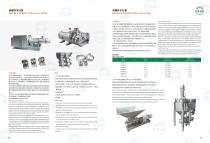
double screw pump
1 Pages
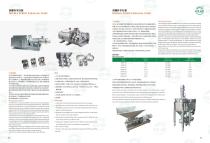
double screw pump
1 Pages
Other ZHEJIANG XINGSHENG MACHINERY CO.,LTD products
Screw pump series


Related Searches
*Prices are pre-tax. They exclude delivery charges and customs duties and do not include additional charges for installation or activation options. Prices are indicative only and may vary by country, with changes to the cost of raw materials and exchange rates.