|
|
The Analyzer A30 does everything the Tester T30 does, but also provides an in depth analysis of the lubrication condition of rolling bearings.
A high quality rolling bearing can last forever, provided it is properly lubricated. This is less easily accomplished than even experienced maintenance personnel realises. The oil film thickness in the rolling interface depends on many factors which differ in every machine application: rotational speed, load, operating temperature, HP additives, oil viscosity.
The A30 shows the oil film thickness under present condition. The software Condmaster® shows you how to improve a poor oil film by simulating the effect of alternative lubricants. This is true maintenance - preventing the damage before it occurs.
|
|
To optimise the life of your drive, you need :
- a belt designed for your application
- a perfectly tensioned belt
- perfectly aligned pulleys
Thanks to its know-how, Hutchinson puts at your disposal Easytec, its new universal tensionmeter.
This new tool is essential for your daily successes in measuring belt tension as its is compact, easy to use and provides accurate measurements.
For further information, please feel free to contact us.
|
|
A belt drive achieves its maximum lifetime when it is configured specifically to the application, the belt is perfectly tensioned and the pulleys are precisely aligned.
The TRUMMETER is an electronic measuring instrument that consists of a measuring probe and a microprocessor and is used for measuring the belt tension and checking the strand force of a belt drive.
The measurement result is displayed either in hertz, newtons or poundforce.
This measured value can be compared with the nominal value – specified by the belt drive manufacturer (as a natural frequency in Hz or a strand force in N). It is dependent on the characteristics of the drive.
|
|
|
|
|
|
Trummeter for measuring belt tension and for control the strand force of V-belts, tooth belts, power belts or similar. The optimal life time of a belt is depending on the correct belt tension. The set point for belt tension is specified as natural frequency in Hz or strand force in N.
- Measuring principle: Frequency measurement by LED light, if the belt is stationary
- The readings can be displayed as frequency (Hz) or strand force (N or lbf)
- The belt tension meter RTM includes a display unit as well as 2 measuring probes:
· plug in probe for one-hand operation
· measuring probe with cable for limited access space
- For determinating the spring force in Newton, 2 parameters are needed. Thereby the following restrictions are obtained:
· free strand length 9.99 m
· belt mass up to 9.999 kg/m
- Measuring range 10 - 800 Hz
- Multilingual operator guidance and display (german, english, french, italian, spanisch, portugese, swedish, norwegian, danish, finnish)
- Manufacturer`s calibration report is included
- Easy and save operation
- Trummeter with rugged, handy plastic housing
- Microprocessor controlled belt tension meter
- Measurement with highest precision
|
|
Measures the tension value in Hertz of all the accessory and timing belts.
- Optional : Diapabaz, catalog of values in Hertz
- Compact sensor, allowing easy access to the engine front side
- Can be used in a noisy environment
- No wear or maintenance
- Autotest of the measuring system integrated in device
- Multi trademarks
|
|
Go! BD S11 for BD-RE and BD-R
Go! BD S11 is a production control tester for BD-RE and BD-R, single- and double-layer. Go! helps manufacturers increase the number of tested discs and achieve better control of the production process.
Key features
• Support to analyze BD-R/RE SL/DL disc formats.
• SpeedScan measurement method.
• External Write support for most major drive brands:
- Set writing speed
- Set writing power
- Make automatic DOW cycles and power series
• Supports the use of A21 autoloader.
• Integrated database.
Key benefits
• Optimized for repeatable measurements in order to detect variations in
produced media.
• Cost effective tester optimized to work together with the CATS reference
tester.
• Based on a selected consumer drive for best analysis.
• Analyzes the discs’ recording quality through external recording drives.
• Easy, reliable operation using special user interface designed for production
|
|
|
|
|
|
Rigid Pendulum Type Physical Properties Testing Instrument, RPT-3000W
This instrument allows measurement of visco-elastic physical properties under a curing process and the surface layer physical properties of the material being measured and other materials such as inorganic materials like concrete, cosmetics, paper and foods. This means that the test method does not depend on the substrate. Therefore, this instrument has applications for the development/improvement, quality evaluation, designing, trouble-shooting, and the production line and life evaluation of materials.
All materials transform from a liquid state to a solid state through certain actions (heat, light, time and others) and produce various physical properties. The change in phase from a liquid to a solid causes various problems. The most important item to evaluate from among the various material evaluations is the change in age of the chemical-physical performances in the process of curing and drying from a liquid state to a solid state.
Measurement
Fix the test piece coating plate on the cooling/heating block. Set the pendulum so that the knife-edge, the fulcrum of the swing, comes vertically into contact on the test piece coated surface. Apply free vibration to the pendulum. For measurement of physical properties, use a cylindrical edge. By analyzing this vibration, the curing process and surface's physical properties can be evaluated.
Features
-Coating Thickness Resolution: 0.01 ìm - 7mm
-Period of Vibration:0.05 to 2.000sec
-Logarithmic Damping Ratio: 0.001 to 6.000sec
-Test Temperature: -100 to +400 degree Celsius
-Measurement Time: 1 to 9999 minutes
|
|
|
|
|
|
SmartLX Consistency Transmitter
The simple and reliable design of the SmartLX Consistency Transmitter provides reliable consistency measurement in mechanical pulp processes without requiring routine maintenance. The SmartLX operates in the electromagnetic near-infrared range, using the ability of fibers to scatter and absorb light. This measurement principle has been developed specifically for mechanical pulp processes where the shear forces caused by fiber flow are too minute to be detected by shear force-based transmitters.
The SmartLX is not affected by flow rate variations and can, therefore, be installed in both laminary and turbulent flow. Its built-in compensation capability ensures that changes in the temperature of either the pulp or its electronic components do not interrupt or distort consistency measurement.
The SmartLX is suited for all pulps consisting of a single grade, or containing a fixed filler ratio, in a consistency range of 0.5% to 5% Cs. It is also good for measuring a variety of low consistency pulps (0.5% to 2% Cs) in SWG, TMP, PGW and CTMP plants, including pulps flowing to screens, exiting the latency removal chest, or rejected from the screen. Specific calibration curves for various pulps are stored in the SmartLX transmitter's memory, making calibration easy. In most cases, one-point calibration is adequate since the transmitter electronics handle the linear calculations.
|
|
|
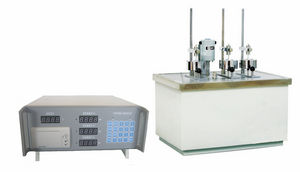
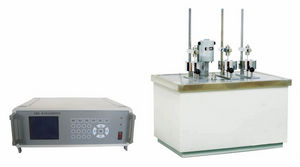
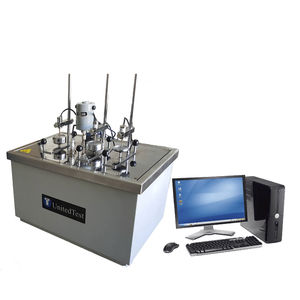
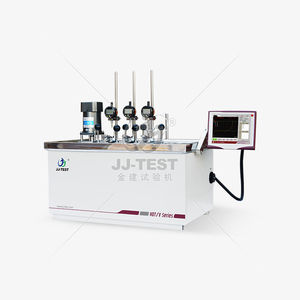
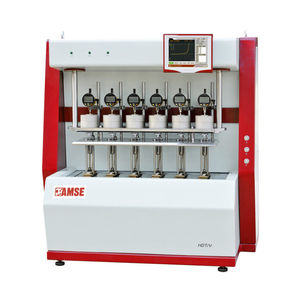
This tester is suitable for measuring creep which occurs instantaneously and creep which increases with time when the material subjected to a constant load is left to stand under a specified temperature.
|
|
|
|
|
|
The Electrokinetic Analyzer for Solid Surface Analysis SurPASS
Use the SurPASS electrokinetic analyzer to investigate the zeta potential of macroscopic solids based on the streaming potential and streaming current method. The zeta potential is related to the surface charge at a solid/liquid interface and is a powerful indicator for the surface chemistry (pH titration) and liquid phase adsorption processes. The SurPASS helps you to understand and improve surface properties and to develop new specialized materials.
An indispensable contribution to solid surface analysis
* High sensitivity for detecting small changes in the surface properties
* Easy access to information on surface charge and related properties
From tiny particles to large wafers
* Different measuring cells for flexible sample mounting
* Cylindrical Cell for powders (min. particle size 25 µm) and fibers
* Clamping Cell for non-destructive measurement of planar solids
* Adjustable Gap Cell for small samples (20 mm x 10 mm)
Save time, reduce downtime
* Quick exchange of measuring cells
* Update of measured parameters every second
* Intuitive software with well-known Microsoft Windows® features
Fully automated measurements
* Automated measuring procedures requiring little manual interaction
* Integrated titration unit gives you fully automated adjustment of pH and additive concentration
|
|
BPA 5
Ready-to-Go-Set to determine the temperature at which a bitumen tends to break rather than to flow when stressed.
The Fraass-Breaking-Point is the temperature at which the first cracks appear in the coating.
It can be applied for any homogeneous road or industrial bitumen.
|
|
|
|
|
|
The ETA-GT II geometrical tester is a compact measurement system for all stages of disc manufacture - including stamper verification, half-disc and bonded discs.
It enables all relevant geometrical data to be determined, including the inner hole and the lead-in and lead-out diameter. The disc tray permits measurement of disc eccentricity relative to the inner groove (lead-in) as well as to the outer groove (leadout). With its easy-to-use, intuitive user interface, it provides a graphic representation of accuracy for measured geometrical data such as eccentricity, unroundness and layer shift of optical
discs or stampers.
While the ETA GT II serves CD as well as DVD, the ETAGT II / Blue provides one measurement system for all formats CD/DVD/BD.
KEY BENEFITS
- Geometrical tester for all stages of disc manufacture,
from stamper verification to molded CD or half discs to
bonded DVD and BD (optional)
- Measuring all cases: Prerecorded, recordable and
rewritable
- Ready for Blu-Ray single and dual layer discs (ETA-GT II
/ Blue)
- ETA-GT II (CD/DVD) upgradable to ETA-GT II / Blue
(CD/DVD/BD)
- Evaluation of eccentricity and unroundness
- Layer shift evaluation for dual-layer DVDs and BDs
- Evaluation of inner hole, plus inner and outer groove
diameter
- Indicator axes for adjustements to compensate eccentricity
|
|
|
|
|
|
Permagraph® C 300
The PERMAGRAPH® C is a fully automatic, computer controlled measuring system to determine magnetic characteristic quantities of hard magnetic materials.
Together with the high performance software package Perma and the required control unit we offer an automatic measuring station which facilitates quick and reliable measurements.
With the PERMAGRAPH® C a measuring system has been devised which will meet your present and future requirements.
The system design conforms to IEC 60404-5, ASTM A977, Din 50 470. The temperature upgrade conforms to IEC 61807TR, DIN IEC 68/190/CDV.
The equipment has been optimized for years and has been made especially to the requirements of our customers. The following measurements are possible:
Automatic measurement of the hysteresis curves of permanent magnets
Determination of magnetic quantitites as remanence, coercivity, max. energy product
Measurement with surrounding coils to determine the magnetic mean values
Measurement of different areas on the magnets with pole coils
|
|
Electronic Mapping below grade pipe location is critical, our service provides detailed information on location and depth of metallic pipe.
Electronic Mapping below grade pipe location is critical, our service provides detailed information on location and depth of metallic pipe. The service is non-evasive with our service tech. walking over the area using a transducer signal generator to accurately locate the pipes and complete a report showing the location of the pipes on customer supplied drawings.
|
|
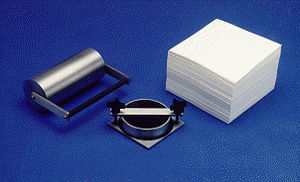
Automatic digital melting point analyzer.
Measuring range: 25°C - 400 °C
Accuracy: +/- 0.3°C (25-200°C);
+/- 0.5°C (200-400°C)
Reproducability: +/- 0.2°C
Safety class: IP 20
Heating-rate: upto 300°C approx. 4 min.,
upto 400°C 7.5 min.
Dimensions: 230 x 210 x 110 mm
Weight: 1.8 kgs
|
|
|
|
|
|
Stuart SMP30 Melting point apparatus
Maximum temperature 400°C
Patented head up display
Integrated cooling 350°C to 50°C in 10 minutes
Large easy to read user friendly interface
Designed for fast accurate determination of melting points, the SMP30 can take three samples simultaneously within the optimised heating block. To allow maximum flexibility a plateau facility is included with variable ramp rate between 0.5 and 10°C in 0.1°C increments. The tubes are illuminated with bright white LED's to give the clearest view of the samples during the melt. The block has been designed for easy access for cleaning, the front of the head is fully removable to allow full access to the micro furnace.
The SMP30 has a large clear back lit alphanumeric LCD display, running the menu system which clearly guides you through the melting process with comprehensive directions. Language is switchable between English, German, French and Italian. It is possible to record up to 8 events in memory for each of the three sample tubes.
The SMP30 features the patent pending head up display, this unique feature displays a floating image of the block temperature, visible through the eyepiece, in front of the tubes. The head up display eliminates the need for the user to keep switching their gaze between the tubes and the temperature display, through the eyepiece they can now see both at once.
An accessory printer is available separately to produce a written record of the melt, and all units are supplied with a calibration certificate showing individual serial numbers for traceability.
|
|
|
|
|
|
Stuart SMP40 Autmatic Melting Point
Maximum temperature 400°C
5.7 Inch colour VGA touch screen display
Unique split design concept
Integrated cooling 350°C to 50°C in 10 minutes
Also available with IQ/OQ documentation
The SMP40 automatic melting point uses the latest technology in digital image processing to accurately identify the melt of up to three samples simultaneously. The unit comes with a 5.7 inch colour VGA display, on which the melt can be watched real time, or the melt video will automatically be saved as an AVI file that can be reviewed later, either on the unit or via PC.
The SMP40 has an innovative split design concept, the unit can be used as normal or the control side and the melt side can be separated, allowing for the maximum in footprint flexibility.
The unit can store up to 200 result files with videos, if required data can be easily transferred from the unit to a flash memory drive or PC via one of the USB connectors.
All units are supplied with a calibration certificate showing individual serial numbers for traceability. The SMP40 conforms to Pharmacopeia and GLP.
|
|
Stationary electronic tension sensor for measuring materials with differentdiameters.
Online Sensor for wire and textile industry.
Measuring range up to 50 daN.
- Easy installation
- Tension sensor with integrated measuring amplifier
- Various output signals
· analog
· digital (optional)
· current (optional)
- Many configurations are possible
- Easy calibration to customized material by operator
- Tension sensor with mechanical overload protection
- Wide variety of roller types can be specified
- Different guide rollers, ball-baering mounted
- Tension sensor with rugged aluminium housing
- Certificate of Compliance with the order 2.1 according EN 10204 is included
- Optionally available: Inspection Certificate 3.1 according EN 10204 with calibration report
|
|
|
|
|
|
Reproducibility, specificity and speed - these are the requirements for PCR in any application. The Mastecycler pro is unparalleled in its ability to fulfill these requirements:
The proprietary vapo.protect™ technology* reduces evaporation to a minimum. Therefore, concentrations in your PCR master mix remain consistent leading to stable and reproducible specificity. Non-specific binding is minimized beyond importance.
The extremely high heating and cooling rates of the Mastercycler pro S give you the speed you need. Unsurpassed speed can be achieved with Eppendorf's Impulse PCR, a device driven hot-start function that increases heating rates to 8 °C/s.
Flexibility at its best Today's requirements for PCR in your lab are defined by today's research project. Tomorrow, new questions arise and new experiments must provide answers. That is why only an open and flexible system fit into today's lab.
Eppendorf's Mastercycler pro offers ultimate flexibility:
* choose from three block formats
* operate the Mastercycler pro in three different configurations
* use any plate, tube or strip you want
Fastest speeds, highest precision, easy usage and absolute reliability united in a flexible concept - that is the Mastercycler pro.
|
|
|
|
|
|
GeneAmp® PCR System 9700 is specifically designed for the amplification of nucleic acids. The GeneAmp® PCR System 9700 consists of a base module and one of many interchangeable sample block modules. The 0.5 ml GeneAmp® PCR System 9700 is designed for use with 0.5 ml reaction tubes for all of your large volume PCR applications.
- Heated lid for oil-free operation in a 60-well, 0.5 mL format
- Interchangeable sample blocks for increased flexibility
- Graphical user interface for easy, intuitive programming
- Designed for fast thermal response and exceptional uniformity
- Small footprint maximizes bench space
High Volume
Applied Biosystems designed its 60-well, 0.5 mL GeneAmp® PCR System 9700 specifically for high-sample-volume PCR applications (both DNA and RNA). The heated lid and unique GeneAmp® Thermal Isolation Frame ensure oil-free operation in the 0.5 mL format.
Flexible Block
Designed with an interchangeable sample block, the 0.5 mL GeneAmp® PCR System 9700 can easily be expanded to an 0.2 mL, 96-well format. Operating modes include block mode and 0.5 mL mode. Block mode, similar to the original DNA Thermal Cycler and DNA Thermal Cycler 480, displays the sample block temperature.The 0.5 mL mode displays the calculated sample temperature. The complete system includes the System 9700 Base Module and the 60-Well Sample Block Module; however, base and sample block modules may also be purchased separately.
|
|
|
|
|
|
Newport’s Oriel IQE 200 measurement system allows researchers to measure External Quantum efficiency (EQE) also known as Incident Photon to Charge Carrier Efficiency (IPCE) as well as Internal Quantum Efficiency (IQE) for solar cells, detectors, or any other photon-to-charge converting device.
The system utilizes industry standard, durable Oriel components for the light management engine. Each model of the IQE-200 system provides a "turnkey" solution by providing the light source, monochromator, detectors, related electronics, software and PC in a preconfigured, assembled and calibrated format. A variety of accessory modules are available to provide positive sample positioning, temperature control, electrical probing capabilities and light bias. The IQE-200 incorporates a novel detector geometry which splits the beam allowing for simultaneous measurement of EQE and the reflective losses to quantify IQE. In addition, an accessory detector can be mounted which allows for measurement of Transmission through the cell for those samples on a transparent substrate. The unique design of the AC system meets the requirements outlined in ASTM Method E 1021-06.
The IQE-200 accessories customize the system to perform QE measurements incorporating temperature control, light biasing, and even motorized mapping capabilities all controlled by our new QE Commander ™ software system. Adding a source meter also allows for point measurements of the IV response of the cell. In conjunction with motorized mapping, it allows the user to "map" the IV performance of the cell under test in a user definable pattern.
|
|
|
The porosity of a material affects its physical properties and, subsequently, its behavior in its surrounding environment. The term "porosimetry" is often used to encompass the measurements of pore size, volume, distribution, density, and other porosity-related characteristics of a material. The adsorption and permeability, strength, density, and other factors influenced by a substance's porosity determine the manner and fashion in which it can be appropriately used.
|
|
Posrosimeter MK1
Features
This easy-to-use, reliable and very precise porosimeter was developed and manufactured by JDC ELECTRONIC SA, follwing a high demand from the free flight lovers, mainly for security. Very quickly this instrument became the reference in matter of porosity measurement and is now used and appreciated world wide.
Purpose :
Enable an air volume to go through a cloth in order to measure its porosity. Principle : measures the time necessary for 0,25 liter of air under 4hPa pressure to go through 38.5 cm2 of cloth.
|
|
|
|
|
|
SAXSess mc² – the modular tool for nanostructure analysis
The SAXSess mc² is a new system for structure characterization on the nanometer scale. Its modular architecture allows users to select the optimal setup for their needs. The SAXSess mc² is the complete solution for the characterization of nanostructures in various materials ranging from proteins, nutrients and active pharmaceuticals to polymers, nanoparticles and catalysts.
A small genius
* Compact design ensures high intensity and ease of use.
* Short measurement times increase sample throughput.
* Clever collimation concept results in unmatched measurement range beyond 200 nm.
Modularity for any needs
* Different powerful X-ray sources and advanced detectors available.
* TrueSWAXS - Simultaneous small- and wide-angle measurements up to 40° scattering angle.
* SmartSAXS - Double beamline option for ultimate experimental possibilities.
* All system devices are integrated in one compact platform with a small footprint.
Unmatched sample handling options
* Versatile sample holders for any sample type (e.g. proteins, polymers,...).
* Precise temperature control from -150 °C to 300 °C.
* High throughput screening of liquids and solids easily possible.
* Multi-directional positioning for sample mapping.
Powerful control and data analysis software
* Full system automation for time- and temperature-dependent experiments.
* Fast and simple data processing using customizable templates.
* Versatile data interpretation and model calculation software.
|
|
Hecus – the innovation factory for nanoanalytical systems – now offers the latest camera system for SAXS/SWAXS/GISAXS measurement: the S3-MICROpix (the well-known S3-MICRO with the Pilatus 100K pixel detector (Dectris, CH)).
Revolutionary x-ray point-focussing optics combined with the versatile detection system Pilatus 100K allow for highest brilliance, economy and ultimate performance of the X-Ray camera.
This system stands for:
* even shorter measurement times
* easy handling
* zero background and ultimate linearity
Ultimate performance is the outcome of the combined knowledge and skills of Dectris and Hecus. The S3-MICRO with the Pilatus 100K-detector is now available and impresses with power, speed and compactness.
|
|
|
|
|
|
SAXS/SWAXS/GISAXS for the routine bio-nanoanalytical laboratory.
Experience revolutionary X-ray point-focussing optics (from Xenocs, Grenoble), extraordinary high brilliance (exceeds best values published for rotating anodes) and bridge the gap to synchrotrons with the Hecus S3-MICRO.
Applications:
* protein solution SAXS
* nanoparticle sizing
* thin-film structure analysis
* LC phase mapping
* nanopowder porosity
Compact & Economical. The compact S3-MICRO System fits into every laboratory. It is powered by an X-ray microsource that operates at a maximum of 50 Watt electrical power, as compared to the several Kilowatts needed for customary x-ray generators (or Megawatts at synchrotrons), most of which had to be cooled away at high cost, also to the environment. Up to 10K Euro annual savings in energy and cooling can be achieved with this Hecus solution.
Fast, Easy & Precise. The S3-MICRO offers a balanced integral design of source, optics and detectors. The ideal SAXS optics – true point focusing optics – makes desmearing a thing of the past: the results are free of optical distortions and readily available for quality assessment (no mathematical corrections are necessary). This enables the measurement of anisotropic, oriented materials and enhances the potential for precise validation, laboratory automatisation and applications in real-time, on-line process control.
Flexible & Modular. The system allows for a wide range of conditions and sample environments, e.g. temperature, pressure, controlled gas atmosphere. A variety of 1D- and 2D-detectors are available (PSD-50M, CCD or solid state pixel detector).
|
|
Small angle scattering X-ray diffraction
For most people these two names or acronyms mean absolutely nothing. But in the field of X-ray diffraction the interest in Small Angle and Wide Angle X-ray Scattering is becoming of major importance.
In that it enables the researcher to measure parameters relating to characteristics of textured samples with small crystallites with dimensions of perhaps tens of nanometres.
|
|
|
|
|
|
NANOSTAR
NANOSTARThe materials scientists and engineers of today are able to understand and influence the properties of materials on a nanoscale level. Exciting new materials such as designer polymers and bioceramics are being made, and continuing advances with materials such as liquid crystals, metal-organic and thin film coatings are made possible by investigating and altering their nanostructures. A reliable, economic and non-destructive method for analyzing nanostructured materials is SAXS (Small-Angle X-ray Scattering). SAXS yields information such as particle sizes and size distributions from 1 to 100 nm, shape and orientation distributions in liquid, powders and bulk samples.
Another field of interest for SAXS application is the study of biological macromolecules (Bio-SAXS) since the scattering profile contains information about their size, shape and internal structure. This allows for the calculation of relevant structural parameters such as the molecular volume, the molecular mass or the radius of gyration.
The Bruker AXS NANOSTAR, with its intense, collimated primary beam and 2-dimensional detector, has a similar design to a synchrotron SAXS beamline. With a 2-dimensional detector, the misinterpretation of data due to a 0-D or 1-D data collection method is avoided, eliminating the need for restrictive initial assumptions about the sample. In fact, the NANOSTAR analyzes pure sample properties, even if the sample particles are asymmetric or show preferred orientation. Additionally, a real space image with µm SAXS resolution of the sample can be taken by performing Nanography.
|
|
|
|
|
|
Micromeritics' ASAP 2050 Xtended Pressure Sorption Analyzer (xPSA) is an easy-to-use instrument capable of collecting adsorption data in an elevated-pressure environment. The instrument is designed to characterize zeolites and novel new materials such as metal organic frameworks (MOF) and other crystalline materials used in PSA processes. Rapidly obtained isotherms using a wide range of gases and the heat of adsorption are routinely determined from this characterization.
The ASAP 2050 analysis manifold is equipped with a pressure transducer capable of operating from vacuum to 10 atmospheres. The instrument may be used with a large variety of gases including: methane, ethane, ethylene, propane, propylene, butane, carbon dioxide, carbon monoxide, nitrogen, oxygen, argon, and nitrous oxide. Retaining many design elements of Micromeritics’ popular ASAP 2020, the ASAP 2050 includes two independent vacuum systems that allow simultaneous preparation of two samples and analysis of another. Sample preparation and analysis can occur concurrently without interruption and without the risk of cross-contamination.
In addition to controlling the instrument’s operation, powerful Windows® software also reduces the raw data collected during the analysis. An interactive reporting system includes an extremely versatile graphic user interface for custom presentation of results. The standard ASAP 2050 system offers a wide variety of reports, including DFT (Density Functional Theory), BET surface area, pore size distributions, and isotherm cycling.
|
|
|
|