

- Electricity - Electronics
- Electronic Component
- Air inductor
- Weilong Intelligent Technology (Dongguan) Co., Ltd.


- Company
- Products
- Catalogs
- News & Trends
- Exhibitions
Air inductor WL1914air corehigh-frequencyHF

Add to favorites
Compare this product
Characteristics
- Technology
- air core, air
- Electrical characteristics
- high-frequency, HF, low-loss, RF
- Configuration
- through-hole type
- Applications
- for electronics, EMI suppression, filter, for telecom applications, RFI suppression
- Other characteristics
- custom-made, copper, copper wire, enameled round copper wire, encapsulated, with round section wire, epoxy resin
Description
Product Overview
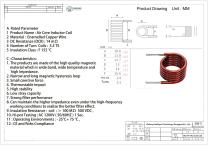
An air core inductor coil is an electronic component formed by winding enameled copper wire into a coil without magnetic core materials. It provides low-loss inductance for high-frequency applications by using air as the magnetic path, avoiding core saturation and hysteresis. Typical uses include radio communications, RF circuits, antennas, filters, oscillators, audio crossover networks and industrial electronic systems.
Product Datasheet
Item - Description
Air Core Inductor Coil - Enameled copper wire
Wire Diameter - 0.20 mm (AWG options available)
Winding Type - Single-layer round or sectional winding
Core Material - Air (non-magnetic)
Footprint Length - 15 mm
Encapsulation - Optional varnish, epoxy or coating
Mounting - Through-hole or custom
Electrical Specifications (Typical)
Inductance Range - 0.1 µH – 100 µH (customizable)
Tolerance - ±2%, ±5%, ±10%
DC Resistance (DCR) - 14 Ω (example with 5.5 turns)
Q Factor - High Q, optimized per frequency range
Self-Resonant Frequency - High (application dependent)
Operating Frequency - kHz to MHz range
Rated Current - Specified per design
Insulation Resistance - ≥100 MΩ
Working Principle
The coil operates by electromagnetic induction: current through the winding generates a magnetic field in air; changes in current induce a voltage opposing rapid variations. Inductance is defined by the number of turns, coil diameter, spacing and wire gauge.
Features
Applications
Advantages & Disadvantages
Technical Specifications
Troubleshooting Notes
Common issues include incorrect winding spacing, loose turns, overheating from excessive current or undersized wire, and EMI from nearby components. Verify winding integrity, measure inductance and resistance, check wire gauge and ventilation, and adjust mounting or spacing as required.
An air core inductor coil is an electronic component formed by winding enameled copper wire into a coil without magnetic core materials. It provides low-loss inductance for high-frequency applications by using air as the magnetic path, avoiding core saturation and hysteresis. Typical uses include radio communications, RF circuits, antennas, filters, oscillators, audio crossover networks and industrial electronic systems.
Product Datasheet
Item - Description
Air Core Inductor Coil - Enameled copper wire
Wire Diameter - 0.20 mm (AWG options available)
Winding Type - Single-layer round or sectional winding
Core Material - Air (non-magnetic)
Footprint Length - 15 mm
Encapsulation - Optional varnish, epoxy or coating
Mounting - Through-hole or custom
Electrical Specifications (Typical)
Inductance Range - 0.1 µH – 100 µH (customizable)
Tolerance - ±2%, ±5%, ±10%
DC Resistance (DCR) - 14 Ω (example with 5.5 turns)
Q Factor - High Q, optimized per frequency range
Self-Resonant Frequency - High (application dependent)
Operating Frequency - kHz to MHz range
Rated Current - Specified per design
Insulation Resistance - ≥100 MΩ
Working Principle
The coil operates by electromagnetic induction: current through the winding generates a magnetic field in air; changes in current induce a voltage opposing rapid variations. Inductance is defined by the number of turns, coil diameter, spacing and wire gauge.
Features
- Optimized for high-frequency performance
- No magnetic core saturation or hysteresis
- Low core loss and signal distortion
- Stable inductance across specified range
- Compact and lightweight
- Fast electromagnetic response
- High Q factor for RF applications
- Suitable for precise signal transmission
- Customizable size and inductance
- Good thermal stability
Applications
- RF communication equipment and antennas
- Signal filters and oscillators
- Audio crossover networks and high-end audio
- Precision measurement and medical electronics
- Industrial automation: sensing, control and filtering
- IoT modules, wireless charging and 5G components
- High-frequency converters
Advantages & Disadvantages
- Advantages: high-frequency stability, no core losses, high linearity, high Q, lightweight and easy customization
- Disadvantages: lower inductance density compared with magnetic-core inductors, potentially higher copper losses at high currents, weaker field concentration
Technical Specifications
- Material: enameled copper wire
- Wire diameter: 0.20 mm (AWG options available)
- Winding: single-layer round or sectional
- Core: air (non-magnetic)
- Footprint length: 15 mm
- Encapsulation: varnish, epoxy or coating options
- Mounting: through-hole or custom
- Inductance range: 0.1 µH – 100 µH (customizable)
- Tolerance: ±2%, ±5%, ±10%
- DC resistance example: 14 Ω (5.5 turns)
- Operating frequency: kHz to MHz
- Insulation resistance: ≥100 MΩ
- Rated current: per custom design
Troubleshooting Notes
Common issues include incorrect winding spacing, loose turns, overheating from excessive current or undersized wire, and EMI from nearby components. Verify winding integrity, measure inductance and resistance, check wire gauge and ventilation, and adjust mounting or spacing as required.
Catalogs
Other Weilong Intelligent Technology (Dongguan) Co., Ltd. products
Ferrite Coil Inductor Antenna


Related Searches
- Transformer
- Dry transformer
- Encapsulated transformer
- Power transformer
- Isolation transformer
- Transformer for industrial applications
- Compact transformer
- Choke coil
- Electrical power supply transformer
- Transformer with copper windings
- Frequency inductor
- Wire-wound inductor
- Current inductor
- Electronic transformer
- Transformer for photovoltaic applications
- DC inductor
- Magnetic inductor
- Electronic inductor
- Power inductor
- Wire-wound choke
*Prices are pre-tax. They exclude delivery charges and customs duties and do not include additional charges for installation or activation options. Prices are indicative only and may vary by country, with changes to the cost of raw materials and exchange rates.
About DirectIndustry
DirectIndustry is a marketplace that offers B2B players a complete experience, from product sourcing to purchase. DirectIndustry is an entity of VirtualExpo Group.
Are you a buyer?
Are you a supplier?
© 2026 All rights reserved - Terms - Privacy policy - General Terms - Manage cookies - 鄂ICP备2026053537号-2 -