


{{product.productLabel}} {{product.model}}
{{#if product.featureValues}}{{product.productPrice.formattedPrice}} {{#if product.productPrice.priceType === "PRICE_RANGE" }} - {{product.productPrice.formattedPriceMax}} {{/if}}
{{#each product.specData:i}}
{{name}}: {{value}}
{{#i!=(product.specData.length-1)}}
{{/end}}
{{/each}}
{{{product.idpText}}}
{{product.productLabel}} {{product.model}}
{{#if product.featureValues}}{{product.productPrice.formattedPrice}} {{#if product.productPrice.priceType === "PRICE_RANGE" }} - {{product.productPrice.formattedPriceMax}} {{/if}}
{{#each product.specData:i}}
{{name}}: {{value}}
{{#i!=(product.specData.length-1)}}
{{/end}}
{{/each}}
{{{product.idpText}}}


Power: 50 W - 750 W
... 24-bit high-resolution encoder installed High efficiency, low heat generation Downsizing by up to 20% Flange compatible with Sigma-5 Medium inertia, high speed ...
YASKAWA Europe GmbH

Power: 50 W - 7,000 W
... 24-bit high-resolution encoder installed High efficiency, low heat generation Downsizing by up to 20% Flange compatible with Sigma-5 Low inertia, high speed ...
YASKAWA Europe GmbH

Power: 450 W - 2,900 W
... 24-bit high-resolution encoder installed High efficiency, low heat generation Downsizing by up to 20% Flange compatible with Sigma-5 Medium inertia, low speed, high torque ...
YASKAWA Europe GmbH


Power: 0 W - 8.5 W
Torque: 0.0006 Nm - 0.01 Nm
Rotational speed: 7,400 rpm - 14,600 rpm
... DC-Micromotors with precious metal commutation These ironless DC motors are the most compact in the industry today and most types feature integrated high resolution encoders for use in highly precise positioning and speed control applications. The ...
FAULHABER Drive Systems

Power: 0 W - 4 W
Torque: 0.0004 Nm - 0.003 Nm
Rotational speed: 5,900 rpm - 15,500 rpm
... Flat DC-Micromotors and DC-Gearmotors Precious-metal commutated DC-Micromotors with uniquely flat coil technology with three flat, self-supporting copper windings used in the SR-Flat series form the basis for drive systems in applications where space ...
FAULHABER Drive Systems

Power: 0 W - 282 W
Torque: 0.0137 Nm
Rotational speed: 44,300 rpm
The original FAULHABER brushless DC servomotors. These ironless slotless motors are built for use in highly challenging areas of application and environmental conditions from the vacuum of space to medical device technology. They are precise, have extremely ...
FAULHABER Drive Systems


Torque: 0.19 Nm - 60 Nm
Rotational speed: 0 rpm - 7,500 rpm
Operating temperature: -10 °C - 40 °C
... Available in 40-170mm frame sizes, SMB motors use innovative salient pole technology to achieve low rotor inertias and high dynamic performance. SMB motors have resolver feedback. Product Overview The SMB series brushless servo motors have been designed ...
Parker Hannifin France SAS

Torque: 1.6 Nm - 35 Nm
Rotational speed: 1,100 rpm - 7,600 rpm
Operating temperature: -20 °C - 60 °C
... Available in 70-155mm frame sizes, EX motors feature an explosion-proof housing, making them suitable for use in explosive atmospheres. The EX series is a range of permanent magnet explosion-proof brushless servo motors designed for use in explosive ...
Parker Hannifin France SAS
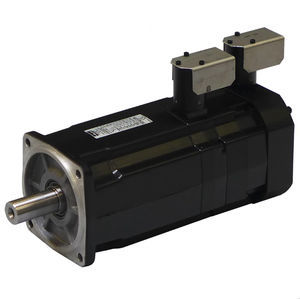
Torque: 2 Nm - 41 Nm
Rotational speed: 0 rpm - 6,800 rpm
Operating temperature: -20 °C - 60 °C
... Available in 70-155mm frame sizes, EY explosion-proof servo motors are suitable for use in explosive atmospheres in Zone 2 and for an ambiant temperature at 40°C or 60°C. Conforms with European (CE) regulation. Parker's EY series is a range of permanent ...
Parker Hannifin France SAS


Power: 750, 200, 400, 100 W
Intensity: 2.4, 3.8, 1.3, 1.4 A
Torque: 1.27, 0.64, 2.39, 0.32 Nm
... Particularly low-cost and compact AC synchronous servo motor for simple positioning tasks. • Basic series - for cost-sensitive, simple positioning tasks • A selection of 3 motor sizes in up to 2 lengths • Brushless, permanently magnetized synchronous ...

Power: 0.35 kW - 12 kW
Torque: 0.6 Nm - 93 Nm
Rotational speed: 2,700 rpm - 7,100 rpm
... The servo motor EMMT-AS for demanding and dynamic applications is characterized by very good controllability and path accuracy for positioning tasks and the space-saving single-cable solution significantly reduces installation effort. • Brushless, ...

Power: 500 W
Intensity: 9.5, 1.4, 5, 1.8 A
Torque: 0.3 Nm - 6.5 Nm
... For simple positioning applications with reduced requirements: the long-life stepper motor series with two-phase hybrid technology. • Small increments and high driving torques thanks to 2-phase hybrid technology • Optimised connection technology • ...


... Parallel-axis type helical gear reducers Features ・Low Noise & Long Life With our proven experience in low-noise design and manufacturing technologies, we have achieved low-noise, long-life gear motors. ・Compact, light weight An aluminum-frame ...
Tsubakimoto Chain
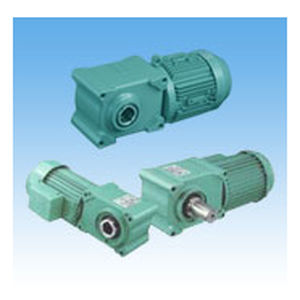
... ・High Efficiency Less sliding and greater efficiency compared to a worm gear. At the same output, there is less power consumption and greater cost effectiveness. ・Low Noise Tsubaki’s know-how in gear motor processing technology ensures low noise ...
Tsubakimoto Chain
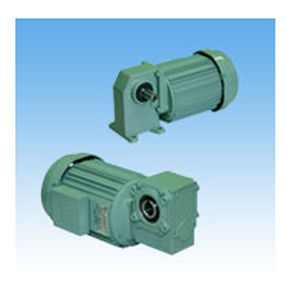
... This reducer is a right-angle worm gear reducer with a motor that offers a small footprint, lightweight design, and quiet operation. Croise Motor make use of worm gears to achieve space savings in equipment layout with right-angleshafts and high reduction ...
Tsubakimoto Chain
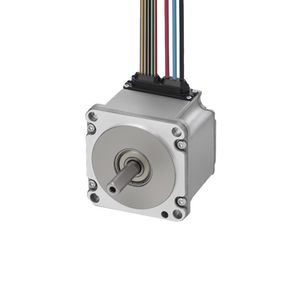

Power: 200 W
Torque: 0.6 Nm
Rotational speed: 3,200 rpm
... ● Main Applications AGVs and AMRs, Delivery Robots, Electric Wheelchairs ● Product Features - Compact & Powerful Our brushless motors generate high output for their size. Engineered to be slim, their structure provides flexible product design. - ...
Mabuchi Motor (Europe) GmbH
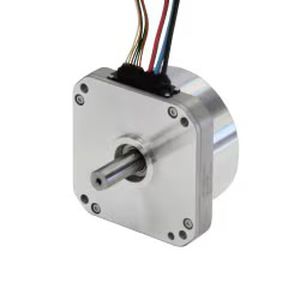
Power: 250 W
Torque: 1 Nm
Rotational speed: 2,400 rpm
... ● Main Applications AGVs and AMRs, Delivery Robots, Electric Wheelchairs ● Product Features - Compact & Powerful Our brushless motors generate high output for their size. Engineered to be slim, their structure provides flexible product design. ...
Mabuchi Motor (Europe) GmbH
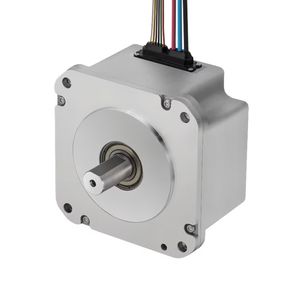
Power: 640 W
Torque: 2.3 Nm
Rotational speed: 2,660 rpm
... ● Main Applications AGVs and AMRs, Delivery Robots, Electric Wheelchairs ● Product Features - Compact & Powerful Our brushless motors generate high output for their size. Engineered to be slim, their structure provides flexible product design. ...
Mabuchi Motor (Europe) GmbH
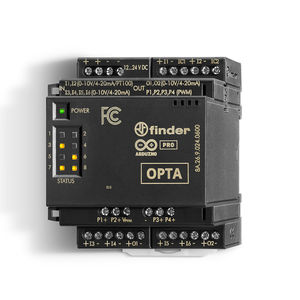

... OPTA module expansion Type 8A.26.9.024.0600, analog version. Connection to OPTA and to the other modules via the AUX auxiliary port. Technical features: 6 analog (0… 10 V, 4…20 mA, PT 100) inputs 2 analog (0… 10 V, 4…20 mA) outputs 4 PWM outputs Nominal ...
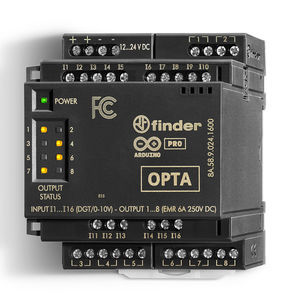
... OPTA EMR module expansion Type 8A.58.9.024.1600, digital version. Connection to OPTA via the AUX auxiliary port. Technical features: 16 digital/analog (0…10 V) inputs 8 EMR 6 A outputs Nominal voltage 12…24 V DC ...
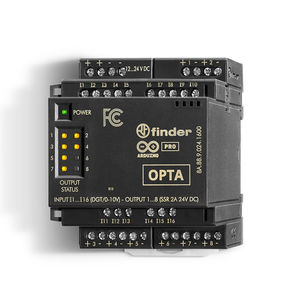
... OPTA SSR module expansion Type 8A.88.9.024.1600, digital version. Connection to OPTA and to the other modules via the AUX auxiliary port. Technical features: 16 digital/analog (0…10 V) inputs 8 SSR 3 A outputs Nominal voltage 12…24 V DC ...


Intensity: 0.3 A
Torque: 0.005 Nm
Rotational speed: 0 rpm - 2,100 rpm
... Size 6 [14mm] Hybrid Rotary Stepper Motor The size 6 [14mm] which is smallest hybrid rotary stepper motor from DINGS has Max. 0.01Nm of holding torque. Material End bell : Aluminum alloy Bearing : Deep groove ball bearing Magnet : Sintered NdFeB Shaft ...
Jiangsu DINGS' Intelligent Control Technology

Intensity: 0.5 A
Torque: 0.02, 0.012 Nm
Rotational speed: 0 rpm - 2,100 rpm
... The size 8 [20mm] Hybrid Rotary Stepper Motor has Max. 0.02Nm of holding torque. Encoders and 22mm frame planetary gearbox solutions are available. For special windings or customization, Please contact DINGS' for further information Material End ...
Jiangsu DINGS' Intelligent Control Technology

Intensity: 1 A
Torque: 0.1, 0.14, 0.06 Nm
Rotational speed: 0 rpm - 1,500 rpm
... The size 11 [28mm] Hybrid Rotary Stepper Motor has Max. 0.14Nm of holding torque. Encoders and 28mm frame planetary gearbox solutions are available. For special windings or customization, Please contact DINGS' for further information. Material End ...
Jiangsu DINGS' Intelligent Control Technology


... The EZ-ZONE® RM expansion module offers wide variety of input with other input and output options and numerous function blocks for customizing to your application. This module is part of the extremely flexible and scalable EZ-ZONE RM controller family ...
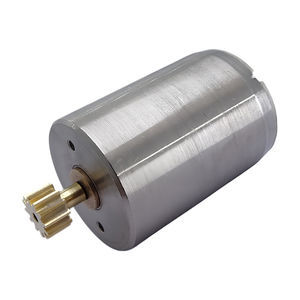

Power: 4.35 W
Intensity: 50 mA
Torque: 0.0256 Nm
... Product overview
The A22C series are coreless motors (outer diameter φ22 mm) from C.I. TAKIRON, offered in multiple sub-models optimized for various voltages, lengths and performance points. Typical applications cited for the A22C series include ...
C.I. Takiron
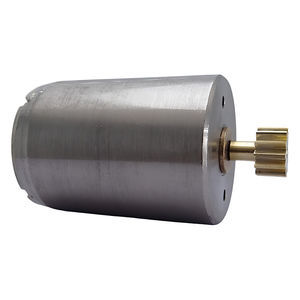
Power: 9.97 W
Intensity: 20, 1,700 mA
Torque: 0.0317 Nm
... Product Overview
The A22C series are coreless motors with an outer diameter of φ22 mm. The series includes multiple sub-models optimized for different voltages, torques and applications. Product pages include detailed specifications, outline ...
C.I. Takiron
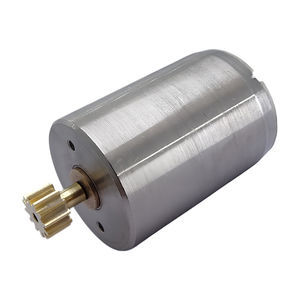
Power: 4.81 W
Intensity: 3,550, 25 mA
Torque: 0.021 Nm
... Overview
A22C series coreless motors (outer diameter φ22 mm) by C.I. TAKIRON. The A22C family includes multiple sub-models used in applications such as surveying instruments and high-pressure nailers (examples: A22C-12, A22C-24). Outline drawings ...
C.I. Takiron


... Provides additional safety outputs for a primary safety device Offers four normally open (NO) safety outputs Provides delayed or immediate outputs, depending on model Offers choice of 24V dc or 24V ac/dc supply voltage, depending on ...


Power: 0.22 kW - 10.76 kW
Torque: 0.64 Nm - 85 Nm
Rotational speed: 6,000, 4,000, 3,000, 2,000 rpm
... High Dynamic AC Brushless Servo Motor Unimotor hd is a high dynamic brushless AC servo motor range designed for use in pulse duty applications where rapid acceleration and deceleration are required. The motors are available in frame sizes from 060 ...


Operating temperature: 5 °C - 45 °C
TiMOTION’s TGM1 series gear motor was designed primarily for ergonomic applications like height adjustable workstations and tables, but can be used in many other applications. This economical product allows for fast, smooth and quiet adjustment of built-in ...
TiMOTION Europe

The TGM2 series is TiMOTION’s most powerful gear motor. It was designed primarily for ergonomic applications like height adjustable workstations and tables, but can be used in many other applications. This economical product allows for fast, smooth and ...
TiMOTION Europe

Operating temperature: 5 °C - 45 °C
The TGM3 series is TiMOTION's compact size gear motor. It was designed primarily for ergonomic applications like height adjustable workstations and tables, but can be used in many other applications. This economical product allows for fast, smooth and ...
TiMOTION Europe
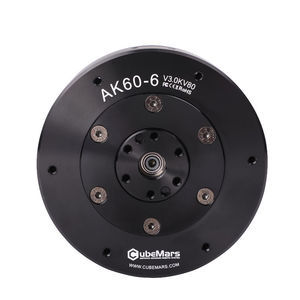

Power: 60 kW - 125 kW
Intensity: 3.8 A
Torque: 3 Nm
... • Upgraded Gear and Driver • Small and easy to control • Highly Integrated with encoder and driver • Ideal for Foot Robots, Exoskeleton Robots, AGV The AK60-6 actuator integrates a high-performance brushless DC motor, a self-developed planetary ...
CubeMars
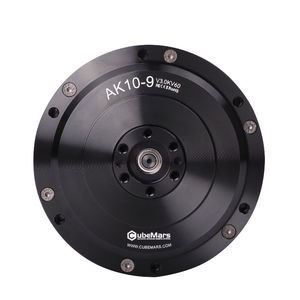
Gear ratio: 9 unit
Operating temperature: -20 °C - 50 °C
... • Highly integrated • MIT power and servo control modes • Input & output dual encoders The AK10-9 V3.0 actuator integrates a high-performance brushless DC motor, a self-developed planetary reducer, an encoder, and an integrated drive, enabling ...
CubeMars
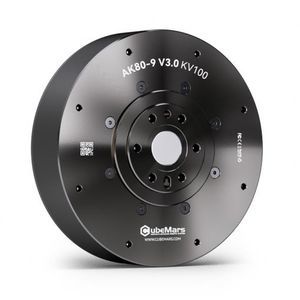
Gear ratio: 9 unit
Operating temperature: -20 °C - 50 °C
... • Highly integrated power module • Supports both Servo and MIT modes • Peak torque: 22Nm The AK80-9 power module is a highly integrated solution that combines a high-performance brushless motor, planetary gearbox, and driver into one, enabling high-torque ...
CubeMars


Power: 0.1 kW - 7.5 kW
Intensity: 10.9 A - 17 A
Torque: 28.01 Nm - 47.75 Nm
... V7U Series Servo Motor Overview VEICHI V7U Series Servo Motor is used together with the newly upgraded SD700 servo drive. Excellent performance design enables our motors to be widely used in various industrial fields, such as machine tools, the packaging ...
SUZHOU VEICHI Electric Co., Ltd.

Power: 0.1 kW - 250 kW
Torque: 0.32 Nm - 47.7 Nm
Rotational speed: 1,500 rpm - 3,000 rpm
... VM7 Series Servo Motor Overview VEICHI VM7 Series Servo Motor is used together with the newly upgraded SD700 servo driver. Excellent performance design enables our motors to be widely used in various industrial fields, such as machine tools, packaging ...
SUZHOU VEICHI Electric Co., Ltd.

Power: 200 W - 7,500 W
Intensity: 1.1 A - 69 A
Torque: 0.32 Nm - 47.8 Nm
... V9E Series Servo Motor Overview VEICHI V9E series general servo motor is one of VEICHI new generation general servo motor series, widely used in semiconductors, industrial robots, auto production lines, precise machine tools. Product Features 1. ...
SUZHOU VEICHI Electric Co., Ltd.

Torque: 0 Nm - 100 Nm
1. Continuous rotation of "0" cogging torque makes the control more accurate and the operation more stable. The design of non cogging structure overcomes the change of magnetic resistance caused by magnetic pole and the torque fluctuation caused by the ...
Guangzhou Haozhi Industrial Co., Ltd
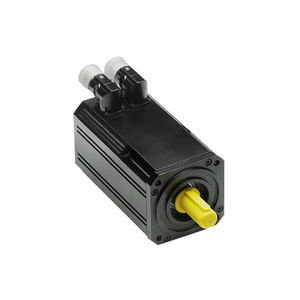
Torque: 0.25 Nm - 75 Nm
The modular construction concept is ideal for a wide range of standard models. The slotless stator design gives this range outstanding properties: high speeds, high torques, insignificant torque ripples, excellent efficiency and increased rigidity. This ...
Guangzhou Haozhi Industrial Co., Ltd
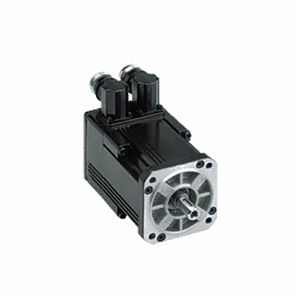
Torque: 0.3 Nm - 78 Nm
This family offers the user a wide range of standard motors. The excellent torque / inertia-ratio gives these motors an extremely high acceleration capability.
Guangzhou Haozhi Industrial Co., Ltd


... Expansion module of the modular safety relay myPNOZ, inputs: 6 for monitoring of 2-hand monitoring Type IIIC to EN 574 and another safety function (1/2-channel wiring with/without detection of shorts across contacts) AND-linked, width: 12.5mm General ...
PILZ

Expansion module of the modular safety relay myPNOZ, outputs: 3 n/o safe delay-on de-energisation switching relay contacts (t=0-300s), 1 signal output in semiconductor technology, inputs: 2 for monitoring 1 safety function: 1/2-channel wiring with/without ...
PILZ
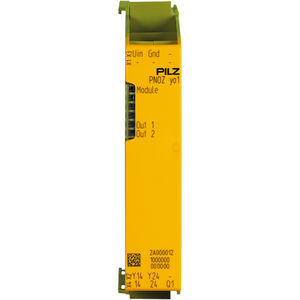
... Expansion module of the modular safety relay myPNOZ, outputs: 2 safe instantaneous switching semiconductor outputs, 1 signal output in semiconductor technology, width: 17.5mm General data Approval - CE CCC UKCA cULus Listed TÜV EAC ...
PILZ


Torque: 0.3 Nm - 140 Nm
... Closed Loop Stepper Motor Driver Combination for AC and DC Power Supply Features Absolute sensor, position monitoring No external sensors necessary Low heat generation EtherCAT, EtherNet/IP, Profinet, Modbus RTU Frame size dimension: 20 - ...
Oriental Motor

... Closed Loop Stepper Motor Driver Combination for AC and DC Power Supply AZ Series Connector Type Features Absolute sensor, position monitoring No external sensors necessary Low heat generation EtherCAT, EtherNet/IP, Profinet, Modbus RTU Frame size ...
Oriental Motor

... Closed Loop Stepper Motor Driver Combination for AC and DC Power Supply AZ Series Connector Type with Gear Features Absolute sensor, position monitoring No external sensors necessary Low heat generation EtherCAT, EtherNet/IP, Profinet, Modbus ...
Oriental Motor


... Expander module for contact expansion 4 safety contacts, STOP 0 1 Signalling output ...

... Expander module for contact expansion 4 safety contacts, STOP 0 2 Signalling outputs ...


Power: 100 W - 5,500 W
Torque: 0.318 Nm - 52.9 Nm
Rotational speed: 3,000, 5,000, 6,000, 2,000 rpm
With the help of AC Servo Motors the functionality of positioners can be increased and furthermore additional applications are possible. A flexible solution from Panasonic! The AC-Servo Motors are free programmable and help improve synchronism with robots, ...


... • Extremely high system efficiency • Compact wash-down design • Maintenance reduction • System solution for simple commissioning and plug & play DuoDrive is a revolutionary integrated gear unit/motor concept in hygienic wash-down design. It combines ...
Getriebebau NORD GmbH & Co. KG

Gear ratio: 1.35 unit - 14,340.31 unit
... Functionality with tradition NORD Helical Gear Units have been produced according to the tried and tested UNICASE principle since the 1980s and are characterised by low maintenance and a long service life Version • Solid shaft gear units • Foot or flange ...
Getriebebau NORD GmbH & Co. KG

Gear ratio: 1.07 unit - 456.77 unit
The NORDBLOC.1 Helical Gear Unit with its smooth surface is an innovative drive solution for all applications where cleanliness is essential. These innovative and patented gear units do not have any installation openings. This increases the stability ...
Getriebebau NORD GmbH & Co. KG


Power: 2, 1 W
Torque: 0.001 Nm - 0.0022 Nm
Rotational speed: 11,400 rpm - 13,000 rpm
... Maxon DCX motors boasts a high power density considering its torque per volume rating. Its strong structure, together with the internationally-renowned patented ironless winding, makes it an ideal drive for every application situation. The DCX 10 L ...
maxon

Power: 1 W
Torque: 0.00089 Nm - 0.00094 Nm
Rotational speed: 12,500 rpm - 13,000 rpm
... Maxon DCX motors boasts a high power density considering its torque per volume rating. Its strong structure, together with the internationally-renowned patented ironless winding, makes it an ideal drive for every application situation. The DCX 10 L also ...
maxon

Power: 3 W
Torque: 0.00288 Nm - 0.00418 Nm
Rotational speed: 8,800 rpm - 8,820 rpm
maxon DCX motors feature unrivaled power density (torque per volume) and absolutely quiet running. The robust engineering, combined with the globally patented ironless winding, makes the DCX motors a highly dynamic drive for almost every application scenario. ...
maxon
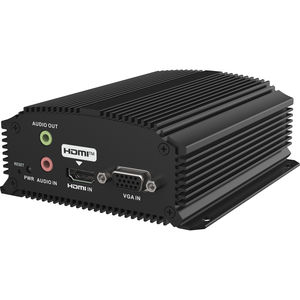

... H.265 encoding formats available; independent configuration of encoding formats for main stream and substream 1-ch HDMI or VGA video input and 2-ch HDMI video loop output provided Encoding at 4K resolution of 4K/2K/1080p/UXGA/720p, etc. Restoration ...


Power: 775 W - 11,700 W
Torque: 4.5 Nm - 510 Nm
Rotational speed: 2,500 rpm
Our exclusive Cartridge DDR® servo motors combine the performance advantages of a frameless motor with the ease of installation of a full-frame motor. They feature an integrated, factory-aligned high resolution feedback device and a unique bearingless ...
Kollmorgen Europe GmbH


Power: 50 W - 15,000 W
Torque: 0.16 Nm - 95.5 Nm
Rotational speed: 1,000, 1,500, 2,000, 3,000 rpm
Accurax G5 servomotors include IP67 protection and connectors on the motor body. Use of 10 pole motors and 20 bit encoder results in 40% reduction in motor cogging. The servomotors are 25% lighter and 15% smaller due to patented new stator design PAC-Clamp, ...
Omron Electronics GmbH