


Multi-function network controller netX 50multi-protocol2 portdata transmission

Add to favorites
Compare this product
Characteristics
- Other characteristics
- 2 port, with integrated I/O, multi-function, multi-protocol, data transmission, RISC
Description
Overview
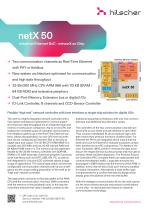
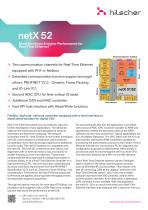
The netX 50 is an integrated network controller designed for industrial communication, supporting fieldbus and Real-Time Ethernet applications. It can operate as a companion chip to a host CPU via an integrated dual-port memory or as a stand‑alone solution with digital I/Os. The device embeds a 32-bit ARM 966E-S CPU (200 MHz) with 112 KB RAM and 64 KB ROM; external memory expansion is possible via the 32-bit memory controller (SDRAM, SRAM, FLASH). Extensive peripherals and serial interfaces (UART, USB, SPI, I²C) plus integrated IO‑Link and CCD controller increase application flexibility.
Highlights
Protocols supported
Order information
Product name | Part number | Brief description
NETX 50 | 2230.000 | Network controller for fieldbus slave and Real‑Time Ethernet slave with memory controller
Technical specifications
The netX 50 is an integrated network controller designed for industrial communication, supporting fieldbus and Real-Time Ethernet applications. It can operate as a companion chip to a host CPU via an integrated dual-port memory or as a stand‑alone solution with digital I/Os. The device embeds a 32-bit ARM 966E-S CPU (200 MHz) with 112 KB RAM and 64 KB ROM; external memory expansion is possible via the 32-bit memory controller (SDRAM, SRAM, FLASH). Extensive peripherals and serial interfaces (UART, USB, SPI, I²C) plus integrated IO‑Link and CCD controller increase application flexibility.
Highlights
- Flexible high-end network controller with host interface or stand‑alone digital I/O mode
- Two communication channels for Real‑Time Ethernet or fieldbus with integrated PHYs
- Integrated dual‑port memory, extension bus option and triple‑buffer/DMA support for high throughput
Protocols supported
- VARAN Client
- Sercos Slave
- PROFINET IO‑Device
- PROFIBUS DP Slave
- POWERLINK Controlled Node
- Open Modbus/TCP Server
- Open Modbus/TCP Client
- EtherNet/IP Adapter
- EtherCAT Slave
- DeviceNet Slave
- CC‑Link Slave
- CANopen Slave
Order information
Product name | Part number | Brief description
NETX 50 | 2230.000 | Network controller for fieldbus slave and Real‑Time Ethernet slave with memory controller
Technical specifications
- CPU: ARM 966E‑S, 32‑bit, 200 MHz
- Internal memory: 112 KByte RAM, 64 KByte ROM
- Integrated dual‑port memory for host communication and status
- Memory controller: 32‑bit, supports external SDRAM, SRAM, FLASH
- Central data switch with five data paths connecting ARM, communication, host and DMA controllers
- Two configurable communication channels with two‑level controller structure (dedicated ALUs + microcode‑driven logic)
- Integrated Ethernet PHYs (reduces external ethernet circuitry to passive components)
- xMAC (Medium Access Controller) and xPEC (Protocol Execution Controller) for low‑level bus access and packet control
- DMA‑supported block transfers and optional triple buffer logic for conflict‑free data exchange
- Peripherals: UART, USB, SPI, I²C; integrated IO‑Link controller and CCD controller
Exhibitions
Meet this supplier at the following exhibition(s):


Other Hilscher products
Multiprotocol SoCs & Stacks


*Prices are pre-tax. They exclude delivery charges and customs duties and do not include additional charges for installation or activation options. Prices are indicative only and may vary by country, with changes to the cost of raw materials and exchange rates.
About DirectIndustry
DirectIndustry is a marketplace that offers B2B players a complete experience, from product sourcing to purchase. DirectIndustry is an entity of VirtualExpo Group.
Are you a buyer?
Are you a supplier?