

- Health - Safety - Environment
- Waste Treatment
- Double shaft shredder
- Liantai Machinery


- Company
- Products
- Catalogs
- News & Trends
- Exhibitions
Double shaft shredder D seriesmetalfor woodfor electronics scrap


Add to favorites
Compare this product
Characteristics
- Number of shafts
- double shaft
- Application
- metal, for wood, for electronics scrap, plastic, for medical waste, for waste, for drums, pallet, tire
- Other characteristics
- high-torque
Description
Product overview
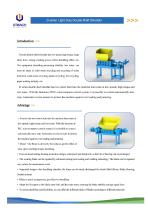
D series Double Shaft Shredder from United Tech Machinery is designed for a wide range of industrial applications. It shreds solid materials — e-waste, metal, wood, plastic, tires, pallets and bulky or contaminated items — to increase bulk density and reduce transport costs. The unit uses two low-speed, high-torque rotors and a PLC microcomputer control system with automatic start/stop and automatic reverse sensors for overload and jam protection.
Advantages
Cutting tools / Blade information
Blade type and geometry determine output particle size and characteristics.
Applications
Specification / Notes
Technical specifications
D series Double Shaft Shredder from United Tech Machinery is designed for a wide range of industrial applications. It shreds solid materials — e-waste, metal, wood, plastic, tires, pallets and bulky or contaminated items — to increase bulk density and reduce transport costs. The unit uses two low-speed, high-torque rotors and a PLC microcomputer control system with automatic start/stop and automatic reverse sensors for overload and jam protection.
Advantages
- Motor and rotor driven via reducer for low-speed, high-torque shredding.
- Sixfold enclosed bearing seals for waterproof and dustproof protection to extend bearing life.
- Repairable, reusable blades using advanced coating and welding to lower maintenance costs.
- Separated shredding chamber design allows full-shaft discharge (rotor, blade, bearing, sealing system) for maintenance.
- Spiral blade arrangement for consistent and effective shredding.
- Hexagon fit between blade inner hole and main rotor for blade stability and even force distribution.
- Multiple blade types available to match input material and required durability.
Cutting tools / Blade information
Blade type and geometry determine output particle size and characteristics.
- Rotor blade thickness affects particle width — thinner blades produce narrower particles.
- Distance or number of rotor blade tips affects particle length — closer spacing or more blades produce shorter particles.
Applications
- Metals: aluminum parts, motor housings, oil drums, vehicle scrap, ferrous waste, steel plates.
- Waste tires: passenger, truck and OTR tires.
- Plastics: drums, packaging cases, pallets, cans.
- Waste treatment: medical, hazardous, industrial and kitchen waste; animal carcasses.
- Electronic waste: refrigerators, TVs, washing machines, other e-waste.
- Secure disposal: hard drives, expired food, paper, medicines.
Specification / Notes
- Power supply voltage selectable per customer requirements.
- Shredding capacity depends on material composition and requested output size.
- Specifications are for reference and may change without prior notice.
Technical specifications
- Brand: United Tech Machinery (D series)
- Machine type: Medium double-shaft shredder with two rotors
- Drive: Motor + rotor via reducer for low speed, high torque
- Control: PLC microcomputer control with automatic start/stop and automatic reverse sensors
- Bearing protection: Sixfold enclosed sealing — waterproof and dustproof
- Blade: Repairable, reusable blades with advanced coating/welding; multiple blade types/options
- Blade arrangement: Spiral arrangement; hexagon inner-hole fit for blade stability
- Chamber design: Separated shredding chamber enabling discharge of whole shaft (rotor, blade, bearing, sealing system)
- Typical feed materials: e-waste, metal, wood, plastic, tires, pallets, barrels, bulky/contaminated materials
- Noise/performance: Designed for low noise, high-torque operation
VIDEO
Catalogs


Other Liantai Machinery products
Shredder


Related Searches
- Grinding mill
- Crushing plant
- Solid classifier
- Baler
- Stationary crushing and screening plant
- Waste shredding machine
- Mobile crushing and screening plant
- Pelletizer
- Eddy current separator
- Horizontal grinding mill
- Primary shredding machine
- Single shaft shredding machine
- Impact crushing and screening plant
- Vertical grinding mill
- Jaw crushing and screening plant
- Two shaft shredder
- High-capacity crushing plant
- Process classifier
- Wood shredding machine
- Recycling plant
*Prices are pre-tax. They exclude delivery charges and customs duties and do not include additional charges for installation or activation options. Prices are indicative only and may vary by country, with changes to the cost of raw materials and exchange rates.
About DirectIndustry
DirectIndustry is a marketplace that offers B2B players a complete experience, from product sourcing to purchase. DirectIndustry is an entity of VirtualExpo Group.
Are you a buyer?
Are you a supplier?