


- Detection - Measurement
- Optical and Acoustic Measurements
- Electronic vibration sensor
- SHENZHEN RION TECHNOLOGY CO.,LTD
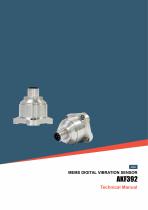
Electronic vibration sensor AKF392MEMScapacitivefor machine monitoring

Add to favorites
Compare this product
Characteristics
- Technology
- electronic, MEMS, capacitive
- Applications
- for machine monitoring, for machine condition monitoring, for preventive maintenance, for automotive applications, for railway applications, for heavy machinery, for vibration meter, for wind turbine
- Other characteristics
- compact, robust, high-precision, 3-axis, digital, with temperature sensor
- Frequency
Min.: 5 Hz
Max.: 1,000 Hz
Description
Product description
The AKF392 family is a three-axis MEMS digital vibration sensor series developed with Swiss-patented technology. The sensors provide digital outputs (RS232 / RS485 / TTL), configurable address codes and the ability to chain multiple units for long-distance multi-point measurement and centralized data analysis. Each sensor integrates a single-crystal silicon capacitive MEMS chip, a low-power ASIC for signal conditioning, a microcontroller for compensation storage and an internal temperature sensor. The device offers low power consumption, factory calibration, solid mechanical design and full protections including solid-state reset power and over-current protection. Scale factor long-term stability and bias typical values are below 0.1% across the full range, ensuring reliable outputs for industrial monitoring applications.
Key features
Scope of application
Parameters
Model family: AKF392 (example variant: AKF392T)
Ranges: ±2 g | ±4 g | ±8 g | ±10 g | ±20 g | ±40 g
Bias calibration: <1 mg (all ranges)
Axes: X, Y, Z (triaxial)
Power on/off repeatability: <2 mg (max)
Temperature coefficient of bias: 0.01 %/°C (typical)
Resolution / threshold (@1 Hz): <1 mg (max)
Nonlinearity: <0.5% / <0.8% / <1% FS (depending on range)
Bandwidth (3 dB): 500 Hz
Cross-axis sensitivity: 1% / 2% (depends on range)
Lateral vibration sensitivity ratio: 1% / 2% / 5% (depends on range)
Noise density: 21 μg/√Hz or 86.6 μg/√Hz (depending on range)
Resonance frequency: 2.4 kHz or 5.5 kHz (depending on range)
Output rates: 68-protocol: 5–1000 Hz selectable; MODBUS: 10/25/50 Hz
Output interfaces & protocols: RS232 / RS485 / TTL — Rion 68 protocol and Modbus RTU
Reliability: MIL-HDBK-217 Grade 2
Shock resistance: 100 g @ 11 ms (half sinusoid, 3 axes)
Recovery time: <1 ms (example: 1000 g, 1/2 sin 1 ms on one axis)
Vibration tolerance: 20 g RMS, 20–2000 Hz (per axis, 30 min random)
Supply: 9–36 VDC; current <60 mA @12 VDC
Connector: M12 industry standard
Weight: sensor 82 g; magnetic base 48 g; L-adapter 20 g
Dimensions: sensor 34.3 × 34.3 × 38.5 mm; magnetic base 34.23 × 34.23 × 6 mm; L-adapter 36 × 44 × 15 mm
Technical specifications
The AKF392 family is a three-axis MEMS digital vibration sensor series developed with Swiss-patented technology. The sensors provide digital outputs (RS232 / RS485 / TTL), configurable address codes and the ability to chain multiple units for long-distance multi-point measurement and centralized data analysis. Each sensor integrates a single-crystal silicon capacitive MEMS chip, a low-power ASIC for signal conditioning, a microcontroller for compensation storage and an internal temperature sensor. The device offers low power consumption, factory calibration, solid mechanical design and full protections including solid-state reset power and over-current protection. Scale factor long-term stability and bias typical values are below 0.1% across the full range, ensuring reliable outputs for industrial monitoring applications.
Key features
- Three-axis measurement: X, Y, Z
- Digital outputs: RS232 / RS485 / TTL
- Supply voltage: 9–36 VDC, current <60 mA @12 V
- Selectable measurement ranges: ±2, ±4, ±8, ±10, ±20, ±40 g
- Bandwidth (3 dB): 500 Hz
- Shock & impact resistance up to specified limits (short shocks up to 2000 g noted)
- Operating temperature: -40°C to +85°C
- Industry-standard M12 connector; compact 34.3 × 34.3 × 38.5 mm housing
Scope of application
- Crash recording, fatigue monitoring and prediction
- Wind-turbine monitoring and condition assessment
- Traffic infrastructure monitoring, railway subgrade analysis and high-speed rail fault detection
- Large rotating machinery and engine monitoring
- Low-frequency vibration and automated monitoring systems
- Medical devices monitoring
- Bridge structural health monitoring
- Vehicle (automotive) vibration monitoring
- Roller and rotating equipment monitoring
Parameters
Model family: AKF392 (example variant: AKF392T)
Ranges: ±2 g | ±4 g | ±8 g | ±10 g | ±20 g | ±40 g
Bias calibration: <1 mg (all ranges)
Axes: X, Y, Z (triaxial)
Power on/off repeatability: <2 mg (max)
Temperature coefficient of bias: 0.01 %/°C (typical)
Resolution / threshold (@1 Hz): <1 mg (max)
Nonlinearity: <0.5% / <0.8% / <1% FS (depending on range)
Bandwidth (3 dB): 500 Hz
Cross-axis sensitivity: 1% / 2% (depends on range)
Lateral vibration sensitivity ratio: 1% / 2% / 5% (depends on range)
Noise density: 21 μg/√Hz or 86.6 μg/√Hz (depending on range)
Resonance frequency: 2.4 kHz or 5.5 kHz (depending on range)
Output rates: 68-protocol: 5–1000 Hz selectable; MODBUS: 10/25/50 Hz
Output interfaces & protocols: RS232 / RS485 / TTL — Rion 68 protocol and Modbus RTU
Reliability: MIL-HDBK-217 Grade 2
Shock resistance: 100 g @ 11 ms (half sinusoid, 3 axes)
Recovery time: <1 ms (example: 1000 g, 1/2 sin 1 ms on one axis)
Vibration tolerance: 20 g RMS, 20–2000 Hz (per axis, 30 min random)
Supply: 9–36 VDC; current <60 mA @12 VDC
Connector: M12 industry standard
Weight: sensor 82 g; magnetic base 48 g; L-adapter 20 g
Dimensions: sensor 34.3 × 34.3 × 38.5 mm; magnetic base 34.23 × 34.23 × 6 mm; L-adapter 36 × 44 × 15 mm
Technical specifications
- Sensor type: single-crystal silicon capacitive MEMS accelerometer (digital)
- Measurement axes: triaxial X, Y, Z
- Selectable full-scale ranges to ±40 g
- Bandwidth: 500 Hz (3 dB)
- Resonance frequency: ~2.4 kHz (low ranges) / ~5.5 kHz (high ranges)
- Noise density and resolution suitable for low-frequency monitoring
- Digital communication: Rion 68 protocol and Modbus RTU over RS232/RS485/TTL
- Robust mechanical housing, factory-calibrated for industrial monitoring
Catalogs
Exhibitions
Meet this supplier at the following exhibition(s):

Other SHENZHEN RION TECHNOLOGY CO.,LTD products
Vibration Sensor


Related Searches
- RION vibration sensor
- RION machine monitoring vibration sensor
- RION robust vibration sensor
- Compact vibration sensor
- General purpose vibration sensor
- RION high-precision vibration sensor
- RION preventive maintenance vibration sensor
- RION MEMS vibration sensor
- Vibration sensor with temperature measurement
- Electronic vibration sensor
- RION 3-axis vibration sensor
- RION vibration sensor for automotive applications
- Process monitoring vibration sensor
- RION waterproof vibration sensor
- Magnetic vibration sensor
- RION vibration sensor for railway applications
- Mechanical vibration sensor
- RION wind turbine vibration sensor
- RION heavy machinery vibration sensor
- RION vibration meter vibration sensor
*Prices are pre-tax. They exclude delivery charges and customs duties and do not include additional charges for installation or activation options. Prices are indicative only and may vary by country, with changes to the cost of raw materials and exchange rates.
About DirectIndustry
DirectIndustry is a marketplace that offers B2B players a complete experience, from product sourcing to purchase. DirectIndustry is an entity of VirtualExpo Group.
Are you a buyer?
Are you a supplier?