



- Company
- Products
- Catalogs
- News & Trends
- Exhibitions
Electric vehicle charger module TH20T10025C7E-WTEVDC


Add to favorites
Compare this product
Characteristics
- Applications
- for electric vehicles, EV
- Specifications
- DC
- Power
20 kW
(27.2 hp)
Description
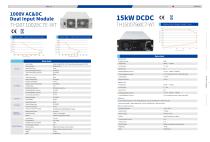
Product introductionTH20T10025C7E-WT is a high-efficiency, high power density charging module developed by Tonhe Technology for mobile battery cabinets. The product supports AC and DC dual-input mode, combining battery charging from the grid and vehicle charging from the battery. It complies with State Grid three-unified-module size requirements.
Product overview
Technical DataModel No: TH20T10025C7E-WT
AC input - Input voltage: Rated 380VAC, three-phase without neutral, operating range 274–487VAC
AC input - Input frequency: 50/60 ±5Hz
AC input - Input power factor: ≥0.99
AC input - Input overvoltage protection: 490 ±10VAC
AC input - Input undervoltage protection: 270 ±10VAC
DC output - Rated output power: 20kW
DC output - Output voltage range: 50–1000VDC
DC output - Output current range: 0.5–67A
DC output - Constant power range: 300–1000VDC constant 20kW output
Output featuresPeak efficiency: ≥96%
Soft start time: 3–8 s
Short circuit protection: self-recovery protection
Voltage regulation accuracy: ≤ ±0.5%
THD: ≤5%
Current regulation accuracy: ≤ ±1%
Current sharing imbalance: ≤ ±5%
Operating environmentOperating temperature: -40℃ to +75℃
Relative humidity: ≤95% (no condensation)
Altitude: ≤2000m (derating above 2000m)
Product featuresCooling method: fan cooling
Standby power consumption: <10W
Communication protocol: CAN (baud rate 125 kbps, physical level 5V)
Address setting: digital screen and key operation
Module dimension (without handle): 460 × 218 × 84 mm (L × W × H)
Weight: ≤13 kg
MTBF: 500,000 hours
Manufacturing & TestAutomated production lines and full manufacturing/testing process for smart EV charging modules. Development and production use SMT, automatic solder paste printing, wave soldering, potting and aging tests. EMC laboratory and test facilities available including semi-anechoic chamber and high-performance power analyzers for charger testing.
WarrantyStandard warranty: 12 months from receipt of shipment.
Technical specifications
Product overview
- AC and DC dual-input mode
- Designed for mobile battery cabinet applications
- High efficiency and high power density; State Grid three-unified form factor
Technical DataModel No: TH20T10025C7E-WT
AC input - Input voltage: Rated 380VAC, three-phase without neutral, operating range 274–487VAC
AC input - Input frequency: 50/60 ±5Hz
AC input - Input power factor: ≥0.99
AC input - Input overvoltage protection: 490 ±10VAC
AC input - Input undervoltage protection: 270 ±10VAC
DC output - Rated output power: 20kW
DC output - Output voltage range: 50–1000VDC
DC output - Output current range: 0.5–67A
DC output - Constant power range: 300–1000VDC constant 20kW output
Output featuresPeak efficiency: ≥96%
Soft start time: 3–8 s
Short circuit protection: self-recovery protection
Voltage regulation accuracy: ≤ ±0.5%
THD: ≤5%
Current regulation accuracy: ≤ ±1%
Current sharing imbalance: ≤ ±5%
Operating environmentOperating temperature: -40℃ to +75℃
Relative humidity: ≤95% (no condensation)
Altitude: ≤2000m (derating above 2000m)
Product featuresCooling method: fan cooling
Standby power consumption: <10W
Communication protocol: CAN (baud rate 125 kbps, physical level 5V)
Address setting: digital screen and key operation
Module dimension (without handle): 460 × 218 × 84 mm (L × W × H)
Weight: ≤13 kg
MTBF: 500,000 hours
Manufacturing & TestAutomated production lines and full manufacturing/testing process for smart EV charging modules. Development and production use SMT, automatic solder paste printing, wave soldering, potting and aging tests. EMC laboratory and test facilities available including semi-anechoic chamber and high-performance power analyzers for charger testing.
WarrantyStandard warranty: 12 months from receipt of shipment.
Technical specifications
- Model: TH20T10025C7E-WT
- Brand: Tonhe
- Rated output power: 20 kW
- Output voltage range: 50–1000 VDC
- Output current range: 0.5–67 A
- Peak efficiency: ≥96%
- Input voltage (AC): Rated 380 VAC, three-phase, operating range 274–487 VAC
- Input frequency: 50/60 ±5 Hz
- Input power factor: ≥0.99
- Voltage regulation accuracy: ≤ ±0.5%
- Current regulation accuracy: ≤ ±1%
- THD: ≤5%
- Cooling method: fan cooling
- Standby power: < 10 W
- Dimensions (L×W×H): 460 × 218 × 84 mm (without handle)
- Weight: ≤13 kg
- MTBF: 500,000 hours
- Operating temperature: -40℃ to +75℃
- Relative humidity: ≤95% (no condensation)
- Altitude: ≤2000 m (derating above 2000 m)
- Communication: CAN (125 kbps, 5 V)
VIDEO
Other Tonhe Technology products
20kW EV Charging Module


Related Searches
- Tonhe Technology power module
- Tonhe Technology charger module
- Tonhe Technology ACDC power module
- Tonhe Technology electric vehicle charger module
- Converter module
- BiDi ACDC power module
- Tonhe Technology SiC power module
- Tonhe Technology DC charger module
- Tonhe Technology digital power module
- Tonhe Technology DC power module
- Tonhe Technology full SiC power module
- DC fast charger module
- AC power module
- BiDi DCDC power module
- Digital converter module
- DCDC power module
*Prices are pre-tax. They exclude delivery charges and customs duties and do not include additional charges for installation or activation options. Prices are indicative only and may vary by country, with changes to the cost of raw materials and exchange rates.
About DirectIndustry
DirectIndustry is a marketplace that offers B2B players a complete experience, from product sourcing to purchase. DirectIndustry is an entity of VirtualExpo Group.
Are you a buyer?
Are you a supplier?