

- Materials - Tools - Components
- Semi-finished products
- Ceramic tube
- Xiamen Innovacera Advanced Materials Co., Ltd

- Company
- Products
- Catalogs
- News & Trends
- Exhibitions
Ceramic tube Mg-PSZringaluminazirconia

Add to favorites
Compare this product
Characteristics
- Shape
- tube, ring
- Composition
- alumina, zirconia
- Other characteristics
- insulation, high-temperature
Description
Magnesium-zirconium ceramic parts are the main components of tundishes in the steel and metallurgical industry. The tundish is primarily used in the steel metallurgical process as a key component of the continuous casting process. Its main function is to store and distribute molten steel, ensuring a continuous and stable flow from the ladle to the mold.
Main Components of a Tundish
- Tundish Body — The main structure that holds molten steel, typically consisting of a refractory lining and a steel shell.
- Lining — Includes the working layer in direct contact with molten steel and the permanent layer for thermal insulation. Commonly made from refractory bricks, castables, or spray coatings.
- Stopper Rod — A critical part for controlling the molten steel flow rate and regulating the steel level in the crystallizer.
- Submerged Entry Nozzle (SEN) — Introduces molten steel into the crystallizer while preventing oxidation and splashing.
- Sliding Gate System — Precisely controls the molten steel flow rate, consisting of upper and lower slides and a drive mechanism.
- Impact Pad — Reduces impact force during molten steel injection and prevents lining erosion.
- Weirs & Dams — Optimize the molten steel flow path and promote the flotation and separation of inclusions.
- Tundish Flux / Powder — Prevents oxidation of molten steel and helps retain heat.
Magnesium-Stabilized Zirconia (Mg-PSZ) Ceramic Parts in Tundishes
Magnesium oxide partially stabilized zirconia (Mg-PSZ) ceramics offer excellent corrosion resistance, outstanding thermal shock resistance, and stability at high temperatures, making them suitable for the following critical tundish components:
- Shroud Nozzle (SEN) — Requires resistance to molten steel erosion and thermal shock. Mg-PSZ significantly extends service life.
- Stopper Rod Tip — Directly contacts molten steel and must be resistant to high-temperature erosion. Mg-PSZ enhances corrosion resistance.
- Sliding Gate Plates — Mg-PSZ provides superior wear and thermal shock resistance against molten steel erosion and mechanical wear.
- Impact Pads — Mg-PSZ is effective in high-erosion areas, extending operational life.
Advantages of Magnesium-Stabilized Zirconia (Mg-PSZ) Ceramics
- High-temperature resistance (up to 2000 °C)
- Excellent thermal shock resistance (withstanding severe temperature fluctuations during continuous casting)
- Superior resistance to molten steel and slag erosion (superior to alumina and mullite)
These unique features make Mg-PSZ ceramics an ideal material for key refractory components in tundishes, particularly in the continuous casting of high-end steel grades.
- Tags: continuous casting materials, Magnesia-stabilized zirconia ceramics, steelmaking tundish parts, tundish refractory components
Technical Specifications / Features:
- Main material: Magnesium oxide partially stabilized zirconia (Mg-PSZ)
- Applications: Tundish components (Shroud Nozzle, Stopper Rod Tip, Sliding Gate Plates, Impact Pads)
- Properties: High-temperature resistance (up to 2000°C), excellent thermal shock resistance, superior corrosion and erosion resistance
Catalogs
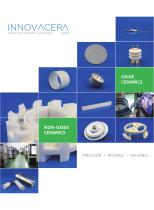

Other Xiamen Innovacera Advanced Materials Co., Ltd products
Zirconia Ceramic


Related Searches
- Ceramic
- Insulation ceramic
- Alumina ceramic
- Ceramic plate
- Tubular ceramic
- High-temperature ceramic
- Substrate
- Ceramic ring
- Ceramic rod
- Refractory material
- Zirconia ceramic
- Ceramic substrate
- Wear-resistant ceramic
- Metal powder
- Ceramic disk
- Aluminum nitride substrate
- Protective ceramic
- Ceramic sheet
- Substrate for the electronics industry
- Cylindrical ceramic
*Prices are pre-tax. They exclude delivery charges and customs duties and do not include additional charges for installation or activation options. Prices are indicative only and may vary by country, with changes to the cost of raw materials and exchange rates.