|
|
Introduction
The IMC-101G industrial Gigabit media converters are designed to provide reliable and stable 10/100/1000BaseT(X) to 1000BaseSX/LX/LHX/ZX media conversion in harsh industrial environments. The IMC-101G's industrial design is excellent for keeping your industrial automation applications running continuously, and each IMC-101G converter comes with a relay output warning alarm to help prevent damage and loss. All IMC-101G models are subjected to a 100% burn-in test, and are available in models that support a standard operating temperature range of 0 to 60°C, and an extended operating temperature range of -40 to 75°C.
Features
• 10/100/1000BaseT(X) and 1000BaseSX/LX/LHX/ZX supported
• Link Fault Pass-Through (LFP)
• Power failure, port break alarm by relay output
• Redundant power input
• -40 to 75°C operating temperature range (T models)
• Designed for hazardous locations
|
|
|
|
|
|
PerkinElmer’s new Fiber Optic Module has been designed for OEM fiber illumination applications. The module uses an LED light source designed to couple high intensity white light into fiber optic bundles for applications including medical endoscopy,microscopy and machine vision. It offers an energy-efficient, maintenance-free alternative to halogen-based and metal-halide fiber optic illuminators. The LED source is comprised of high power white LEDs, patent-pending optics to precisely couple light into fiber and a heat sink. It has been designed to couple light into 3-10 mm fiber; the light is easily adaptable to a broad range of fiber manufacturers and sizes. Light intensity control electronics are available as an option.
The LED light module delivers a high intensity homogenous spot from the distal end of the fiber bundle. The new module offers a low heat, and low voltage alternative to 150-Watt halogen-based fiber illuminators. In contrast to halogen bulbs, the color temperature of LED light does not change when the light is dimmed or as the bulb ages, resulting in a consistent visual appearance.
|
|
|
Toshiba is one of the top photocoupler suppliers in the world. We have the broadest product line-up with various output types such as Transistor, Triac, Thyristor, MOSFET (a.k.a. photorelays) and ICs, to meet different applications and customer's requirements. Toshiba introduced the LEDIP package, which has been popular in the industry. Also, the well-known white mold technology introduced by Toshiba achieves a high level of optical coupling efficiency. Toshiba is working on developing a variety of packages, functions and efficient production processes to offer the best line-up in the industry. One of the latest packages pioneered by Toshiba is Shrink Dual Inline Package (SDIP). Furthermore, Toshiba has been introducing many new products into the line-up of IC couplers, expanding the product portfolio of high-speed signal driver couplers and highly integrated power device driver couplers.
|
|
TAOS Inc’s Light-to-Voltage (LTV) solutions combine a photodiode and transimpedance amplifier on a single monolithic IC. The LTV family provides a linear analog voltage output that is proportional to light intensity which is normally fed to an ADC for digital processing. This output can be connected directly to an ADC for digital processing, a comparator for thresholding or other analog circuitry for filtering or further processing.
The devices cover a wide range of speed and responsivity options across different spectral responses to span a variety of applications to measure ambient light, light absorption or reflection, and as an infrared data receiver in light controls, printers, light curtains or remote controllers. A summation CHART is avaialble fo
|
|
The coupler is a component of each connector system.
All OSI components are exclusively equipped with qualified brand couplers. This ensures a optimum combination with the used connector types and guaranties the specified characteristics.
|
|
|
|
|
|
These electronic devices, photoelectric sensors or photocells, use the light emission principle combined with the electronic and are made up
of an emitter or luminous source, the light rays of which are detected by a receiver. The variation in luminous signal, obtained when interrupting this ray, is converted into an electrical signal and is measured and used by
an electrical circuit. The light used is either infrared or red. By making use of this light various type of photoelectric sensors can be made. The AECO photoelectric sensors available in the FOTOSTAR range are the FT18M - FT18 -FTQ series in direct reflection, with reflector with polarized light and emitter-receiver versions. Due to their flexibility regarding the various
standard programmable versions these products offer the possibility of stocking reduction and are easily interchangeable with most of the units available on the market. They are used in the field of automation to check for the presence, counting, position control, etc., and they
are compatible with most logic programmers.
|
|
Description
New, small Opto-Coupler generation according EN50020. The potted Opto-Couplers are perfectly suitable for the galvanic separation of intrinsically safe and non- intrinsically safe circuits. Transistor technology guarantees clearly defined, clean switching status; with transmission frequencies up to 50kHz - universally applicable. The maximum peak voltage for electric circuits amounts to ` ia` 375 V. They are approved according to ATEX and DIN EN 50020.
|
|
Optocouplers - Hermetic
Avago Technologies has supplied high reliability hermetic optocoupler products since 1975 for use in state-of-the-art applications. These devices are capable of operation over the full military temperature range of -55 degrees C and +125 degrees C. All products are manufactured and tested on a MIL-PRF-38534 certified line and are included in the DSCC (Defense Supply Center Columbus) Qualified Manufacturers List QML-38534 for Hybrid Microcircuits. All hermetic optocouplers are available under DSCC Standard Microcircuit Drawings (SMD) Class H, suitable for military applications and most are available as Class K for space applications. A commercial version for harsh industrial use is also available on all products. Avago Technologies continuity and support of the industry has remained stable with zero product obsolescence.
|
|
|
|
|
|
Description:
The OPIA series optocouplers are designed for applications that use an analog output (Phototransistor or Photo Darlington) in a dual-in-line package. A wide selection of configurations are available. With typical isolation voltage of 2,500 or 5,000 Volts RMS, these product meet typical power system isolation requirements. Theory of operation: The LED transmitter is used to illuminate the Photosensor providing electrical isolation between two power systems while maintaining the ability to transmit information from one power system to the other. In many applications, analog signal levels may be required to be transmitted between two power systems while maintaining isolation between the power systems up to 5,000 volts RMS. A variety of LED and photosensor configurations are available depending on the system requirements
Features:
- 2,500 to 5,000 Vrms electrical isolation
- Choice of a Single and Dual LED
- Phototransistor or Photo Darlington Sensor
- Low-cost plastic Dual-In-Line (DIP) package
|
|
Part Number: KB827-B
GENERAL PURPOSE
HIGH ISOLATION VOLTAGE
SINGLE TRANSISTOR TYPE
PHOTOCOUPLER SERIES
FEATURES
1.Lead forming (gull wing) type, for surface mounting.
2.High isolation voltage between input and output (Viso=5000 Vrms).
3.Compact dual-in-line package
KB827-B: 2-channel type.
4.Recognized by UL and CUL, file NO.E225308.
5.Approved by VDE 0884 Teil2(NO:40006364)
(Creepage distance between input and output:7mm or more).
6.RoHS Compliant.
APPLICATIONS
1.Computer terminals.
2.Registers,copiers,automatic vending machines.
3.System appliances, measuring instruments.
4.Programmable logic controller.
5.Signal transmission between circuits of different potentials and impedances.
|
|
|
|
|
|
DESCRIPTION
The PS9587, PS9587L1, PS9587L2 and PS9587L3 are optically coupled isolators containing a GaAlAs LED on the input side and a photo diode and a signal processing circuit on the output side on one chip.
The PS9587L1 and PS9587L2 are designed specifically for long creepage-distance as well as high common mode transient immunity (CMR) and high speed digital output type. Consequently, they are suitable for high speed logic interface that needs long creepage-distance (8 mm) on mounting.
The PS9587L1 is lead bending type for long creepage distance.
The PS9587L2 is lead bending type for long creepage distance (Gull-wing) for surface mount.
The PS9587L3 is lead bending type (Gull-wing) for surface mounting.
FEATURES
- Long creepage distance (8 mm MIN.: PS9587L1, PS9587L2)
- High common mode transient immunity (CMH, CML = ±15 kV/µs MIN.)
- High isolation voltage (BV = 5 000 Vr.m.s.)
- High-speed response (10 Mbps)
- Pulse width distortion (%u23D0tPHL %u2212 tPLH%u23D0 = 10 ns TYP.)
- Open collector output
- Ordering number of tape product: PS9587L2-E3: 1 000 pcs/reel
: PS9587L3-E3: 1 000 pcs/reel
- Pb-Free product
- Safety standards
- UL approved: File No. E72422
- CSA approved: No. CA 101391
- BSI approved: No. 8937, 8938
- SEMKO approved: No. 615433
- NEMKO approved: No. P06207243
- DEMKO approved: No. 314091
- FIMKO approved: No. FI 22827
- DIN EN60747-5-2 (VDE0884 Part2) approved (Option)
APPLICATIONS
- FA Network
- Measurement equipment
- PDP
|
|
Relays and Optos
Relays and optos are produced in different shapes and forms - from terminal enclosures to plug-in bases that can be fitted on the mounting rail. Their purpose is to switch, amplify and multiply digital signals in automation technology.
In electrical engineering, switching means opening and closing electric circuits. The switch receives the information as a command from the control circuit. Switching can be carried out by contactors, relays, switches and buttons or via a contactless set-up using semiconductor relays and optos.
With relays, semiconductor relays and optos, the advantages of modern relay and semiconductor technology can be used. Thanks to their compact design, they can be integrated into control concepts for the mounting rail even when space is tight.
|
|
Terminal optocoupler MIRO 6.2 MIRO 6.2 pluggable
Optocouplers AMMS EMMS AMMDS AMMDU
AMS Transistor, switched positive to 4 A
Optocouplers for pole changing switch MIRO 12.4 DC - MOTOR CONTROL
Accessories
|
|
|
These high-speed photodetectors were designed to offer the ideal combination of high-speed performance (up to 25 GHz) and optical-input flexibility. They show flat response in both amplitude and phase up to 25 GHz and are optimized for frequency-domain applications.
|
|
Description
FC series detectors are made through coupling InGaAs PIN photodiodes with FC connection using lenses. FC series detectors have high response within 1.0~1.65µm and the whole response spectral be extend to 0.65~1.65µm due to the optimized diode structure. Internal optical attenuator is used for measure higher optical power. The maximum of detectable optical power can get to 25dBm and 30dBm, respectively.
FC series are mostly applied for optical measurement. User can select appropriate units according to needed wavelength and linear range.
Features
* High Response within 1.0~1.65µm
* Low Dark Current
* Planar Structure
* Broad Spectral Response Range (0.65~1.65µm)
* Broad Dynamic Range
* High Reliability
* FC Connection, Firm Coaxial Package
Applications
* Optical Measurement
* Optical Detection
* Online Measuring of Optical Fiber Cable
* Output Test for Optical Amplifier
* Data Transmission
|
|
RMT offers coordinated pairs (solid state light emitter and photodetector) suitable for application in non-dispersive infra-red (NDIR) gas analyzers and optical sensors.
The pairs consist of high effective photodetector and special solid state pulsed light emitter.
The spectral responses of the photodetector and light emitter are coordinated for effective operation at absorption lines of measuring gases.
Additional built-in narrow band filters integrated onto photodetector (or/and light emitter) provide high selectivity of measuring schemes.
Standard options of the optopairs are suitable for analyzing of CO2 (carbon dioxide), CH4 (methane), hydrocarbons mixtures.
|
|
|
|
|
|
|
HAMAMATSU realized MSM (Metal-Semiconductor-Metal) photodetector having ultrafast response. The GaAs MSM Photodetector G4176 features 30 ps response time for both rise and fall while keeping a low dark current (100 pA at Ta-25 °C). The rise time of the InGaAs MSM Photodetector G7096 is 40ps. Symmetrical and interdigital Schottky contacts are fabricated at the sensitive area, whose size can be larger than other kinds of fast response photodetectors. This makes easier to set up with optics. Therefore, MSM photodetectors are suited for measurements of optical high-speed waveform and optical communications. There is no electrical polarity in MSM photodetectirs, that is, both polarities of a bias voltage are available, and the polarity of an output signal depends on its connection. Two kinds of packages are prepared for each MSM photodetector. The package of G4176 & G7096 is a coaxial metal type (patent : Japan 2070802), which is easy to connect with an electrical SMA-connector. That of G4176-01 & G7096-01 is a TO-18, which is very common. An optical fiber or connector input types are available as a custom option. Contact your local representative for more information.
|
|
Various packages available:
- SFH 5110: IR remote control receiver (30, 33, 36, 38, 40kHz)
- SFH 5140 F: Schmitt-Trigger IC in Miniature Sidelooker Package with Lens
- SFH 5410: IR remote control receiver (36 and 38kHz)
- SFH 5440: Schmitt-Trigger IC in Smart DIL Package
- SFH 5840: Schmitt-Trigger IC in TO-18 Package with Glass Lens
- SFH 5711: High accuracy Ambient Light Sensor in SMT Chipled
|
|
|
Toshiba photosensors and photointerrupters are widely used in the market today. The advanced Toshiba packaging technology allows the company to introduce compact devices, which are popular in the consumer electronics product market. Toshiba is among the pioneers in introducing illuminance sensors (a.k.a. ambient light sensors). These light sensors are now used in many mobile devices such as cell phones and other consumer electronic products.
|
|
|
|
|
|
The TSL2561 is a light-to-digital converter that transform light intensity to a digital signal output capable of direct I2C (TSL2561) interface. Each device combines one broadband photodiode (visible plus infrared) and one infrared-responding photodiode on a single CMOS integrated circuit capable of providing a near-photopic response over an effective 20-bit dynamic range (16-bit resolution). Two integrating ADCs convert the photodiode currents to a digital output that represents the irradiance measured on each channel. This digital output can be input to a microprocessor where illuminance (ambient light level) in lux is derived using an empirical formula to approximate the human eye response. The TSL2561 device supports a traditional level style interrupt that remains asserted until the firmware clears it.
* Approximates Human Eye Response
* Programmable Interrupt Function with User-Defined Upper and Lower Threshold Settings
* 16-Bit Digital Output with I2C Fast-Mode at 400 kHz
* Programmable Analog Gain and Integration Time Supporting 1,000,000-to-1 Dynamic Range
* Automatically Rejects 50/60-Hz Lighting Ripple
* Low Active Power (0.75 mW Typical) with Power Down Mode
* RoHS Compliant
|
|
|
TAOS Inc’s Light - to- Digital Converters combine a broadband photodiode (350 nm to 1100 nm) with a visible light blocking photodiode in a single CMOS integrated circuit. With integrated analog-to-digital conversion circuitry, data is output via a serial interface using two standard protocols: SMBus and I2C.
|
|
|
The LTF sensor performs the functions of light sensing, signal conditioning, and A/D conversion in a single monolithic IC. The LTF device converts light intensity to a digital format for a direct interface to a microcontroller. The output of this device is a square wave or pulse train whose frequency is linearly proportional to light intensity and features a dynamic range of 120dB.
|
|
|
|
|
|
The TSL237 light-to-frequency converter combines a silicon photodiode and a current-to-frequency converter on a single monolithic CMOS integrated circuit. The output is a square wave (50% duty cycle) with frequency directly proportional to light intensity. Because it is TTL compatible, the output allows direct interface to a microcontroller or other logic circuitry. The TSL237 has been temperature compensated for the ultraviolet-to-visible range of 320 nm to 700 nm and responds over the light range of 320 nm to 1050 nm. The device is characterized for operation over the temperature range of -25 degrees C to 70 degrees C and supplied in a 3-lead clear plastic side-looker package with an integral lens
* High-Resolution Conversion of Light Intensity to Frequency With No External Components
* Communicates Directly With a Microcontroller
* High Irradiance Responsivity (2.3 kHz/(uW/cm²) at 524 nm)
* Low Dark Frequency (<2 Hz at 50° C)
* Single-Supply Operation (2.7V to 5.5V)
* Stable 200 ppm/°C Temperature Coefficient
* RoHS Compliant (-LF Package Only)
|
|
Sculpted Silica Fiber Tips
- Beam Shaping
- Energy Coupling
- Integrated Features
Shape - Use or Characteristic
1. Minifying Taper - decollimator
2. Threaded Diffuser - light diffuser
3. Cone Tip - concentrator - radiator
4. Minifier Combined with Sphere - focusing or collimating
5. Magnifier End - collimator
6. Integral Sperical Lens End - focusing
7. Side-fire Laser End Tip - right angle "soft beam"
8. Focused Taper - high energy laser beam insertion
9. Integral Positive Lens
10. Integral Negative Lens
Note: Output beam profile dependent on input characteristics.
Dimensions are typical of silica optical fiber dimensions. Diameters range up to approximately 2mm. The illustrations are not to exact scale.
|
|
|
|
|
|
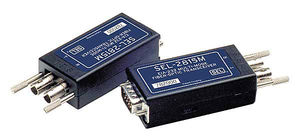
Fiber Optic Converters
Extend Communications Up to 9 Miles!
Any two pieces of asynchronous serial equipment can communicate at half or full duplex over two fibers at rates up to 460 kbps for RS-422/485 or 115.2 kbps for RS-232 with a pair of these converters. Fiber lines are inherently resistant to EMI/RFI and transient surges, so they are ideal for data communications near heavy electrical equipment and other electrical or radio interference.
Standards can be mixed and matched so RS-232 devices can be connected to RS-422/485 devices, replacing a converter and isolator. When working with RS-485 signals, B&B Electronics’ Automatic Send Data control eliminates the need for driver software. Serial connections are on terminal blocks; multimode fiber side has two ST connectors. Requires external power supply not included.
General Features
FOSTCDRi-SC extends communication up to 9 miles
Wide temperature ranges (-40 to 80º C)
Extend signal up to 2.5 miles
Modbus ASCII or RTU compatible
Automatic Send Data control
EMI/RFI and transient Immunity
DIN rail mount
CE approved
Premium model - FOSTCDRi - features include 10-48 VDC operation, triple isolation, 2000V input/output power supply, UL Class 1 Div 2 approval, CSA approval, CE approved.
Standard model - FOSTCDR - features include 10-30 VDC operation, 2-way isolation, 2000V input/output, CE approved
|
|
High-Power Detector
Durable
Energy mode
Smart Interface
Full NIST-Traceability
Personal Wavelength Correction™
Highest Damage Threshold: 100 kW/cm²
New Disk Technology with the Best Absorber
Effective aperture diameter 17mm (area 2.27m²)
11PMK-W5 power detectors surface absorber stands up to average power densities of 100 kW/cm². That is the best in the world for average power density. 11PMK-W5 high-power detectors come ready to mount on a rod, a bracket and the square case even lets you set them right on the optical table.
These 11PMK series detectors are the best choice for any high average power density application. With Energy Mode option every member of 11PMK-H5 family can be equipped to measure single shot pulse energies as well as average power. From 450 mJ up to 6 J Q-switched or 600 J long pulse.
11PMK-W5 family is compatible with Standa 11Uno standalone power meter and 11P-Link PC based power meter.
|
|
| ... products without technical information |
| |
|
|