

- Metrology - Laboratory
- Analytical Instrumentation
- Electrical network analyzer
- Wuhan UHV Power Technology Co.,Ltd.


- Products
- Catalogs
- News & Trends
- Exhibitions
Frequency response analyzer UHV-310for electrical networksfor testingportable


Add to favorites
Compare this product
Characteristics
- Application domain
- for electrical networks, for testing
- Measured value
- frequency response
- Configuration
- portable
- Mode of use
- automatic
- Other characteristics
- digital, data acquisition, computer-controlled, wireless, dual-channel, Bluetooth, notebook-controlled
Description
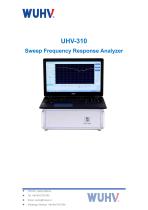
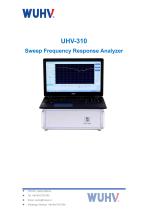
The UHV-310 SFRA Sweep Frequency Response Analyzer is a transformer winding tester composed of a main host and a laptop, designed to detect internal winding faults using Frequency Response Analysis (FRA) with linear and segmented sweep capability up to 1 MHz.
Product Introduction
The UHV-310 Sweep Frequency Response Analyzer measures characteristic parameters of internal transformer windings and applies FRA to accurately identify winding deformation, bulging, displacement, tilting, inter-turn shorts and inter-phase faults. It is suited to field and laboratory inspections and integrates laptop-based software with automated report generation.
Technical Features of Transformer Winding Deformation Tester
Technical Parameters / Specifications
Documentation
Experimental Procedures and Precautions of SFRA Test Set
What scenarios are necessary for Sweep Frequency Response Analyzer?
Product Introduction
The UHV-310 Sweep Frequency Response Analyzer measures characteristic parameters of internal transformer windings and applies FRA to accurately identify winding deformation, bulging, displacement, tilting, inter-turn shorts and inter-phase faults. It is suited to field and laboratory inspections and integrates laptop-based software with automated report generation.
Technical Features of Transformer Winding Deformation Tester
- High-speed, highly integrated microprocessor for precise data acquisition and instrument control.
- Direct USB interface for wired data transfer to a laptop.
- Bluetooth wireless connectivity for data exchange during field operations.
- Advanced DDS digital frequency-sweep technology for accurate diagnosis of winding distortion, bulging, displacement, tilting, inter-turn short circuits and inter-phase faults.
- Dual-channel 16-bit A/D acquisition with high-resolution dB measurement for improved signal accuracy.
- Software-adjustable output amplitude with peak output up to 10 V.
- Automated reporting: system generates test reports in electronic Word format.
- High measurement repeatability: in-phase test repeatability exceeds 99.5% for the same winding phase.
- PCB surface treatments for resistance to moisture and corrosive gases.
- Flexible measurement modes: supports linear and segmented sweep modes compatible with mainstream technical methodologies.
- Display options for linear and logarithmic frequency axes to comply with national amplitude-frequency reporting standards.
Technical Parameters / Specifications
- Linear frequency sweep measurement range: (1 kHz) (1 MHz)
- Segmented sweep frequency measurement range: (0.5 kHz) (1 MHz), divided into segments:
- (0.5 kHz) (10 kHz)
- (10 kHz) (100 kHz)
- (100 kHz) (500 kHz)
- (500 kHz) (1000 kHz)
- Amplitude range: (-100 dB) (+20 dB)
- Amplitude accuracy: +20 dB -60 dB: ±1 dB; -60 dB -100 dB: ±2 dB
- Sweep accuracy: 0.01%
- Signal input impedance: 1 MΩ
- Signal output impedance: 50 Ω
- In-phase test repetition rate: 99.5%
- Instrument dimensions: 300 × 340 × 120 mm3
- Aluminum alloy packaging box dimensions: 310 × 400 × 330 mm3
- Weight: 10 kg
Documentation
- System generates electronic Word test reports automatically; user manual and calibration certificate available in PDF on request.
Experimental Procedures and Precautions of SFRA Test Set
- 1. Firstly, check if the grounding condition of the transformer is good, and all bushing leads should be disconnected.
- 2. Record in detail the nameplate data of the test sample and whether there are any abnormalities in the original working conditions, as well as the position of the tap changer of the test sample transformer under the current testing condition, and carefully input the test sample situation registration window.
- 3. Reminder: After the transformer is powered off, first short-circuit all the sleeves to the ground and fully discharge them. The preferred transformer test item is the transformer winding deformation frequency response method test, which aims to avoid saturation of the transformer core caused by other tests with DC signals (such as DC resistance test).
- 4. Eliminate interference from radio waves and spatial electric fields by grounding and shielding interference signals at the corresponding measurement endpoints.
- 5. Establish a sub directory of the test sample data file based on the condition of the test sample; After the test is completed, the measured data should be backed up to this directory and attention should be paid to organizing the work.
- 6. Data storage format: Files are stored in ASCII code format, and users can use various text editing software to read and modify them.
- 7. Measure the transformer that has just been taken out of operation, and try to dissipate heat and cool it down as much as possible before measurement; However, during the entire measurement process, the cooling measures should be stopped and the temperature should be maintained to avoid excessive temperature changes that may affect the consistency of the measurement results.
What scenarios are necessary for Sweep Frequency Response Analyzer?
- Handover acceptance test: After transportation and before installation of the new transformer, confirm that the winding status is consistent with that of the factory.
- After a short circuit fault: immediately detect and quickly determine whether power can be forcefully supplied or whether it needs to be returned to the factory for repair.
- Regular preventive testing: As the preferred means of monitoring winding deformation, it replaces the traditional reactance method.
- Retirement appraisal: providing data support for the extension or scrapping of transformers.
VIDEO
Catalogs
Other Wuhan UHV Power Technology Co.,Ltd. products
Transformer Tester


Related Searches
- Gas analyser
- Concentration analyser
- Monitoring analyser
- Liquids analyser
- Automated analyzer
- Desktop analyzer
- Process analyser
- Portable analyser
- Continuous analyser
- Water analyser
- Real-time analyser
- Laboratory analyser
- Compact analyser
- Digital analyser
- Calibration analyser
- Temperature analyser
- Chromatography system
- Power quality analyser
- Sampling analyser
- Control analyser
*Prices are pre-tax. They exclude delivery charges and customs duties and do not include additional charges for installation or activation options. Prices are indicative only and may vary by country, with changes to the cost of raw materials and exchange rates.
About DirectIndustry
DirectIndustry is a marketplace that offers B2B players a complete experience, from product sourcing to purchase. DirectIndustry is an entity of VirtualExpo Group.
Are you a buyer?
Are you a supplier?