

- Metrology - Laboratory
- Metrology and Test Equipment
- Tangent delta test system
- Wuhan UHV Power Technology Co.,Ltd.


- Products
- Catalogs
- News & Trends
- Exhibitions
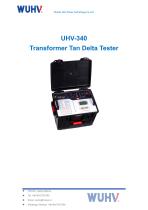
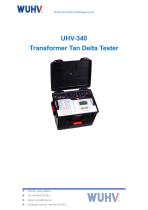
Tangent delta test system UHV-340for research and developmentlaboratoryfor the electronics industry


Add to favorites
Compare this product
Characteristics
- Test type
- tangent delta
- Domain
- laboratory, for the electronics industry, for power transformers, for research and development
- Applications
- for transformers
- Configuration
- on site
- Other characteristics
- automatic, precision, high-voltage
Description
Overview to Transformer Tan Delta Tester
The UHV-340 Transformer Tan Delta Tester is a fully automatic, high-precision instrument for measuring dielectric loss tangent (tgδ) and capacitance (Cx) of transformers and other high-voltage equipment in power plants and substations. The Transformer Tan Delta Tester employs frequency-conversion anti-interference technology and advanced digital analysis to maintain accuracy in strong electric-field environments.
Key features of Transformer Capacitance & Tan Delta Tester
Technical parameters / Specifications
Application field of Tan Delta Tester
Instrument Maintenance Regulations of Tan Delta Test Set
What are the advantages of variable frequency testing compared with power frequency testing?
The UHV-340 Transformer Tan Delta Tester is a fully automatic, high-precision instrument for measuring dielectric loss tangent (tgδ) and capacitance (Cx) of transformers and other high-voltage equipment in power plants and substations. The Transformer Tan Delta Tester employs frequency-conversion anti-interference technology and advanced digital analysis to maintain accuracy in strong electric-field environments.
Key features of Transformer Capacitance & Tan Delta Tester
- Frequency-conversion anti-interference: stable measurements even under up to 200% interference for reliable on-site testing.
- High-precision measurement: frequency floating, digital waveform analysis and bridge self-calibration with a high-precision three-end standard capacitor; consistent forward/reverse connection results.
- All-range input resistance < 2 Ω to negate additional test-line capacitance effects.
- Supports external oil-cup connection for insulating-oil tan-delta tests and solid-material electrodes for solid insulation tests.
- Automatic system-frequency identification (50 Hz / 60 Hz) and generator compatibility; operates with significant frequency fluctuations.
- Built-in series and parallel dielectric-loss models for calibration-platform compatibility and instrument verification.
- Multiple safety protections: high-voltage, low-voltage, grounding and CVT protection limits; no 10 kV output during improper CVT measurement.
- Automatic voltage-tracking to compensate for voltage rise when testing large-capacity objects (anti "capacitance rise").
- Seismic-resistant design for long-distance transport; high-voltage insulated cable included.
- External standard-capacitor interface; automatic tracking of external test power frequency (40 Hz–70 Hz); supports frequency and series-resonant power supplies for large-capacity HV tests.
- Circuit contact bad-discharge prompt for easier wiring identification; optional thermal printer; onboard calendar/clock and storage for up to 100 measurement groups.
Technical parameters / Specifications
- High-voltage output: 0.5–10 kV, 500 V steps (20 levels); capacity: 1500 VA.
- Accuracy: tgδ: ±(reading × 1.5% + 0.06%); Cx: ±(reading × 1.5% + 5 pF).
- Resolution: tgδ: 0.001%; Cx: 0.001 pF.
- Measuring range: tgδ: 0.001%–100%.
- Internal HV capacitance range: 3 pF–60000 pF / 10 kV; 60 pF–1 µF / 0.5 kV.
- External HV capacitance range: 3 pF–1.5 µF / 10 kV; 60 pF–30 µF / 0.5 kV.
- CVT variable-ratio test: variation accuracy ±(reading × 1%); range 10–99,999; phase accuracy ±0.1°; phase range 0–359.9°.
- Power supply: AC 220 V ±10%, 50/60 ±1 Hz.
- Measuring methods: single-frequency modes (45/50/55/60/65 Hz) and different-frequency automatic conversion modes (50D: 45Hz/55Hz; 60D: 55Hz/65Hz).
- Harmonic adaptability: ≤ 3%.
- Operating ambient temperature: -15 ℃–50 ℃; relative humidity < 80%.
- Dimensions: 460 × 345 × 345 mm3; weight: 35 kg.
Application field of Tan Delta Tester
- 1. Power industry
- Power plants and substations: In power plants and substations, the inter frequency dielectric loss tester is mainly used to test the high-precision measurement of dielectric loss tangent and capacitance of various high-voltage power equipment. Its integrated structure and built-in components such as dielectric loss testing bridge, variable frequency voltage regulating power supply, step-up transformer, and SF6 high stability standard capacitor make the testing process more accurate and efficient.
- 2. Research institutions
- Research on High Voltage Electrical Equipment: The inter frequency dielectric loss tester is suitable for measuring the TG δ and capacitance of high-voltage electrical equipment in workshops, laboratories, and research institutions. Its multiple testing modes (such as internal high voltage, external high voltage, internal standard, external standard, positive connection method, reverse connection method, etc.) can meet different testing needs.
- 3. In the field of electronic manufacturing
- Electronic device design and production: In the design and production process of electronic devices, the inter frequency dielectric loss tester can measure the dielectric loss at different frequencies to obtain the loss characteristics of the dielectric at different frequencies. This has a significant impact on the working state and performance of the circuit.
- 4. Insulation material testing
- Insulation oil test: Equipped with an insulation oil cup and a high-frequency dielectric loss tester, it can test the dielectric loss of insulation oil. It is more sensitive to detecting distributed defects such as overall moisture and aging of insulation or air gap discharge defects in insulation.
Instrument Maintenance Regulations of Tan Delta Test Set
- 1. Cleaning of instruments
- When the instrument is turned off or powered off, gently wipe the surface of the instrument with a soft cloth or tissue to prevent moisture and impurities from entering.
- 2. Storage of instruments
- When the instrument is not in use for a long time, it should be stored in a dry and well ventilated environment.
- Avoid prolonged exposure of the instrument to high temperature, high humidity, or corrosive gases.
- 3. Regular calibration and maintenance
- The accuracy and performance of the instrument may decrease over time, and it is recommended to calibrate and maintain it regularly.
- It is recommended to calibrate the instrument once a year or every two years based on usage frequency and environment.
What are the advantages of variable frequency testing compared with power frequency testing?
- Variable frequency testing effectively suppresses 50Hz power frequency interference through frequency conversion and digital filtering technology. This allows more accurate and reliable measurements, especially in substations and other environments with strong electromagnetic interference.
VIDEO
Other Wuhan UHV Power Technology Co.,Ltd. products
Transformer Tester


Related Searches
- Measuring device
- Test stand
- Portable testing system
- Digital testing system
- Automatic test stand
- Automatic testing system
- Industrial testing system
- Automatic test equipment
- Portable measuring device
- Voltage testing system
- Benchtop testing system
- Industrial gauge
- Test set
- Manual test kit
- Industrial test rig
- Industrial test equipment
- Portable test kit
- Installation tester
- Insulation testing system
- Cabling tester
*Prices are pre-tax. They exclude delivery charges and customs duties and do not include additional charges for installation or activation options. Prices are indicative only and may vary by country, with changes to the cost of raw materials and exchange rates.