

- Metrology - Laboratory
- Metrology and Test Equipment
- DC tester
- Wuhan UHV Power Technology Co.,Ltd.


- Products
- Catalogs
- News & Trends
- Exhibitions
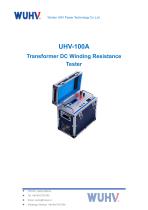
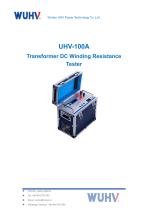
DC tester UHV-100Aresistancefor transformersstator winding


Add to favorites
Compare this product
Characteristics
- Test type
- DC, resistance
- Tested product
- for transformers, stator winding
- Configuration
- compact
- Other characteristics
- automatic
Description
Overview
The UHV-100A transformer DC winding resistance tester uses advanced power technology and a high-speed microcontroller to provide automated, accurate DC resistance measurements for transformer windings. It is compact and lightweight, delivers high output current, offers strong anti-interference performance and includes automatic discharge with alarm and protective functions.
Technical parametersModel: UHV-100A
Current range and range 100A 10μΩ100mΩ
40A 50μΩ500mΩ
20A 100μΩ1Ω
10A 500μΩ2Ω
5A 1mΩ4Ω
Accuracy ± (0.2%±2 words)
Resolution 0.1μΩ
Ambient humidity -10℃40℃
Relative humidity ≤80%RH No condensation
Working power supply AC220V±10% 50Hz
Alternate names
Safety measures
Precautions
Purpose of testing
The UHV-100A transformer DC winding resistance tester uses advanced power technology and a high-speed microcontroller to provide automated, accurate DC resistance measurements for transformer windings. It is compact and lightweight, delivers high output current, offers strong anti-interference performance and includes automatic discharge with alarm and protective functions.
Technical parametersModel: UHV-100A
Current range and range 100A 10μΩ100mΩ
40A 50μΩ500mΩ
20A 100μΩ1Ω
10A 500μΩ2Ω
5A 1mΩ4Ω
Accuracy ± (0.2%±2 words)
Resolution 0.1μΩ
Ambient humidity -10℃40℃
Relative humidity ≤80%RH No condensation
Working power supply AC220V±10% 50Hz
Alternate names
- DC Winding Resistance Tester
- Resistance Meter
- Three-circuit Transformer DC Resistance Tester
Safety measures
- Read the instruction manual carefully before use.
- Operator should have basic electrical knowledge.
- Do not use the instrument in rain, corrosive gas, excessive dust, high temperature or direct sunlight.
- Avoid prolonged shocks or severe vibrations.
- Maintenance and troubleshooting must be performed by qualified personnel.
- After testing, wait for the discharge alarm to stop before switching off power and removing test leads.
- When measuring an unloaded tap-changer, wait for the discharge indicator alarm to stop before switching taps.
- Do not move the test clamp or power cable during measurement.
Precautions
- Before testing a no-load tap changer, ensure it is reset. After discharge, wait at least 10 seconds after the alarm stops before operating the tap changer.
- Before disconnecting, wait for discharge completion and alarm stop; wait >10 seconds where possible to ensure full charge release.
- Select test current within the specified ranges. If current exceeds preset value the unit remains charging; if range is insufficient it displays "current too low" — select appropriate current.
- When using magnetic-assist connections, account for effective range changes (parallel/series coil connection may add approx. 1.5× high-voltage coil resistance).
- Removing short contacts after discharge in three-wire magnetic-assist setups may cause residual-current sparks — this can be normal.
- Clean oxide films on exposed winding terminals or twist the clamp after connection to ensure reliable contact and accurate measurement.
Purpose of testing
- 1. Evaluate the performance of electrical equipment: DC resistance testing is mainly used to accurately measure the winding or conductor resistance of electrical equipment such as transformers, motors, and cables. The size of the resistance directly reflects the quality of the internal connections of the equipment and the integrity of the conductor material. It can detect issues such as broken strands, poor welding, and increased contact resistance. By measuring and analyzing these data, we can evaluate whether the equipment meets the design requirements, and thus determine its working performance and operating status.
- 2. Preventive maintenance: Regular DC resistance testing can help identify potential faults and provide early warning. For example, in a transformer, an imbalance in the resistance of each phase winding may indicate that the internal structure has been damaged; Abnormal resistance in motor windings may be a sign of insulation aging, overheating, or other issues. So, DC resistance testing is an important part of preventive maintenance plans.
- 3. Ensure safe operation: Low impedance circuits can reduce line losses and heat generation, ensure efficient and stable operation of equipment, and avoid safety accidents such as fires caused by local overheating due to excessive resistance. In addition, measuring key components such as high-voltage switch contacts and fuse contact resistance is also an important means to prevent arc discharge and ensure the safe operation of the power system.
VIDEO
Other Wuhan UHV Power Technology Co.,Ltd. products
Transformer Tester


Related Searches
- Measuring device
- Test stand
- Portable testing system
- Digital testing system
- Automatic testing system
- Automatic test stand
- Industrial testing system
- Automatic test equipment
- Voltage testing system
- Portable measuring device
- Benchtop testing system
- Industrial gauge
- Manual test kit
- Test set
- Industrial test rig
- Laboratory testing system
- Tester with LCD screen
- Installation tester
- Industrial test equipment
- Insulation testing system
*Prices are pre-tax. They exclude delivery charges and customs duties and do not include additional charges for installation or activation options. Prices are indicative only and may vary by country, with changes to the cost of raw materials and exchange rates.
About DirectIndustry
DirectIndustry is a marketplace that offers B2B players a complete experience, from product sourcing to purchase. DirectIndustry is an entity of VirtualExpo Group.
Are you a buyer?
Are you a supplier?