

- Metrology - Laboratory
- Analytical Instrumentation
- Machine monitoring analyzer
- Wuhan UHV Power Technology Co.,Ltd.


- Products
- Catalogs
- News & Trends
- Exhibitions
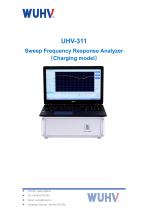
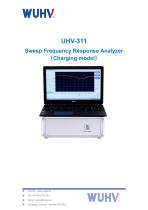
Frequency response analyzer UHV-311for machine monitoringfor testingstability

Add to favorites
Compare this product
Characteristics
- Application domain
- for machine monitoring, for testing
- Measured value
- frequency response, stability
- Configuration
- portable
- Mode of use
- automated
- Other characteristics
- digital, with data logger, dual-channel, high-speed, AI-assisted
Description
Overview to SFRA Test Set
The Sweep Frequency Response Analyzer is an essential tool for detecting internal structural faults in power transformers. Core technology: DDS-based digital high-speed frequency sweeping. Measurement modes: linear sweep and segmented sweep. Control architecture: embedded microprocessor with MIL-spec stability components. Device intended for on-site Frequency Response Analysis (FRA) to assess transformer winding integrity.
Product parameters
Implements internal FRA algorithms to measure winding characteristic parameters with high resolution, enabling detection of mechanical deformations (distortion, bulging, displacement, tilt) and electrical faults (inter-turn shorts, phase-to-phase contact). Non-invasive procedures minimize on-site intervention and eliminate transformer disassembly.
Technical parameters
Linear sweep frequency range: 1 kHz – 1 MHz
Segmented sweep ranges: 0.5 kHz – 1 kHz; 0.5 kHz – 10 kHz; 10 kHz – 100 kHz; 100 kHz – 500 kHz; 500 kHz – 1000 kHz
Amplitude range: -100 dB – +20 dB
Amplitude measurement accuracy: ±1 dB (+20 dB to -60 dB); ±2 dB (-60 dB to -100 dB)
Sweep accuracy: 0.01%
Signal input impedance: 1 MΩ
Signal output impedance: 50 Ω
In-phase test repeatability: 99.5%
Instrument size (L × W × H): 300 × 340 × 120 mm3
Packing box size (L × W × H): 310 × 400 × 330 mm3
Weight: 10 kg
Features of Transformer Winding Deformation Tester
Technical specifications
Equipment Classification of Transformer Winding Deformation Tester
1. Frequency response analysis method tester
Main application scenarios of Sweep Frequency Response Analyzer
Why Choose Us As The Supplier of Sweep Frequency Response Analyzers?
The Sweep Frequency Response Analyzer is an essential tool for detecting internal structural faults in power transformers. Core technology: DDS-based digital high-speed frequency sweeping. Measurement modes: linear sweep and segmented sweep. Control architecture: embedded microprocessor with MIL-spec stability components. Device intended for on-site Frequency Response Analysis (FRA) to assess transformer winding integrity.
Product parameters
Implements internal FRA algorithms to measure winding characteristic parameters with high resolution, enabling detection of mechanical deformations (distortion, bulging, displacement, tilt) and electrical faults (inter-turn shorts, phase-to-phase contact). Non-invasive procedures minimize on-site intervention and eliminate transformer disassembly.
Technical parameters
Linear sweep frequency range: 1 kHz – 1 MHz
Segmented sweep ranges: 0.5 kHz – 1 kHz; 0.5 kHz – 10 kHz; 10 kHz – 100 kHz; 100 kHz – 500 kHz; 500 kHz – 1000 kHz
Amplitude range: -100 dB – +20 dB
Amplitude measurement accuracy: ±1 dB (+20 dB to -60 dB); ±2 dB (-60 dB to -100 dB)
Sweep accuracy: 0.01%
Signal input impedance: 1 MΩ
Signal output impedance: 50 Ω
In-phase test repeatability: 99.5%
Instrument size (L × W × H): 300 × 340 × 120 mm3
Packing box size (L × W × H): 310 × 400 × 330 mm3
Weight: 10 kg
Features of Transformer Winding Deformation Tester
- Advanced DDS core: dedicated digital high-speed scanning for precise FRA across 0–1 MHz.
- High-fidelity acquisition: SoC-controlled dual-channel 16-bit A/D sampling with ≥99.5% repeatability.
- Dual-sweep operation: linear and segmented sweeps compatible with national technical standards (GB/T 1094.18).
- Non-invasive test protocol: only busbar disconnection required; avoids transformer teardown.
- Ergonomic field use: measurement-insensitive lead configuration for safe operation on transformer tank.
- Standards-compliant output: selectable axis scaling (linear or logarithmic) and national amplitude–frequency conformance.
- Intelligent signal control: software auto-range ±10 V output with adaptive sampling frequency.
- High-resolution scanning: configurable resolution steps (0.25 / 0.5 / 1 kHz) for detailed spectral analysis.
- AI-driven diagnostics: six-curve historical comparison, automated parameter calculation and winding deformation diagnosis with expert-level conclusions.
- Automated reporting: environmental parameter logging, measurement archiving and Word/PDF color report generation.
Technical specifications
- Model: UHV-311
- Linear sweep frequency range: 1 kHz – 1 MHz
- Segmented sweep ranges: 0.5 kHz – 1 kHz; 0.5 kHz – 10 kHz; 10 kHz – 100 kHz; 100 kHz – 500 kHz; 500 kHz – 1000 kHz
- Amplitude range: -100 dB to +20 dB
- Amplitude accuracy: ±1 dB (+20 dB to -60 dB); ±2 dB (-60 dB to -100 dB)
- Sweep accuracy: 0.01%
- Input impedance: 1 MΩ
- Output impedance: 50 Ω
- In-phase test repeatability: 99.5%
- Instrument dimensions (L×W×H): 300 × 340 × 120 mm
- Packing box dimensions (L×W×H): 310 × 400 × 330 mm
- Weight: 10 kg
Equipment Classification of Transformer Winding Deformation Tester
1. Frequency response analysis method tester
- Principle: By detecting the amplitude frequency response characteristics of the winding to the sweep signal, a curve is formed. Determine whether the winding is deformed by comparing historical curves or three-phase curves.
- Features: High sensitivity, able to detect slight winding deformation and changes in distribution parameters.
- Limitations: The analysis of results requires some experience and is greatly affected by on-site interference factors.
- Principle: Measure the short-circuit impedance value of the transformer under low voltage, and determine the winding deformation based on the impedance change rate by comparing the nameplate value or historical data.
- Characteristics: The judgment criteria are relatively clear (usually industry standards use a change rate of ± 3% as a warning value), and the anti-interference ability is strong.
- Limitations: The sensitivity to slight deformations is not as good as the frequency response method.
- Principle: Integrate the above two methods into one instrument.
- Features: Complementary advantages, it can perform high-sensitivity curve scanning and verify through short-circuit impedance values, greatly improving the accuracy of diagnosis. It is currently the mainstream and recommended choice.
Main application scenarios of Sweep Frequency Response Analyzer
- Handover acceptance test: Before the new transformer is put into operation, establish the original fingerprint spectrum and impedance data of the winding as the basis for future comparison.
- Post fault diagnosis: After the transformer is subjected to output short circuit or near-field short circuit impact, it is immediately tested to determine whether the winding is damaged and whether it can be put back into operation.
- Inspection after major overhaul or transportation: Verify whether the mechanical structure of the winding of the transformer remains in good condition after long-distance transportation or major overhaul of the suspension cover.
- In operation status assessment: Regular physical examinations are conducted on transformers that have been in operation for a long time or have a history of abnormal vibration to evaluate their health status.
Why Choose Us As The Supplier of Sweep Frequency Response Analyzers?
- We have rich experience in the research and export of power testing equipment. Sweep Frequency Response Analyzers are widely used in power companies, transformer manufacturers, testing institutions, and industrial enterprises. The equipment meets international standards and provides strict factory testing, professional technical training, fast delivery, and comprehensive after-sales service support. It can provide reliable and efficient one-stop power testing solutions for global customers.
Other Wuhan UHV Power Technology Co.,Ltd. products
Transformer Tester


Related Searches
- Gas analyser
- Concentration analyser
- Monitoring analyser
- Liquids analyser
- Automated analyzer
- Desktop analyzer
- Process analyser
- Portable analyser
- Continuous analyser
- Water analyser
- Real-time analyser
- Laboratory analyser
- Compact analyser
- Digital analyser
- Calibration analyser
- Temperature analyser
- Chromatography system
- Power quality analyser
- Sampling analyser
- Control analyser
*Prices are pre-tax. They exclude delivery charges and customs duties and do not include additional charges for installation or activation options. Prices are indicative only and may vary by country, with changes to the cost of raw materials and exchange rates.
About DirectIndustry
DirectIndustry is a marketplace that offers B2B players a complete experience, from product sourcing to purchase. DirectIndustry is an entity of VirtualExpo Group.
Are you a buyer?
Are you a supplier?