|
|
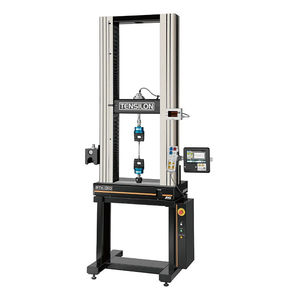
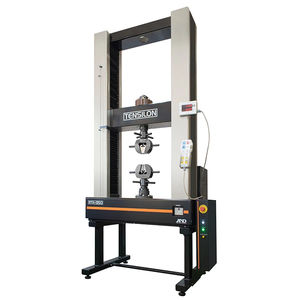
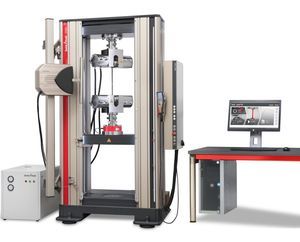
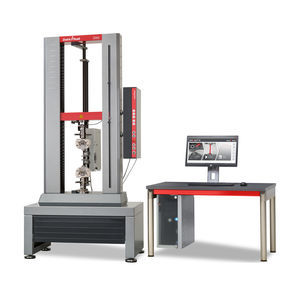
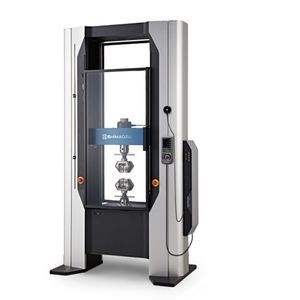
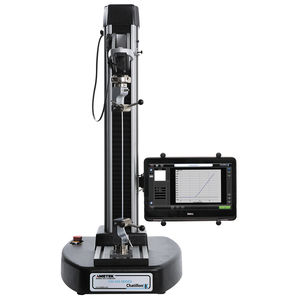
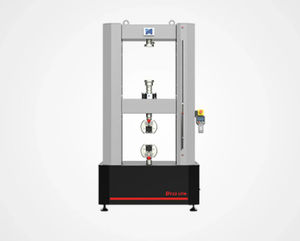
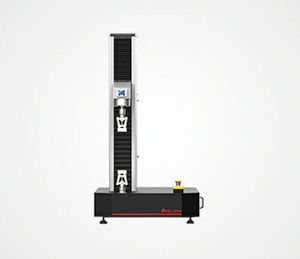
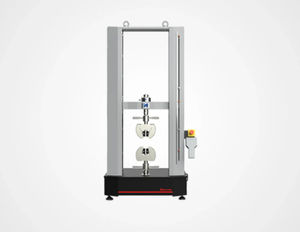
These series are mainly designed for tensile, compression, bending and shearing test of metallic and non-metallic materials. With special accessory, they can complete mechanics performance test of rubber, belt, chain, steel, cable, cement, brick, concrete and other materials. They are wildly used in machinery, building engineering and material, space flight & aviation, railway, metallurgical, textile, petrochemical and production industry, scientific research institute, college, university and other fields.
|
|
|
|
|
|
A highly versatile range of drop weight impact testers for performing a wide range of medium energy tests on materials, specimens and end products of various geometry
Key features:
Laboratory grade instrumentation and very rigid construction for highest accuracy test results.
Guided mass system to ensure that the impact geometry is correct throughout the test.
Highly accurate and repeatable drop parameters.
Very robust construction stands up to the rigours of dynamic testing to provide high reliability with a minimum of downtime.
Easily interchangeable contact parts simplify maintenance and reduce cost of ownership.
Very high levels of safety employing multiple redundant systems, compliant with 89/392/EEC and 91/368/EEC machinery safety directives.
High quality, easy to use control and analysis software ensures consistency and enhances throughput.
Simple service requirements of single phase mains electricity and compressed air reduce installation costs.
Multiple impact facility for fatigue testing.
Wide range of strikers, anvils, fixtures and jigs available for standard test geometries, and for custom testing.
Optional sample strippers for extracting striker from tough ductile specimens.
Optional second impact prevention system for non-penetrating tests.
Optional high velocity impact option for impact velocities up to 20m/s.
Optional dynamic displacement measurement system for direct measurement of the sample deformation.
Optional high speed, fully integrated video system to provide visualization of specimen failure mode.
Optional temperature conditioning chamber, -70°C to +150°C.
|
|
|
|
|
|
Impact testing is designed to measure the performance of an object under high-rate loading. Instron offers a complete range of proven solutions for impact testing both raw material specimens and finished components. Our family of advanced instruments includes: instrumented drop weight towers, servohydraulic high rate systems, and pendulum testers.
Dynatup® 9200 Series Impact Test Machines
Dynatup® 9200 Series Impact Test Systems are suitable for a wide variety of applications requiring low to high impact energies. Designed for testing both raw material specimens and finished components, the 9200 Series is our most advanced and versatile impact test instrument.
Features
High performance test frames with powerful ball screw and motor drive system-less wear and tear versus traditional hoist and cable or bungee cord style systems.
Easy to use operator control panel for precision manual control.
Clear protective doors and panels on all sides for full viewing of test.
Modular crossheads with interchangeable drop weights-change weights safely in seconds.
High bandwidth DSP (Digital Signal Processing) electronics-for greater accuracy.
Impulse™ data acquisition and analysis software-for collecting, analyzing, and reporting detailed impact performance data
Available full computer test setup and control based on user input: impact velocity, energy, or drop height-less operator errors, higher productivity.
High speed data acquisition rates: up to 5 MHz simultaneous sampling-more data where you need it.
|
|
Impact testing machine for metal and non-metallic
Impact test conforms to ASTM, ISO and GB standards with Charpy Izod and Tensile impact includes analogs, digital and computer. It is also with instrumented to get the curves and characteristic data for impact test.
From the applications, it includes:
- Measuring range from 300J up to 800J for metal
- Measuring range from 1J up to 50J for non-metal
- Charpy, Izod, Tensile impact for metal and non-metal
- Instrumented function can be with the impact test
- Lower temperature bath is optional for environment test
|
|
Max impact energy(J): 150, 300, 450, 600, 750, 3000
Features:
The model ZBC2000 series pendulum impact tester comes from SANS pendulum impact testing machines series family, fashionable design and complete assembly with SANS high technology satisfied with impact resistance tests of metal material under dynamic loading, It is widely applied into the following industries: manufacturer of metal material, quality control of products, institutes and colleges, R&D.
Comply with ISO R148, ISO R83, EN10045, ASTM E23
Optional computer with software control is available to realize semiautomatic operation. Operator only need charge specimens. Others can be controlled by software.
Optional specimen feeding system is available. Combined with computer and software, fully automatic operation can be realized.
Optional cooling chamber is available to satisfy cold specimen test down to -100 OC
|
|
Pendulum Type Impulsion Experimental Machine is suitable for testing the impulsion toughness of metallic materials. Model CBD electronic impulsion experimental machine adopts Inter monolithic processor 89C52 and 89C51 as the major CPU to carry out the process control, data processing and printing of impulsion esperiments. The experiment is carried out automatically, so are striking and lifting the pendulum.Miniprinter is equipped so that the test risults are easy to be recorded. Automatically recording test results.It can handle impulsion experiments continually.
Main Specifications:
1. Maximum impact energy: 300J
2. Impact speed: 5.2m/s
3. Presaging angle of the pendulum: 150°
4. Distance from the center of tested specimen: 750mm
5. Arc radius of the impulsion cutter: 2mm
6. Angle of the impulsion cutter: 30°
7. Angle definition: 0.1°
8. Power: 300w 380V ± 10%
9. Weight:900kg
|
|
Mainly used to determine the anti-impact capability of ferrous metal materials with high toughness, especially for steel and iron and their alloy, under dynamic load.
This machine can be operated semi-automatically. The pendulum of the machine can be raised or released automatically. Be applicable for continuing testing in different kinds of laboratories and other metallurgy industrial manufactories.
It is designed and developed according to national standard GB/T3808-2002 (ISO148-1998) "Pendulum Impact Testing Machine"
|
|
|
|
|
|
Impact testers are designed to determine the impact energy required to break a sample. This information is crucial to manufacturers,as the strength and durability of the product will often determine performance characteristics and marketability. The TMI Impact Testing System uses a high resolution optical encoder and data acquisition to determine the impact resistance of rigid materials in accordance with a wide variety of ASTM and ISO test standards. Interchangeable pendulums and specimen holders are available to measure the impact resistance of a variety of materials. Common test methods include Izod, Charpy, Tension and Laminate testing. Environmental chambers are also available to deliver CO2 or N2 allowing the characterization of materials at cold temperatures. Essentially the Impact test is a single point test that measures a materials resistance to impact from a swinging pendulum. The mass and drop height deliver a definable kinetic energy.
APPLICATIONS
Plastics, Rubber, Light Metals, Ceramics, Wood, Laminates, Adhesives
STANDARDS Conforms to
ASTM D256 and ISO 180 for Izod,
ASTM D256 and ISO 179 for Charpy
ASTM D1822 for Tension Impact testing
OPTIONS
A complete line of Izod, Charpy, and Tension Impact accessories are available.
FEATURES
• Digital display, storage and editing of up to 500 readings
• Selectable units (J/m, ft•lb./in., kg•cm/cm, ft•lb/in², kg•cm/cm²,
kJ/m²)
• RS-232, settable limits, statistics-average, standard deviation, and
high/low results
• Classification of specimens according to failure category
• Auto calibration - automatically calibrates for windage and friction
• Hammers are quickly and easily interchangeable
|
|
Tinius Olsen manufactures a range of different pendulum impact testers that can be easily changed from a Charpy configuration to an Izod configuration. These testers come in a couple of capacities and are designed primarily for either plastics or metals impact testing.
All testing hardware is fully complemented by Tinius Olsen developed software that turns your hardware into a sophisticated quality analysis system. Be sure to examine the software products to determine which package is right for your application.
|
|
This impact tester has gained wide acceptance in testing the impact resistance of many types of coatings from paints to varnishes to tough plated, plastic or laminated coatings. It is also widely used to establish quality control standards for resistance to impact surface damage and penetration of many construction materials including plastics, resins, fiberglass, sheet metals, and plywood.
Two models are available:
English Model
- Two and four pound weights included
- Maximum allowable force of 80 and 160 inch-lbs
- Round nose punch, 0.625 in (1.59 cm) diameter
- 40 inch guide tube
Metric Model
- One and two kilogram weights included
- Maximum allowable force of 100 and 200 kg-cm
- Round nose punch, 0.625 in (1.59 cm) diameter
- 100 cm guide tube
|
|
|
|
|
|
A dedicated system for the multi-axial impact testing of flexible sheet film to defined quality standards: ASTM D1709, DIN53373, BSI 2782 method 352D and ISO EN
7765. The test measures the film’s impact resistance and energy absorption characteristics, typically for quality control purposes. As standard the system accommodates films up to 1mm thick and tests with impact energies of up to 95 Joules.
Key Features:
• Designed for ease of use to reduce operator training time.
• A short, highly automated test cycle results in high throughput.
• Very rugged high reliability design suited to production environments.
• Drop height range 50mm to 1200mm continuously variable.
• Impact velocity range 1m/s to 4.85m/s continuously variable.
• Impact energy range 4J to 95J.
• High quality, laboratory grade instrumentation with traceable calibration.
• High resolution data acquisition.
• Full force vs. deformation graph calculated and stored for each test.
• Automatic calculation of all relevant results including failure deformation, failure energy.
• User-defined documentation information stored with each test.
• Automatic save of all data after each test, either to individual automatically named files, or to a test database.
• On screen reporting of selected test results.
• Standard report print-out.
• Export of results to Excel or a text file for independent analysis.
• Responsive life-time technical support.
|
|
|
|
|
|
The Falling Dart Impact Tester is intended for the determination of mechanical properties of packaging material such as plastic films, laminates and paper.
The tester comprises a horizontal base-plate on which a vertical column of steel has been erected and which on its top carries a release mechanism in which the falling dart can be inserted.
The dart consists of a hemispherical part of aluminium with polished surface and a diameter of 38.1 mm (1.5 in.), having a vertical shaft in the center of the flat top surface. Around the shaft additional weights can be fitted.
On the base-plate in the vertical center line of the inserted dart, a circular clamping device has been fitted. This clamping device consists of a firm and a movable cylinder, both having an inner diameter of 127 mm (5 in.).
By means of a handle operated excenter, a sample can be clamped slippage free between both cylinders.
The bottom of the firm cylinder has been provided with a 2-3 mm thick disc of soft rubber in order to eliminate damage of the falling dart.
SPECIFICATIONS
Falling Height: 660 mm (26 in.)
Weight of falling dart without additional weights: 50 g ± 0.5%
Additional weights: 5 pcs. of 5 g ± 0.5%
25 pcs. of 15 g ± 0.5%
5 pcs. of 100 g ± 0.5%
Falling speed on sample: Approx. 3.5 m/sec.
Meets ASTM Standard D 1709-62 Procedure A
Commercial Standard CS 227-59
TNO-Standard I.v.V. 2.15 1968
|
|
|
|
|
|
The High-Speed Integrated Video option is available for any of the Imatek range of impact testers, to greatly enhance understanding of the behaviour of a specimen as it undergoes an impact.
Imatek offer a fully integrated system under the control of the ImpAcqt software. This is used to both control the camera and analyse the resulting video sequence. Since the camera and the data acquisition share the same trigger, data points and images can be precisely correlated. A video sequence provides a great deal of qualitative information about the impact event, and the software also allows quantitative information to be extracted.
High-speed video offers an advantage in many application areas, but is particularly useful when complex structures are being tested, and for high-rate tensile testing.
Either of Imateks two video systems can be operated in stand-alone mode, independently of the impact tester and ImpAcqt software. This makes them general purpose tools that can be used with a wide range of test apparatus and applications, helping to justify the capital outlay.
As standard the HSV option provides a complete package including C3008 data aquisition, software, camera, choice of lenses, lighting controller, lights and tripods/stands.
info@imatek.co.uk
Tel: +44 (0)1438 821624
www.imatek.co.uk
|
|
|
TABER's Linear Abraser was designed to test virtually any size or shape specimen and is especially useful to evaluate ink adhesion of decorated plastics or other products. This versatile instrument can also be used to evaluate material properties including resistance to wear, scratch (single or multiple pass), marring, scrape, color transfer [commonly referred to as crocking or a crockmeter], plus others. With the universal or a custom attachment, 'real world' testing and other forms of material durability can be performed.
|
|
|
|
|
|
The Digital Ink Rub Tester is designed to measure scuffing or rubbing resistance. Several tests can be performed
including dry rub-the amount of transfer ink from one dry surface to another, wet rub-the amount of transfer of ink from wetted surface to another, wet bleed or transfer-ink transfer to a water-saturated blotter, wet smear-similar to wet bleed with the addition or rub cycles, functional rub/wet rub-smear or transfer tests using a liquid other than water and hot abrasion. An optional heated weight provides a uniform test for evaluating “hot abrasion” resistance of printed cartons, labels etc.
APPLICATIONS
Printing, Coatings, Packaging, Inks
SPECIFICATIONS
* Includes (1) 1.8 kg(4 lb) weight, (1) 0.9 kg(2 lb) weight, spare rubber pads, and scoring fixture
* Heated weights 2 lb and 4 lb available
* Replacement Pads available
STANDARDS
Meets TAPPI T-830 and ASTM D5264
* ASTM D5264 Standard Practice for Abrasion Resistance of Printed Materials
* TAPPI T-830 Ink rub test of container board
FEATURES
* Three speeds- The standard speed (42 cycles per minute) and two higher speeds (85 and 100 cycles per minute) allow you to decrease the testing time for samples requiring a higher number of rubs
* Large character LCD Display
* Displays count up, count down, test status and configurations
* Preset counts remain in memory
* Automatic shut-off
* Selectable “test complete” alarm
* Two-year warranty
|
|
|
|
|
|
The Internal Bond™ Tester is designed to determine the internal bond strength of a variety of Paper and Board materials according to TAPPI T 569. The instrument design is based on a falling pendulum which creates a high speed impact on a paper specimen. The paper specimen is sandwiched between two double-coated tape substrates. The pendulum impact measures the total energy required to delaminate the internal fibers of a specimen in a “Z” type direction into two separate piles. The system also incorporates an automatic sample preparation station which allows five specimens to be accurately prepared simultaneously.
APPLICATIONS
Newsprint, Fine Paper, Liner Board, Book Stock, Carton Board, Medium, Coatings, Laminates
FEATURES
* Storage and editing of up to 500 readings
* Selectable units (ft.lb/in², J/m² and kg•cm)
* RS-232 serial output
* Report printout with built-in printer
* Magnetic hammer release and magnetic brake
* Automatic calibration
* Automatic specimen hold-down during test sequence
* Settable limits, statistics-average, standard deviation, high/low results
* Automatic cutting of samples saves you time and keeps you safe
* 5.7 inch LCD color display with 320 x 240 resolution
* 15 Character alphanumeric keypad
* 6 function keys for easy test setup
* 10 soft key icons allow simple intuitive navigation of test functions
* Conforms to TAPPI standard T 569
|
|
|
|
|
|
A range of drop weight impact testers for measuring the fracture characteristics and fracture ductility of steel specimens according to the following standards: API recommended practice 5L3, EN 10274, ASTM-E 436 and 'Pellini'
Key features:
Very robust construction stands up to the rigours of high energy testing to provide high reliability with a minimum of downtime.
Easily interchangeable contact parts simplify maintenance and reduce cost of ownership.
State-of-the-art testing accommodates impact energies up to 100,000J and specimens up to 50mm thick.
Very high levels of safety employing multiply redundant systems, compliant with 89/392/EEC and 91/368/EEC machinery safety directives.
Automated specimen loading provides compliance with cycle times required by test methods, while maintaining operator safety.
Very rigid base and anvils ensures very low flexure under high test loads.
Guided mass system to ensure that the impact geometry is correct throughout the entire test.
Highly accurate and repeatable drop parameters.
High quality, easy to use control software ensures consistency and enhances throughput.
Optional instrumentation package to measure impact force up to 1500kN.
Provides values for peak force and energy to fail, together with a high resolution force-deflection curve to analyse failure mode.
Optional variable mass system to provide precise control over impact parameters.
Optional high speed, fully integrated video system to provide visualization of specimen failure mode.
Optional liquid cooled temperature conditioning bath.
Responsive life-time technical support.
|
|
|
|
|
|
Model: ZCJ1302-1, ZCJ1302-2, ZCJ1302-3, ZCJ1302-4
Max impact energy: 300J
Features:
This machine is for impact resistance test of various flats and pipes. It's the necessary test instrument for factories and scientific research institutes.
Full automatic control allows that automatically preventing a second time impact, automatically crosshead adjusting to zero , automatically specimen adjusting to zero, automatically crosshead returning to a predetermined height, and automatically detecting door closing state.
Special control panel and display can satisfy user operation and display requirements, for example, display real-time test data, height, velocity, and impact height setup. This system has power-off protection function, preset impact height data may not lose at power failure.
This instrument is applicable to test impact energy of plastics, ceramics, nylons, construction materials and other non-metal pipes and flats. Provide with automatic height control, display and drop control. Lower test platform adjustment is driven by motor automatically, which reduces labor intensity of operator and improves productivity.
|
|
|
|
|
|
The continuous growth in pipeline networks means that materials testing is becoming more and more important for the protection of people and the environment.
Against this background Zwick has enlarged its product program for metals testing and introduced a new DWT line of large drop impact testers from 20 to 100 kJ.
The drop weight test helps Engineers to evaluate the fractured surfaces of Ferritic steels, as the relative proportions of deformation and brittle fracture surfaces are diagnosed by visual determination. Ferritic steels are usually used for pipeline tubes or for sheet metals used in the manufacturing of such tubes.
The recommended practice 5L3 issued by the American Petroleum Institute (API) describes the testing procedure to be used on large-drop impact testers. A specimen supported at both ends is impacted with a cold-press-fitted notch, with the point of impact opposite the notch. Since the specimen thicknesses are very large sections of actual pipeline tubes, high impact energies of up to 100,000 Joule are necessary to break the specimen.
Zwick’s DWT large-drop impact testers are differentiated by their sophisticated integral safety concept that does not allow any access to the test area while in test mode. Furthermore, for drop impact tests, high rates of testing are required, so Zwick has developed a pneumatic feeding system to simplify the loading of the specimens into the testing machine.
|
|
Simple hand-operated Sheet Metal Testing Machine, Model 100
Recommended for use in factories and workshops where a low rate of metal forming is carried out on thin material. As a useful accessory, an attachable microscope with illumination is available making the detection of the cracks much easier. The blank holder force of 10 kN conforming to the standards, is applied by means of saucer springs. The deep-drawing index is displayed on an electro-mechanic pulse counter with a resolution of 0.1 mm.
|
|
- By consistent vertical and horizontal force measuring with the test stand, more accurate measuring becomes possible.
- Select a suitable stand from a wide range of the products according to your requirement.
- Contribute to simplification of testing work and reduction of the labor.
- Recommend to use the stand with the digital force gauges.
|
|
Model: TVE
- Capacity: Up to 500 Newtons
- Large and removable base plate with various holes for fixture mountings
- Max Tarvel: 297mm from base plate
- Height of upper hook above base plate: 460mm
- Travel distance per knob rotation (stroke): 3.1mm
|
|
Single Column Testing Machines 1-5 kN (225-1124 lbf)
Lloyd Instruments offers a range of affordable single column test machines for a wide variety to test applications up to 5 kN (1124 lbf).
All machines are capable of tensile, compression, flexural, peel, shear, friction testing and more. Flexible, easy to use and maintain, they offer high accuracy position measurement, rapid data acquisition, multi-lingual and multi-unit display options as well as full PC integration with ISO TickIT accredited NEXYGENPlus material test and data analysis software.
|
|
|
The universal testing machines of Instron make it possible to test in traction and compression on the same frame. Moreover, some built permit the tests of constraints reversed. The tests can be of the traction type, compression, shearing, inflection, peeling, tearing, cyclic and inflection.
|
|
|
|
|
|
Model: CMT5504; CMT5105; CMT5205; CMT5305; CMT5505; CMT5605
Capacity: 50kN; 100kN; 200kN; 300kN; 500kN; 600kN
Features:
These rugged electromechanical UTMs feature SANS strain gage load cell force measuring systems. Choice of single working space or dual working space load frame and maximum frame capacities from 50N to 600kN. Options for the Electomatic machines include extra length screws and columns for extraordinary sized samples.
All testing hardware is fully complemented by SANS developed software that turns your hardware into a sophisticated quality analysis system. Be sure to examine the software products to determine which package is right for your application. SANS professional testing software and proprietary control system ultimate come true closed loop testing and control of load, extension and displacement.
Better than 1/300000, no step, and unchanged in full range
4. Multi-cycle control modes: Control system is capable in load cycle, displacement cycle, extensometer cycle or their combination
5. Extending function: Equipped with multi-load cells to meet the further requirement of customers
6. High security: The system can inspect and protect automatically once overload, over currency; Position limiter; Emergency stop
7. Comply with different standards, such as ASTM, BS, JIS, ISO, IEC
Easy to use and operate
1. High accuracy: Measurement accuracy of testing speed, load, crosshead displacement can meet or surpass +0.5%% of reading
2. High sampling rate: The sampling rate 50Hz, reach advanced international level
3. High load resolution:
|
|
|
This series of machine is suitable to test the mechanics properties of metal, non-metal and compound materials. It is designed according to GB, JIS, ASTM, DIN, and ISO standards. It can automatically calculate tensile strength; yield strength, elongation ratio and broken strength and other parameters of the materials. It is ideal equipment for quality control and laboratory research in factories and high schools.
|
|
|
|
|
|
The Lab Master Release and Adhesion testing system operates with Windows® Based Software, and features: The ability to create user-defined test set-up, individual test speed selection, user-definable default areas for analysis, exporting graphs or data to Microsoft Excel and SPC programs, and enhanced Calibration - verifies existing and new calibration, and keeps a calibration log for ISO record keeping. Test data visually represents the characteristics of the peel.
APPLICATIONS
Tape, Pressure-sensitive labels, Release Paper, Blister Packs, Closures, Medical Products, Seals, Security Labels
SPECIFICATIONS
* Standard range of 0–11,339 g (0–25 lb)
* Other Load Cells Available
* Tests samples up to 5 cm (2 in.) wide with maximum peeling length of 30.48 cm (12 in.)
* Variable speeds from 30.48 to 4064 cm and 12 to 1600 in.
STANDARDS
Meets TLMI L-IA1 and L-IA2, PSTC-1, 3, and 4, and FINAT FTM 1, 2, 3,& 4
FEATURES
* Analysis of raw data collected from pull for immediate feedback of test results
* Intuitive user-friendly controls
* Accurate field calibration with built-in ISO 9000 compliance record-keeping with on-screen user definable “calibration due” alerting
* PC Network compatibility for output of other lab management systems
* Test Materials at 90°, 135°, and 180° angles of peel
* Piezoelectric sensing system
|
|
Tinius Olsen's line of Benchtop Materials Testing Machines are designed to test a wide spectrum of materials including metals, plastics, rubber, textiles, paper, yarn, wire, adhesives, ceramics, timber, foils, composites and finished components in tension, compression, flexure or shear. Maximum frame capacities from 1kN (200lbf, 100kg).
All testing hardware is fully complemented by Tinius Olsen developed software that turns your hardware into a sophisticated quality analysis system. Be sure to examine the software products to determine which package is right for your application.
|
|
These rugged electromechanical testing machines are designed to test metals, composites, rigid reinforced plastics, webbing etc. in tension, compression, flexure, shear, tear and peel. These machines feature high precision interchangeable loadcells, superior pre-loaded ballscrews and powerful drive systems that mean they can easily tackle the most challenging of applications.
Load frame capacities are 100kN (22,500 lbf), 150kN (33,750 lbf), 200kN (45,000 lbf) and 300kN (67,500 lbf).
All testing hardware is fully complemented by Tinius Olsen developed software that turns your hardware into a sophisticated quality analysis system. Be sure to examine our software products section to determine which package is right for your application.
|
|
The Zwick servo-hydraulic testing machines are flexible and reliable testing systems. They can be adapted to multiple applications such as tests on standard specimens or individual components and assemblies (rubber-metal elements or artificial hips). All servo-hydraulic testing machines are optimized to meet your requirements.
The different load frame types have been designed to guarantee a long life and easy maintenance so that they are a reliable long term investment. Their capacity ranges from 5 kN up to 1000 kN and their testing frequency from a few Hz up to 100 Hz or 200 Hz thanks to their enhanced stiffness and increased natural frequency.
|
|
|
|