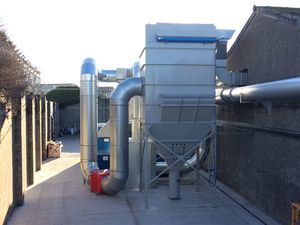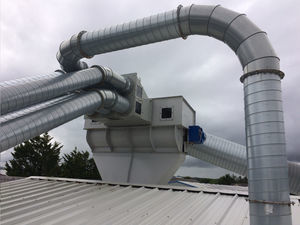
OverviewCyclone is a cyclonic (vortex) separation unit designed to remove waste and dust from an airstream without primary reliance on filter media. The unit comprises an upper circular body, a top tangential inlet and a lower cone. A central cylindrical tube (thimble) is mounted on the cyclone axis and extends below the tangential inlet to allow cleaned air to exit.
OperationDust-laden air introduced tangentially induces a vortex inside the chamber. Particulates are driven outward by centrifugal forces along the cyclone wall and move downward toward the cone. As the air approaches the central thimble it reverses direction and rises; cleaned air exits through the thimble while separated dust and particulates are discharged downwards into a collection bin, compactor or briquetter.
Design choices and benefitsThe cyclone interior is smooth and does not include spiral guides that can trap light webbing-type trims. The design contains no rotating parts (unless an optional balance fan is fitted), reducing maintenance. Streamlined internal geometry manages airflow to limit turbulence and improve separation of a range of particulate types.
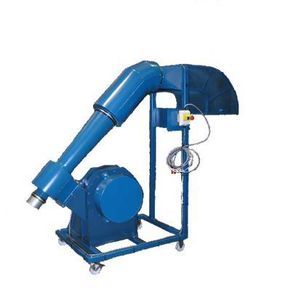
Optional features- Balance fan fitted to the clean air outlet to assist operation.
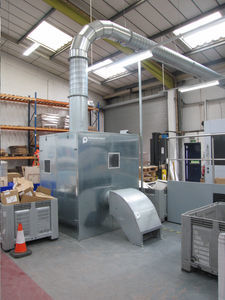
- External sound absorption cladding for noise-sensitive installations.
- Post-cyclone filtration (including HEPA) if very fine dust remains in the discharge.
Images (illustrative)- Cyclone working theory
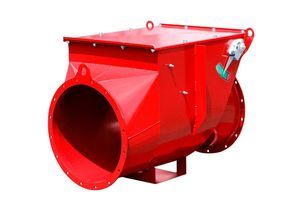
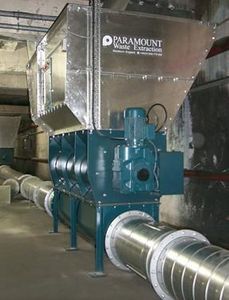
- Rotary valve under a small Cyclone
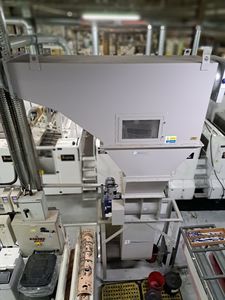
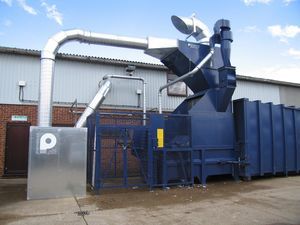
- Small cyclone waste to compactor via rotary valve
Caractéristiques / spécifications techniques- Type: Cyclonic (vortex) separation unit
- Construction: Upper circular body with top tangential inlet and lower cone
- Clean air outlet: Central axial thimble extending below tangential inlet
- Interior: Smooth, no spiral guides (designed to handle light webbing trims)
- Moving parts: None (unless optional balance fan fitted)
- Discharge options: Collection bin, compactor or briquetter
- Optional additions: Balance fan at clean air outlet; external sound absorption cladding; post-cyclone filtration including HEPA if required