

- Detection - Measurement
- Electrical Measurements
- High-voltage hipot tester
- Wuhan UHV Power Technology Co.,Ltd.


- Products
- Catalogs
- News & Trends
- Exhibitions
DC hipot tester VLFACportablehigh-voltage

Add to favorites
Compare this product
Characteristics
- Options
- DC, AC, portable, high-voltage
Description
Product overview
The VLF Hipot Tester is a portable AC very‑low‑frequency (VLF) withstand tester engineered for dielectric testing of high‑capacitance equipment such as power cables, large generators and motors. It uses digital frequency conversion and microprocessor control, with photoelectric isolation between the controller and HV generator and a closed‑loop negative feedback HV‑LV control to deliver stable output without capacitive rise.
Technical specifications
Series models and capacities
Features
Main applications
Advantages vs DC testing
FAQ (summary)
Technical summary
The VLF Hipot Tester is a portable AC very‑low‑frequency (VLF) withstand tester engineered for dielectric testing of high‑capacitance equipment such as power cables, large generators and motors. It uses digital frequency conversion and microprocessor control, with photoelectric isolation between the controller and HV generator and a closed‑loop negative feedback HV‑LV control to deliver stable output without capacitive rise.
Technical specifications
- Power supply: AC 220V ±5%, 50/60Hz (if generator used: digital inverter 220V, >8kW; ordinary generators/UPS not allowed).
- Output voltages (peak): 30kV, 40kV, 50kV, 60kV, 70kV, 80kV, 90kV.
- Output frequencies: 0.1Hz, 0.05Hz, 0.02Hz, 0.01Hz.
- Load capacity examples (model-dependent): 0.1Hz up to ~0.4–1.1μF; 0.05Hz up to ~0.8–2.2μF; 0.02Hz up to ~2.0–5.5μF; 0.01Hz up to ~4–11μF.
- Measurement accuracy: ±3%.
- Voltage peak error: ≤3%.
- Waveform distortion: ≤5%.
- Operating environment: -10℃ to +40℃; humidity ≤85% RH.
Series models and capacities
- 30/1.1 — 30kV (peak); 0.1Hz ≤1.1μF; 0.05Hz ≤2.2μF; 0.02Hz ≤5.5μF; 0.01Hz ≤11μF; power fuse 10A; generator >3kW; controller ≈4kg, booster ≈25kg.
- VLF‑40kV — 40kV (peak); 0.1Hz ≤0.8μF; 0.05Hz ≤1.6μF; 0.02Hz ≤4μF; 0.01Hz ≤8μF; fuse 15A; generator >4kW; controller ≈4kg, booster ≈25kg.
- VLF‑50kV — 50kV (peak); 0.1Hz ≤0.7μF; 0.05Hz ≤1.4μF; 0.02Hz ≤3.5μF; 0.01Hz ≤7μF; fuse 20A; generator >5kW; controller ≈4kg, booster ≈35kg.
- VLF‑60kV — 60kV (peak); 0.1Hz ≤0.6μF; 0.05Hz ≤1.2μF; 0.02Hz ≤3μF; 0.01Hz ≤6μF; fuse 20A; generator >6kW; controller ≈4kg, booster ≈45kg.
- VLF‑80kV — 80kV (peak); 0.1Hz ≤0.5μF; 0.05Hz ≤1.0μF; 0.02Hz ≤2.5μF; 0.01Hz ≤5μF; fuse 30A; generator >8kW; controller ≈4kg, booster ≈50kg.
- VLF‑90kV — 90kV (peak); 0.1Hz ≤0.4μF; 0.05Hz ≤0.8μF; 0.02Hz ≤2.0μF; 0.01Hz ≤4μF; fuse 30A; generator >9kW; controller ≈4kg, booster ≈55kg.
Features
- Digital frequency conversion and microprocessor control enabling automated test sequences (boost, buck, measure).
- User interface: 7‑inch capacitive LCD touch screen and simple wiring for field use.
- Comprehensive protection: HV/LV overvoltage and overcurrent protection with fast trip (≤10ms).
- Safety: photoelectric isolation between controller and generator.
- Closed‑loop HV‑LV negative feedback to prevent capacitive rise on high‑capacitance loads.
- HV‑side sampling for accurate voltage and current measurement; automatic data storage and printing; multi‑language display.
- Portable design suitable for on‑site testing.
Main applications
- Power cables: acceptance and preventive testing of XLPE cables (commonly up to 35kV) for defects such as water trees.
- Rotating machines: factory and maintenance dielectric testing for large generators and motors when power‑frequency testing is impractical.
- Other high‑capacitance specimens: capacitor bushings, GIS and composite HV equipment.
Advantages vs DC testing
- No residual space charge accumulation due to alternating polarity — equipment can return to service without prolonged discharge.
- Improved detection of certain aging defects (e.g., water ingress, mechanical damage) because VLF AC field distribution better represents operating conditions.
FAQ (summary)
- Why choose VLF rather than power‑frequency or DC? — VLF reduces required test power for high‑capacitance specimens and detects some aging defects more effectively.
- How is safety ensured? — Multiple integrated protections (overvoltage, overcurrent, zero‑voltage start, automatic discharge) and fast trip protect operators and equipment.
- How to choose test voltage and duration? — Follow national/industry standards or manufacturer recommendations and adapt to the condition of the tested equipment.
- What can affect output waveform quality? — Load characteristics, circuit nonlinearities and external electromagnetic interference.
Technical summary
- Supply: AC220V±5%, 50/60Hz (digital inverter generator >8kW if used).
- Outputs: 30–90kV (peak).
- Frequencies: 0.1Hz, 0.05Hz, 0.02Hz, 0.01Hz.
- Accuracy: ±3%; waveform distortion ≤5%; peak error ≤3%.
- Operating range: -10℃ to +40℃; humidity ≤85% RH.
Catalogs
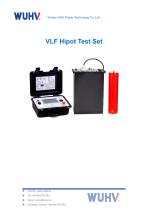
VLF Hipot Tester-Catalog
7 Pages
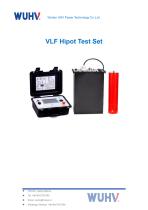
VLF Hipot Test Set-Catalog
7 Pages
Other Wuhan UHV Power Technology Co.,Ltd. products
High Voltage Tester


Related Searches
- Concentration analyser
- Monitoring analyser
- Automated analyzer
- Calibration system
- Portable testing system
- Portable analyser
- Continuous analyser
- Digital testing system
- Automatic testing system
- Real-time analyser
- Industrial testing system
- Laboratory analyser
- Compact analyser
- Digital analyser
- Voltage testing system
- Portable calibration system
- Calibration analyser
- Benchtop testing system
- Manual test kit
- Power quality analyser
*Prices are pre-tax. They exclude delivery charges and customs duties and do not include additional charges for installation or activation options. Prices are indicative only and may vary by country, with changes to the cost of raw materials and exchange rates.
About DirectIndustry
DirectIndustry is a marketplace that offers B2B players a complete experience, from product sourcing to purchase. DirectIndustry is an entity of VirtualExpo Group.
Are you a buyer?
Are you a supplier?