


- Products
- Zhengzhou Yugong Construction Machinery Co., Ltd.
Brickmaker QT series

Add to favorites
Compare this product
Description
If you are interested, please contact us now to learn more about our product information and customized services.
Email: admin@ygmachinerychina.com
WhatsApp: +86 13837112713
WeChat: +86 13837112713
Product overview
Investing in an efficient brick making machine reduces unit production costs on construction sites and improves material utilization. Field data indicate that matched hydraulic‑vibration forming systems can increase raw material utilization by ~35%, shortening equipment payback time. This summary presents functions, typical outputs and on‑site results to help technical buyers compare models and assess ROI.
Main field applications
An automated brick making machine produces hollow blocks, solid bricks, curb stones and interlocking pavers via swappable molds. Typical applications include municipal permeable pavers for plazas and walkways, commercial and residential block production for sound and thermal performance, and slope protection units to prevent erosion.
Semi-automatic vs. Fully automatic
Semi-automatic units (example: QT3-15) suit small yards and start-ups with manual feeding/stacking; typical output ~8,000–9,000 pieces per 8‑hour shift. Fully automatic lines (examples: QT4-15, QT5-15) integrate batching, electronic weighing and auto-stackers to reach ~11,000–13,000+ pieces per 8‑hour shift while reducing labor needs. Actual capacity depends on block size and cavity count.
How to check build quality
Inspect the hydraulic power pack, vibration assembly (combined hydraulic + vibration molding increases compaction and compressive strength), welded steel frame and guide pillar thickness, hydraulic valve brand/condition, and presence of PLC for diagnostics and push‑button operation. Robust guide pillars and thick plates improve durability under continuous vibration.
Real field case (summary)
A complete QT4-15 automatic line with batching unit and pallet supply was shipped in one 40ft container and commissioned within three days. The line delivered a stable output of ~12,000 blocks/day, reduced unit cost for hollow blocks by ~28% and enabled equipment payback in under six months for the customer.
Brick Making Machine Parameters (table)
Technical characteristics / specifications
Email: admin@ygmachinerychina.com
WhatsApp: +86 13837112713
WeChat: +86 13837112713
Product overview
Investing in an efficient brick making machine reduces unit production costs on construction sites and improves material utilization. Field data indicate that matched hydraulic‑vibration forming systems can increase raw material utilization by ~35%, shortening equipment payback time. This summary presents functions, typical outputs and on‑site results to help technical buyers compare models and assess ROI.
Main field applications
An automated brick making machine produces hollow blocks, solid bricks, curb stones and interlocking pavers via swappable molds. Typical applications include municipal permeable pavers for plazas and walkways, commercial and residential block production for sound and thermal performance, and slope protection units to prevent erosion.
Semi-automatic vs. Fully automatic
Semi-automatic units (example: QT3-15) suit small yards and start-ups with manual feeding/stacking; typical output ~8,000–9,000 pieces per 8‑hour shift. Fully automatic lines (examples: QT4-15, QT5-15) integrate batching, electronic weighing and auto-stackers to reach ~11,000–13,000+ pieces per 8‑hour shift while reducing labor needs. Actual capacity depends on block size and cavity count.
How to check build quality
Inspect the hydraulic power pack, vibration assembly (combined hydraulic + vibration molding increases compaction and compressive strength), welded steel frame and guide pillar thickness, hydraulic valve brand/condition, and presence of PLC for diagnostics and push‑button operation. Robust guide pillars and thick plates improve durability under continuous vibration.
Real field case (summary)
A complete QT4-15 automatic line with batching unit and pallet supply was shipped in one 40ft container and commissioned within three days. The line delivered a stable output of ~12,000 blocks/day, reduced unit cost for hollow blocks by ~28% and enabled equipment payback in under six months for the customer.
Brick Making Machine Parameters (table)
- Hollow block | 400*200*200 mm | Molding cycle 15–20s | QTY/mould 6 pcs | QTY/hour 1080–1440 pcs | QTY/8hr 8640–11520 pcs
- Hollow block | 400*150*200 mm | Molding cycle 15–20s | QTY/mould 7 pcs | QTY/hour 1260–1680 pcs | QTY/8hr 10080–13440 pcs
- Hollow block | 400*100*200 mm | Molding cycle 15–20s | QTY/mould 11 pcs | QTY/hour 1980–2640 pcs | QTY/8hr 15840–21120 pcs
- Porous block | 240*115*90 mm | Molding cycle 15–20s | QTY/mould 15 pcs | QTY/hour 2700–3600 pcs | QTY/8hr 21600–28800 pcs
- Standard brick | 240*115*53 mm | Molding cycle 15–17s | QTY/mould 30 pcs | QTY/hour 6300–7200 pcs | QTY/8hr 50400–57600 pcs
- Paver | 225*112.5*60 mm | Molding cycle 20–25s | QTY/mould 15 pcs | QTY/hour 2160–2700 pcs | QTY/8hr 17280–21600 pcs
Technical characteristics / specifications
- Denomination examples: QT3-15, QT4-15, QT5-15 (QT series)
- Forming method: combined hydraulic forming and vibration molding for high compaction
- Mold flexibility: swappable molds for hollow blocks, solid bricks, pavers and curb stones
- Automation options: semi-automatic (manual feeding/stacking) or fully automatic (batching, electronic weighing, auto-stacker)
- Typical outputs: semi-automatic ~8,000–9,000 pieces/8hr; fully automatic ~11,000–13,000+ pieces/8hr (depends on block size and cavity count)
- Shipping footprint: compact lines (e.g., QT3-15/QT4-15) can fit in one 40ft container; larger lines may need additional containers for silos/conveyors
- Key durability features: heavy welded steel frame, thick guide pillars, branded hydraulic valves, PLC control cabinet
Catalogs
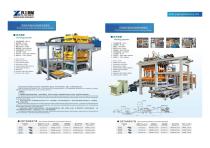
Brick Making Machine
18 Pages
Other Zhengzhou Yugong Construction Machinery Co., Ltd. products
Construction Machine


*Prices are pre-tax. They exclude delivery charges and customs duties and do not include additional charges for installation or activation options. Prices are indicative only and may vary by country, with changes to the cost of raw materials and exchange rates.
About DirectIndustry
DirectIndustry is a marketplace that offers B2B players a complete experience, from product sourcing to purchase. DirectIndustry is an entity of VirtualExpo Group.
Are you a buyer?
Are you a supplier?