


- Company
- Products
- Catalogs
- News & Trends
- Exhibitions
Cardboard baling press HBAfor paperfor wastefor packaging

Add to favorites
Compare this product
Characteristics
- Applications
- for cardboard, for paper, for waste, for packaging
- Orientation
- horizontal
- Other characteristics
- automatic, hydraulic, high-capacity, high-density, high-power, triple compression
- Bale weight
Max.: 1,200 kg
(2,646 lb)Min.: 200 kg
(441 lb)- Capacity
Max.: 13 t/h
(7.961 lb/s)Min.: 1 t/h
(0.612 lb/s)- Motor power
22 kW, 37 kW, 45 kW, 55 kW
(29.9 hp, 50.3 hp, 61.2 hp, 74.8 hp)- Press force
Max.: 200 t
(220 us ton)Min.: 40 t
(44 us ton)
Description
Overview
A fully automatic horizontal baler engineered for corrugated cardboard (OCC), cartons and mixed paper streams. The ENERPAT HBA-series produces dense, uniform bales with automated conveying, compression and tying to simplify storage, handling and recycling logistics.
Key features and operation
Applications / Proven use
Control, safety & maintenance
Technical specifications
A fully automatic horizontal baler engineered for corrugated cardboard (OCC), cartons and mixed paper streams. The ENERPAT HBA-series produces dense, uniform bales with automated conveying, compression and tying to simplify storage, handling and recycling logistics.
Key features and operation
- Fully automatic conveying, feeding, hydraulic compression and automatic bale ejection.
- Triple-action compression: three synchronized hydraulic cylinders deliver uniform, high-density bales.
- Hydraulic system built for continuous heavy-duty use: large-flow valve groups, H-type tapered leak-resistant connections and Hallite cylinder seals.
- Smart PLC touchscreen control (Siemens/Schneider) for one-touch operation, adjustable cycle/feeding times and real-time diagnostics.
- German automatic tying mechanism using high-tensile quenched steel wire for transport-ready bales.
- Available in multiple capacities and configurations to match throughput needs from entry-level to high-capacity models.
Applications / Proven use
- Designed for processing corrugated cardboard, cartons, waste paper and mixed paper fractions.
- Documented throughput examples: up to 8 t/h in large carton-processing lines; ~4 t/h for paper trimming in print operations (actual results depend on model and material).
Control, safety & maintenance
- PLC-based control with diagnostic alerts to reduce downtime and guide scheduled maintenance.
- Robust hydraulic components and leak-resistant connections minimize maintenance frequency and risk of fluid loss.
Technical specifications
- Available model range and representative specifications:
- HBA40-7272 — Press Force: 40 tons; Motor Power: 22 kW; Bale Size: 720×720×L (mm); Bale Weight (OCC): 200–500 kg; Feed Hopper: 1500×640 mm; Capacity: 1–3 tons/h; Tying wires: 4.
- HBA80-11075 — Press Force: 80 tons; Motor Power: 37 kW; Bale Size: 1100×750×L (mm); Bale Weight (OCC): 600–900 kg; Feed Hopper: 1500×1020 mm; Capacity: 4–8 tons/h; Tying wires: 4.
- HBA100-110110 — Press Force: 100 tons; Motor Power: 45 kW; Bale Size: 1100×1100×L (mm); Bale Weight (OCC): 800–1100 kg; Feed Hopper: 1800×1020 mm; Capacity: 7–12 tons/h; Tying wires: 5.
- HBA120-110125 — Press Force: 120 tons; Motor Power: 55 kW; Bale Size: 1100×1250×L (mm); Bale Weight (OCC): 900–1200 kg; Feed Hopper: 2100×1020 mm; Capacity: 9–13 tons/h; Tying wires: 5.
- HBA150-110125 & HBA200-110130 — Higher-capacity variants with press forces up to the series range; motor power typically 45–55 kW; bale sizes and feed hoppers scale with model.
- Compression range across series: ~30 to 200 tons (model-dependent).
- Motor power range across series: ~11 to 110 kW (model-dependent).
- Tying: automatic steel-wire tying mechanism (German technology) with high-tensile quenched wire.
Catalogs
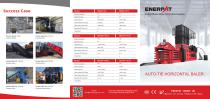
Other ENERPAT AMERICA products
Horizontal Baler


Related Searches
- Grinding mill
- Crushing plant
- Bagging machine
- Baler
- Waste shredding machine
- Automatic bagging machine
- Mobile crushing and screening plant
- Pelletizer
- Eddy current separator
- Horizontal grinding mill
- Primary shredding machine
- Single shaft shredding machine
- Vertical grinding mill
- Jaw crushing and screening plant
- Two shaft shredder
- High-capacity crushing plant
- Recycling plant
- Bulk material bagging machine
- Horizontal baler
- Vertical baler
*Prices are pre-tax. They exclude delivery charges and customs duties and do not include additional charges for installation or activation options. Prices are indicative only and may vary by country, with changes to the cost of raw materials and exchange rates.
About DirectIndustry
DirectIndustry is a marketplace that offers B2B players a complete experience, from product sourcing to purchase. DirectIndustry is an entity of VirtualExpo Group.
Are you a buyer?
Are you a supplier?