

- Metrology - Laboratory
- Metrology and Test Equipment
- Digital tensiometer
- Huazheng Electric


- Company
- Products
- Catalogs
- News & Trends
- Exhibitions
Digital tension meter HZZL-3portableautomatic


Add to favorites
Compare this product
Characteristics
- Type
- digital
- Configuration
- portable
- Options
- automatic
Description
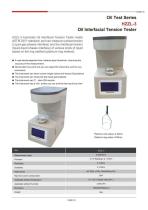
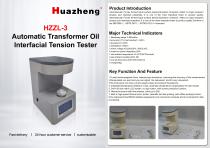
The Transformer Oil Interfacial Tension Tester is an indispensable tool for professionals in the power industry, offering unparalleled accuracy and reliability. It operates on the principle of measuring the force required to detach a droplet of oil from a water surface, a key indicator of the oil’s purity and its ability to insulate and cool the transformer effectively. High interfacial tension values typically signify good oil quality, while lower values can indicate contamination or degradation, necessitating timely maintenance or replacement.
Main functions and features:
- Intermolecular Forces formed liquid surface tension. Numbers of tension reflect on liquid sample’s physics and chemical properties, it is one of the most important index to product quality.
- Uses electromagnetic force-balance-type transducer, improving the accuracy of the measurement.
- Single-point calibration and adjustable instrument for convenience.
- The instrument can show current weight values and tension equivalence.
- Integrated temperature detection circuit, automatic temperature compensation for test results.
- 240×128 dot matrix LCD screen, no logo button, with screen protection function.
- Historical records with time stamps, store up to 255 entries.
- Built-in high-speed thermal micro printer, beautiful and fast printing, with offline printing function.
- RS232 interface equipment for computer connection, convenient for data processing.
Technical Parameters:
- Measuring range: 0-200 mN/m
- Accuracy: 0.1% (test result) ±0.1 mN/m
- Precision: 0.1 mN/m
- Sensibility: 0.1 mN/m
- Mains voltage: AC220V ±20%, 50Hz ±10%
- Maximum power dissipation: 20W
- Suitable ambient temperature: 10~30℃ (25℃ optimal)
- Suitable ambient humidity: ≤85% RH
- Overall dimensions: 200×300×330 mm
- Weight: 6 kg
Measurement Principle:
- When the platinum ring is pulled up from the "liquid-gas" interface or the "liquid-liquid" interface, a circular liquid column membrane forms under the platinum ring. As the ring continues to rise, the liquid column membrane ruptures. The maximum force value detected by the electromagnetic force balance sensor is converted into the tension value by the formula: M=mg/2L, where L is the Pt circle’s circumference.
- The test value is affected by several factors: (1) Pt circle’s average radius and the Pt wire’s radius; (2) Density contrast between the liquid sample and other medium; (3) Purity of the liquid, as electrolyte impurities will seriously reduce the tension value; (4) Ambient temperature.
- Since the liquid column formed at the platinum ring is not cylindrical, a correction factor F must be introduced. The calculation formula for the correction factor F is given by Zuidema and Waters. The final result after correction is calculated using densities and radii of the platinum ring and wire.
Summary: The Transformer Oil Interfacial Tension Tester is an essential instrument for maintaining the efficiency and reliability of electrical transformers. Its precision, ease of use, and robust design make it a valuable asset for any professional in the power industry, ensuring that transformers operate at peak performance and remain in optimal condition for years to come.
Key Specifications:
- Measuring range: 0-200 mN/m
- Accuracy: 0.1% (test result) ±0.1 mN/m
- Precision: 0.1 mN/m
- Sensibility: 0.1 mN/m
- Mains voltage: AC220V ±20%, 50Hz ±10%
- Maximum power dissipation: 20W
- Suitable ambient temperature: 10~30℃ (25℃ optimal)
- Suitable ambient humidity: ≤85% RH
- Overall dimensions: 200×300×330 mm
- Weight: 6 kg
VIDEO
Other Huazheng Electric products
Transformer Oil Test Equipment


Related Searches
- Test stand
- Huazheng portable tester
- Huazheng digital tester
- Huazheng automatic tester
- Automatic test stand
- Huazheng industrial tester
- Huazheng automatic testing device
- Huazheng voltage tester
- Huazheng benchtop tester
- Manual test kit
- Huazheng test system
- Industrial test rig
- Huazheng laboratory tester
- Huazheng tester with LCD screen
- Huazheng installation tester
- Insulation testing system
- Huazheng industrial testing device
- Huazheng portable testing device
- Huazheng cable tester
- Huazheng resistance tester
*Prices are pre-tax. They exclude delivery charges and customs duties and do not include additional charges for installation or activation options. Prices are indicative only and may vary by country, with changes to the cost of raw materials and exchange rates.
About DirectIndustry
DirectIndustry is a marketplace that offers B2B players a complete experience, from product sourcing to purchase. DirectIndustry is an entity of VirtualExpo Group.
Are you a buyer?
Are you a supplier?