


- Metrology - Laboratory
- Metrology and Test Equipment
- Wet film thickness gauge
- ERICHSEN GmbH & Co. KG
Wet film thickness gauge Model 234portablewheelstainless steel

Add to favorites
Compare this product
Characteristics
- Applications
- wet film
- Type
- portable
- Technology
- wheel
- Other characteristics
- stainless steel
- Measuring range
Min.: 0 µm
Max.: 1,500 µm
Description
Film thickness measurement plays an essential part in the use and testing of paints and coating materials. The film thickness is a decisive factor in determining appearance, protective qualities and durability.
A film which is too thin will afford inadequate protection and reduced hiding power. For this reason, technical specifications stipulate minimum film thicknesses and regular controls must be carried out to ensure that these values are consistent.
On the other hand, an excessively thick film is the result of using too much coating material, causing costs to increase accordingly. Furthermore, thicker coatings do not always mean an improvement in properties: for example, they have an adverse affect on drying time.
The physical and mechanical properties of a coating are directly dependent on the film thickness. If meaningful testing is to be conducted, the film thickness must therefore be uniform.
Wet film thickness gauges are used to check freshly applied coatings and can also be used to calculate the resulting dry film thickness. If deviations from the specified value are detected, corrective measures can be taken immediately.
Mechanical film thickness gauges provide a number of advantages:
Application
On all flat or uniformly curved (concave and convex) surfaces.
Test Principle
The disc-shaped measuring instrument is rolled over the wet film. During this process two knurled, concentric rims roll across the substrate whilst an excentrically positioned measuring rib picks up coating material as soon as the distance of the rib from the rims is equivalent to the wet film thickness to be measured.
Design and Function
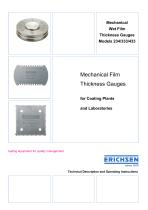
The hardened, precision-ground measuring disc of stainless steel is 50 mm in diameter and 11 mm thick. It features a freely rotating aluminium guide roller to enable the instrument to be rolled over the surface.
Available in 8 different versions and measurement ranges.
The read-out scale is engraved on one side around the periphery of the disc. Each instrument is supplied in a case.
Measuring Procedure
Measurement 1
Grip the guide roller of the instrument between thumb and index finger and place on test surface so that contact is made on the side directly opposite the zero mark. Apply light pressure, roll instrument towards the zero mark and lift off.
Measurement 2: (cross check)
The instrument is positioned as instructed for measurement 1, but rolled in the opposite direction until it reaches the zero mark.
Read off wet film thickness from the scale at the point where wet film marking commences, compare with the opposite side and establish mean value.
A film which is too thin will afford inadequate protection and reduced hiding power. For this reason, technical specifications stipulate minimum film thicknesses and regular controls must be carried out to ensure that these values are consistent.
On the other hand, an excessively thick film is the result of using too much coating material, causing costs to increase accordingly. Furthermore, thicker coatings do not always mean an improvement in properties: for example, they have an adverse affect on drying time.
The physical and mechanical properties of a coating are directly dependent on the film thickness. If meaningful testing is to be conducted, the film thickness must therefore be uniform.
Wet film thickness gauges are used to check freshly applied coatings and can also be used to calculate the resulting dry film thickness. If deviations from the specified value are detected, corrective measures can be taken immediately.
Mechanical film thickness gauges provide a number of advantages:
- Handy, portable, and simple to operate, even by unskilled personnel.
- Sturdy construction, direct reading.
- Measurements can be carried out on any surface. Since the system functions completely mechanically, substrates of glass, wood, metal or plastic are permissible.
- In comparison to other systems, mechanical film thickness gauges are favourably priced
Application
On all flat or uniformly curved (concave and convex) surfaces.
Test Principle
The disc-shaped measuring instrument is rolled over the wet film. During this process two knurled, concentric rims roll across the substrate whilst an excentrically positioned measuring rib picks up coating material as soon as the distance of the rib from the rims is equivalent to the wet film thickness to be measured.
Design and Function
The hardened, precision-ground measuring disc of stainless steel is 50 mm in diameter and 11 mm thick. It features a freely rotating aluminium guide roller to enable the instrument to be rolled over the surface.
Available in 8 different versions and measurement ranges.
The read-out scale is engraved on one side around the periphery of the disc. Each instrument is supplied in a case.
Measuring Procedure
Measurement 1
Grip the guide roller of the instrument between thumb and index finger and place on test surface so that contact is made on the side directly opposite the zero mark. Apply light pressure, roll instrument towards the zero mark and lift off.
Measurement 2: (cross check)
The instrument is positioned as instructed for measurement 1, but rolled in the opposite direction until it reaches the zero mark.
Read off wet film thickness from the scale at the point where wet film marking commences, compare with the opposite side and establish mean value.
Catalogs
Exhibitions
Meet this supplier at the following exhibition(s):


Other ERICHSEN GmbH & Co. KG products
Film thickness


Related Searches
- ERICHSEN testing machine
- Measuring device
- ERICHSEN test chamber
- Test stand
- ERICHSEN temperature test chamber
- ERICHSEN material testing machine
- ERICHSEN automatic testing machine
- ERICHSEN hardness tester
- ERICHSEN climate chamber
- ERICHSEN quality control test chamber
- PC-controllable testing machine
- ERICHSEN portable tester
- ERICHSEN humidity test chamber
- ERICHSEN environmental test chamber
- Digital testing system
- Benchtop indentation hardness tester
- ERICHSEN industrial testing machine
- ERICHSEN vertical testing machine
- Automatic test stand
- Tensile test machine
*Prices are pre-tax. They exclude delivery charges and customs duties and do not include additional charges for installation or activation options. Prices are indicative only and may vary by country, with changes to the cost of raw materials and exchange rates.