

- Power Transmission - Mechanical components
- Motor and Motor Control
- DC servo-drive
- Zhejiang Xinli Electric Technology Co., Ltd.

- Products
- Catalogs
- News & Trends
- Exhibitions
DC servo-drive 60ST-M0 seriesACthree-phase motormotor

Add to favorites
Compare this product
Characteristics
- AC/DC
- DC, AC
- Motor type
- three-phase motor
- Product applications
- control, device, executive, for motors, shaft, gear, motor
- Voltage
- 220 V
- Protection class
- IP65
- Other characteristics
- for motors
- Intensity
Max.: 4.1 A
Min.: 1.2 A
- Power
0.2 kW, 0.4 kW, 0.6 kW
Description
The servo motor is also known as the executive motor. In an automatic control system, it is used as
an execution element to convert the received electrical signal into an angular displacement or angular speed output
on the motor shaft.
An AC servo driver is an electronic device used to control and power an AC servo motor. It typically receives commands from a controller or a computer system and converts them into a signal that can be used to control the speed, position, and torque of the motor.
The AC servo driver works by providing the necessary voltage and current to the motor windings, which generates a rotating magnetic field that produces motion. It also monitors feedback signals from the motor, such as encoder or resolver signals, and adjusts the motor's performance to ensure precise and accurate movement.
The three main components of servo motors are:
Motor: The motor is the core component of the servo system. It is responsible for converting electrical energy into mechanical energy. Servo motors can be either DC motors or AC motors.
Gear Train: The gear train is a mechanical system of gears that connects the motor to the output shaft. It is used to increase the torque and reduce the speed of the output shaft. The gear train can be made up of one or more gears and can be of various types, such as spur gears, planetary gears, or worm gears.
Catalogs
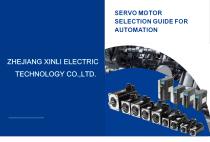
Catalogue-2025 English Version
45 Pages
Exhibitions
Meet this supplier at the following exhibition(s):

Other Zhejiang Xinli Electric Technology Co., Ltd. products
Servo Motor


Related Searches
- Electromotor
- Direct current motor
- Synchronous motor
- AC electromotor
- Multipole motor
- Electric gearmotor
- Induction motor
- BLDC motor
- Motor for industrial applications
- 3-phase motor
- Servo motor
- 4-pole electromotor
- Ultra high-efficiency motor
- 2-pole electromotor
- Ultra-compact motor
- Servo-amplifier
- 380 V electromotor
- Permanent magnet motor
- Right angle gearmotor
- Induction motor
*Prices are pre-tax. They exclude delivery charges and customs duties and do not include additional charges for installation or activation options. Prices are indicative only and may vary by country, with changes to the cost of raw materials and exchange rates.