

- Industrial machines and equipment
- Surface Treatment Equipment
- Wet blast cabinet
- Zhengzhou Yugong Construction Machinery Co., Ltd.
Wet blast cabinet YG seriesautomaticfor heavy-duty applications


Add to favorites
Compare this product
Characteristics
- Technology
- wet
- Operational mode
- automatic
- Applications
- for heavy-duty applications
- Width
Max.: 1,000 mm
(39.4 in)Min.: 400 mm
(15.7 in)- Height
Max.: 2,000 mm
(79 in)Min.: 1,150 mm
(45 in)
Description
Overview
A sand blasting machine (blast tank) uses a high-speed abrasive stream propelled by compressed air to clean, derust and prepare metal or non-metal surfaces for coating. It removes rust, scale and old paint while creating a controlled surface profile for improved coating adhesion.
Main types
Capacity & Mobility
Air supply & recommended accessories
A blast tank requires a dedicated air compressor. Example: a 600-type unit typically needs 4–6 m³/min at 0.8 MPa. Industrial setups use stationary compressors with air receivers; field projects often use mobile diesel compressors. For tanks under 700 mm diameter, pair with a 25 mm ID hose and an 8 mm or 10 mm nozzle. Pneumatic control valves or automatic control enable remote gun switching and reduce labor requirements.
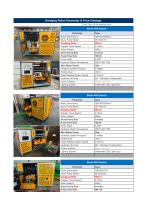
Sand Blasting Machine Parameters (table)
Machine models | YG400 | YG500 | YG600 | YG700 | YG800 | YG900 | YG1000
Diameters (mm) | 400 | 500 | 600 | 700 | 800 | 900 | 1000
Height (mm) | 1150 | 1150 | 1150 | 1250 | 1700 | 2000 | 2000
Volume (cubic meter) | 0.26 | 0.26 | 0.26 | 0.3 | 0.6 | 0.8 | 1
Pressure (MPa) | 0.4-8 (applies across models)
Air consumption (m³/min) | 3 (nominal; model dependent)
Common abrasive media & consumption
Case study (example)
FAQ (selected)
Caractéristiques / spécifications techniques
A sand blasting machine (blast tank) uses a high-speed abrasive stream propelled by compressed air to clean, derust and prepare metal or non-metal surfaces for coating. It removes rust, scale and old paint while creating a controlled surface profile for improved coating adhesion.
Main types
- Dry Sand Blasting Machine: Operates with dry abrasive only. Simpler design and lower initial cost; suitable for heavy-duty outdoor cleaning where flash rust risk is manageable.
- Wet Sand Blasting Machine: Mixes water with abrasive media (approx. 1:1). Greatly reduces airborne dust and helps meet stricter environmental or indoor-site requirements.
Capacity & Mobility
- Portable Sand Blasting Machine: Typical diameters 400–700 mm. Units are wheeled, hold ~100–400 kg of abrasive and usually weigh under 300 kg for easier site movement.
- Stationary Sand Blasting Machine: Larger tanks (800–1200 mm) mounted on structural legs; hold up to ~800 kg abrasive. Higher capacity reduces refill frequency but does not increase instantaneous blasting rate.
Air supply & recommended accessories
A blast tank requires a dedicated air compressor. Example: a 600-type unit typically needs 4–6 m³/min at 0.8 MPa. Industrial setups use stationary compressors with air receivers; field projects often use mobile diesel compressors. For tanks under 700 mm diameter, pair with a 25 mm ID hose and an 8 mm or 10 mm nozzle. Pneumatic control valves or automatic control enable remote gun switching and reduce labor requirements.
Sand Blasting Machine Parameters (table)
Machine models | YG400 | YG500 | YG600 | YG700 | YG800 | YG900 | YG1000
Diameters (mm) | 400 | 500 | 600 | 700 | 800 | 900 | 1000
Height (mm) | 1150 | 1150 | 1150 | 1250 | 1700 | 2000 | 2000
Volume (cubic meter) | 0.26 | 0.26 | 0.26 | 0.3 | 0.6 | 0.8 | 1
Pressure (MPa) | 0.4-8 (applies across models)
Air consumption (m³/min) | 3 (nominal; model dependent)
Common abrasive media & consumption
- Typical abrasives: brown corundum, dustless garnet, copper slag, silica sand.
- Example consumption: 40–50 mesh abrasives ~100 kg per 10 minutes (varies with nozzle, pressure and operator technique).
- Abrasive grains can be reused/recycled until they degrade into fine dust.
Case study (example)
- Background: Contractor required rust removal and repainting of a structural river bridge.
- Challenge: Manual methods were slow and scaffold movement limited heavy equipment.
- Solution: Selected a YG Machinery 600-type mobile dry unit with a 6 m³/min diesel compressor and a Q235B steel tank (6 mm wall).
- Results: Cleaning speed ~25 m²/h, labor reduced ~60%, and paint adhesion pass rate improved to ~98%.
FAQ (selected)
- What drives the sand blasting machine price? Factors include steel plate thickness (e.g., 8 mm carbon steel), pneumatic control options and whether an air compressor or automation is included.
- Which abrasive media should I use and can it be recycled? Common choices are brown corundum, garnet, copper slag and silica sand. Abrasives are reusable until they break down; selection depends on the surface, finish required and local regulations.
Caractéristiques / spécifications techniques
- Manufacturer / Brand: YG Machinery
- Model series: YG series (YG400, YG500, YG600, YG700, YG800, YG900, YG1000)
- Tank diameters: 400 mm — 1000 mm (model dependent)
- Tank heights: 1150 mm — 2000 mm (model dependent)
- Tank volumes: 0.26 m³ — 1 m³ (model dependent)
- Operating pressure range: 0.4 — 8 MPa
- Nominal air consumption: 3 m³/min (model dependent; example for 600-type: 4–6 m³/min at 0.8 MPa)
- Types: Dry (air-only) and Wet (water + abrasive) configurations
- Mobility: Portable (wheeled) units 400–700 mm; stationary (leg-mounted) units 800–1200 mm
- Nozzle/hose guidance: use 25 mm ID hose with 8 mm or 10 mm nozzle for tanks under 700 mm diameter
VIDEO
Catalogs
Other Zhengzhou Yugong Construction Machinery Co., Ltd. products
Other Machine


Related Searches
- Automatic washing machine
- Water washing machine
- Industrial washing machine
- Blast machine
- Parts washing machine
- Metal shot blasting machine
- Blast room
- Mobile cleaning system
- Coating machine
- Turbine shot blasting machine
- Washing machine with dryer
- High-pressure washing machine
- Automatic blast room
- Surface cleaning shot blasting machine
- Paint striping machine
- Wet blasting cabinet
- Blast cabinet for heavy-duty applications
- Concrete shot blasting machine
- Mobile blast machine
- Multipurpose shot blasting machine
*Prices are pre-tax. They exclude delivery charges and customs duties and do not include additional charges for installation or activation options. Prices are indicative only and may vary by country, with changes to the cost of raw materials and exchange rates.