

- Detection - Measurement
- Position, Speed and Acceleration Measurements
- 2-axis inclinometer
- Shenzhen Ruicom Technology Co., Ltd.


- Company
- Products
- Catalogs
- News & Trends
- Exhibitions
2-axis tilt sensor HTS61-axisCANCAN Bus


Add to favorites
Compare this product
Characteristics
- Number of axes
- 1-axis, 2-axis
- Output
- CAN, CAN Bus
- Technology
- MEMS
- Other characteristics
- high-precision, with aluminum housing, waterproof, temperature-compensated, for angle measurement, OEM, IP67
- Inclination
Max.: 35 °
Min.: -35 °
- Resolution
0.001 °
Description
Product Overview
The HTS6 is a compact industrial tilt sensor (single- or dual-axis) providing CAN 2.0A output and sub-millidegree resolution. It integrates a high-precision 16-bit differential A/D converter with a fifth-order digital filter and an on-board temperature sensor for real-time temperature drift compensation. Default output rate is 50 Hz; higher or custom rates are available on request. The unit is designed for stable operation in demanding industrial environments and for applications requiring precise platform leveling and attitude reference.
Applications
Performance Parameters
Notes on parameters
The HTS6 is a compact industrial tilt sensor (single- or dual-axis) providing CAN 2.0A output and sub-millidegree resolution. It integrates a high-precision 16-bit differential A/D converter with a fifth-order digital filter and an on-board temperature sensor for real-time temperature drift compensation. Default output rate is 50 Hz; higher or custom rates are available on request. The unit is designed for stable operation in demanding industrial environments and for applications requiring precise platform leveling and attitude reference.
Applications
- Industrial automation and process control
- Construction and engineering machinery platform leveling
- Photovoltaic tracker control systems
- Aerospace attitude reference and integration
- Precision instrument and machine leveling
- High-precision tilt measurement for platforms and related systems
Performance Parameters
- Measurement ranges (examples): ±10°, ±35° (custom selectable from ±1° to ±35°)
- Measurement axis: single-axis / dual-axis
- Resolution: 0.001°
- Measurement accuracy (@25°C): 0.005° (RMS) for smaller ranges, 0.01° (RMS) for larger ranges
- Long-term stability: 0.01° / 0.02° (depend on range)
- Zero-point temperature coefficient (-40 to 85°C): ±0.002°/°C
- Sensitivity temperature coefficient (-40 to 85°C): ≤50 ppm/°C
- Startup time: 0.5 s
- Device response frequency: 20 Hz (device), default output response typically 50 Hz
- Output rate (configurable): 5 / 15 / 35 / 50 Hz
- Output signal: CAN 2.0A
- EMC: compliant with EN61000 and GBT17626
- MTBF: ≥99,999 hours
- Insulation resistance: ≥100 MΩ
- Shock resistance: 100 g @11 ms, triaxial (half-sine)
- Vibration resistance: 10 grms, 10–1000 Hz
- Protection rating: IP67
- Wiring: standard 2 m shielded aviation connector cable (7P × 6.8 mm), abrasion-resistant, wide-temperature
- Weight: ≤250 g (excluding cable)
Notes on parameters
- Resolution: smallest angular change detectable within the effective measurement range.
- Measurement accuracy: evaluated at standard ambient temperature including linearity, repeatability, hysteresis, zero offset and cross-axis sensitivity.
- Zero-point temperature coefficient: change in output per °C at zero input over rated temperature range.
- Sensitivity temperature coefficient: change in full-scale output with temperature (stability index).
VIDEO
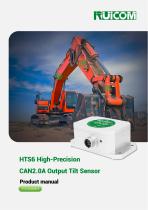

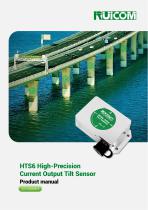
Other Shenzhen Ruicom Technology Co., Ltd. products
Tilt Sensor


Related Searches
- Tilt sensor
- Digital tilt sensor
- Dual-axis inclinometer
- MEMS tilt sensor
- Multi-axis inclination sensor
- High-precision tilt sensor
- Analog tilt sensor
- IP67 tilt sensor
- Single-axis inclinometer
- Rugged tiltmeter
- Waterproof tilt sensor
- Angle measurement tilt sensor
- High-resolution tilt sensor
- Tilt switch
- RS-485 tilt sensor
- Tilt sensor with aluminum housing
- RS-232 tilt sensor
- Anti-vibration tilt sensor
- CAN tilt sensor
- TTL tilt sensor
*Prices are pre-tax. They exclude delivery charges and customs duties and do not include additional charges for installation or activation options. Prices are indicative only and may vary by country, with changes to the cost of raw materials and exchange rates.
About DirectIndustry
DirectIndustry is a marketplace that offers B2B players a complete experience, from product sourcing to purchase. DirectIndustry is an entity of VirtualExpo Group.
Are you a buyer?
Are you a supplier?
© 2026 All rights reserved - Terms - Privacy policy - General Terms - Manage cookies - 鄂ICP备2026053537号-2 -  鄂公网安备42018502009509号 -