

- Power Transmission - Mechanical components
- Actuator and Positioning System
- Linear solenoid
- Weilong Intelligent Technology (Dongguan) Co., Ltd.


- Company
- Products
- Catalogs
- News & Trends
- Exhibitions
Linear solenoid WL2551tubularcompact24-volt


Add to favorites
Compare this product
Characteristics
- Type
- linear
- Other characteristics
- compact, electromagnetic, industrial, for automation, tubular, 24-volt, DC, push-pull, with spring return
- Voltage
Max.: 24 V
Min.: 12 V
- Force
Max.: 10 N
Min.: 1 N
- Stroke
Max.: 10 mm
(0.39 in)Min.: 1 mm
(0.04 in)
Description
Overview
The WL2551 linear tubular solenoid is a compact electromagnetic actuator designed for high linear force in a small cylindrical envelope. Its enclosed tubular steel housing improves mechanical stability, thermal behaviour and protection against dust and vibration, making it suitable for industrial automation and embedded OEM applications.
Key features
How it works
Applying DC current to the coil generates a magnetic field that pulls the ferromagnetic plunger toward the coil center to produce straight-line (push or pull) motion. A return spring restores the plunger when current is removed.
Applications
Advantages and disadvantages (summary)
Technical specifications
The WL2551 linear tubular solenoid is a compact electromagnetic actuator designed for high linear force in a small cylindrical envelope. Its enclosed tubular steel housing improves mechanical stability, thermal behaviour and protection against dust and vibration, making it suitable for industrial automation and embedded OEM applications.
Key features
- Enclosed cylindrical housing for stability and environmental protection
- High force density relative to unit size
- Fast response and low operational noise
- Multiple voltage ratings and customization for stroke, force, shaft style and mounting
- Tubular design enhances thermal dissipation and longevity
How it works
Applying DC current to the coil generates a magnetic field that pulls the ferromagnetic plunger toward the coil center to produce straight-line (push or pull) motion. A return spring restores the plunger when current is removed.
Applications
- Automation: conveyor actuation, sorting mechanisms
- Locking & access control: electronic locks, latches, cabinet locks
- Vending and office equipment: dispenser and release mechanisms, printers
- Medical devices: compact actuator modules, diagnostic equipment, fluid control valves
- Automotive: switches, actuator mechanisms, gearbox locks
- OEM and embedded systems requiring compact, repeatable linear actuation
Advantages and disadvantages (summary)
- Pros: compact footprint; high force for size; quick response; simple reliable construction; flexible mounting and customization
- Cons: limited stroke reduces effective force for long travel; coil heating under continuous duty (requires thermal management); continuous power draw unless latching design is used; sensitive to radial/side loads; audible impact click; not inherently proportional without dedicated drivers
Technical specifications
- Model: WL2551
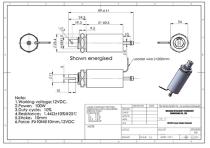
- Size: φ25.4 × 51.5 mm
- Plunger diameter: φ12 mm
- Rated voltage (example): DC 24 V
- Stroke: 0–12 mm
- Force (range): 1–10 N
- Power: 40 W
- Current: 1.67 A
- Resistance: 14.4 Ω
- Life: ≥ 200,000 cycles
- Working cycle (example): 0.1 s ON, 1 s OFF
VIDEO
Catalogs
Other Weilong Intelligent Technology (Dongguan) Co., Ltd. products
Tubular Solenoid


Related Searches
- Actuator
- Linear actuator
- Electric actuator
- Compact actuator
- Industrial actuator
- DC actuator
- Electromagnet
- Rotary actuator
- 24 V actuator
- 12 V actuator
- Linear electromagnet
- DC electromagnet
- Actuator for medical applications
- ISO actuator
- Voltage solenoid
- Compact electromagnet
- Holding electromagnet
- 24-volt electromagnet
- Single-acting actuator
- Electromagnetic electromagnet
*Prices are pre-tax. They exclude delivery charges and customs duties and do not include additional charges for installation or activation options. Prices are indicative only and may vary by country, with changes to the cost of raw materials and exchange rates.
About DirectIndustry
DirectIndustry is a marketplace that offers B2B players a complete experience, from product sourcing to purchase. DirectIndustry is an entity of VirtualExpo Group.
Are you a buyer?
Are you a supplier?